Every week your team loses hours copying numbers between spreadsheets, writing the same emails again and chasing details that live in one person’s head. For a small business in Vietnam on a tight budget, that busywork hurts first. It is also where AI for business in Vietnam pays off soonest.
This guide covers what the technology does, where to start and which rules apply. Our AI services support you from the first training session to full rollout.
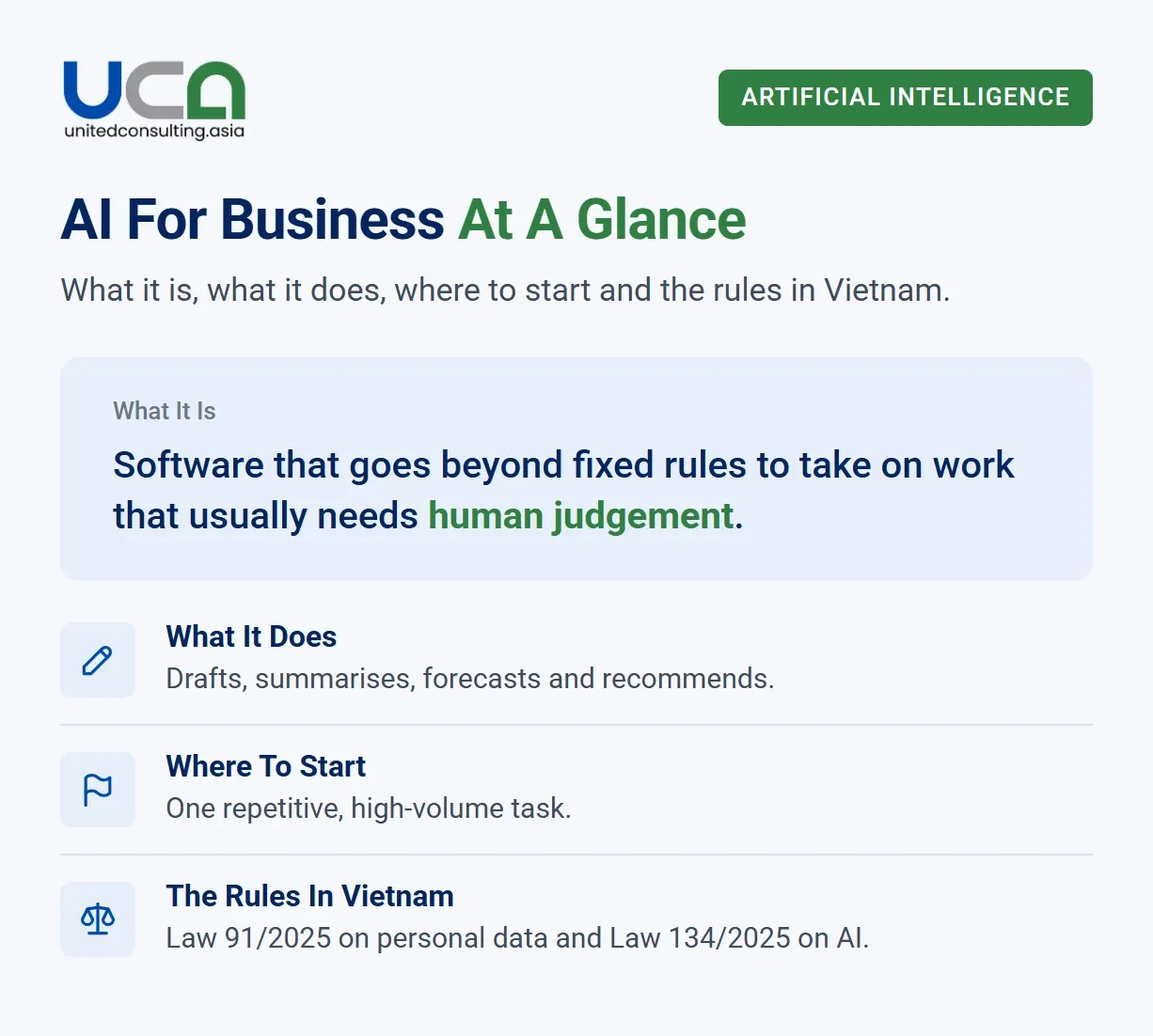
TL;DR - AI for business means software that goes beyond fixed rules, often by learning from data, to take on work that normally needs human judgement, from drafting replies to forecasting demand. It pays off fastest on repetitive, high-volume tasks. In Vietnam, the Personal Data Protection Law and the new Law on AI set duties for any business that uses personal data or deploys AI.
In this guide:
- What is AI for business in Vietnam, and how does it create value?
- Where should a business in Vietnam start with AI?
- What are the main AI use cases for businesses?
- How is AI changing jobs and business functions in Vietnam?
- What should you decide before spending on AI?
- What are the best AI solutions for businesses in Vietnam?
- How United Consulting can help with AI in Vietnam
What Is AI for Business in Vietnam, and How Does It Create Value?
In practical terms, AI handles everyday commercial work: drafting, summarising, forecasting and recommending. For most small and medium-sized enterprises (SMEs) it arrives as features inside tools you already use, such as email, spreadsheets, customer relationship management (CRM) systems and accounting platforms, and it sits comfortably alongside outsourced accounting support.
The gains show up in three places:
- Time returned to skilled staff.
- Fewer manual errors.
- More capacity to serve more customers without hiring more people.
Vietnam is already past the trial stage. A 2026 adoption study found that 26% of Vietnamese businesses, around 245,000 firms, now use AI, up from 18% a year earlier.
Which AI Technologies Matter for Small Businesses?
Four families of AI do almost all the practical work in a small company. They overlap, and one tool often draws on several.
- Generative AI assistants. Tools that draft, summarise and translate text. Most teams meet this family first, inside email and documents.
- Machine learning models. Systems that forecast demand, flag odd entries or score leads by learning from your own past data.
- Workflow automation. Software that moves documents and data between systems, and now calls AI to read, decide and route each item.
- AI agents. Programs that carry out multi-step tasks across your tools, always with human checkpoints.
How Is Vietnam Supporting AI Adoption?
Vietnam treats AI as national policy. The National Assembly passed the country’s first Law on Artificial Intelligence (Law 134/2025) in December 2025, and it has been in force since 1 March 2026. It takes a risk-based approach: the higher the stakes, the tighter the rules.
The law also binds foreign firms deploying AI in Vietnam. The government’s national AI strategy (Decision 1671, August 2026) gives SMEs, business households and cooperatives a pillar of their own, Pillar 7, with a target of supporting at least 500,000 of them by 2030.
Behind it sits Resolution 57 on science, technology, innovation and digital transformation, issued in December 2024.
For a foreign entrepreneur or country manager, two facts follow. Adoption is encouraged, and data handling and AI use carry legal duties, whether you run a small local team or a regional office.
Where Should a Business in Vietnam Start With AI?
- Start with one repetitive, high-volume task where mistakes are cheap to catch and quick to fix.
- Keep it boring. The best first projects are expense sorting, meeting notes, first-draft replies and document checks.
- Build from proven tasks. For more ideas, the productivity quick wins guide lists the tasks teams hand over first.
- Chase a narrow win. One task that saves five hours a week beats a large plan that never gets finished.
Before paying for anything big, start with free or low-cost tools and a single workflow. That is the simplest answer to how to use AI in your company on a budget, and it is the same first step owners across Vietnam and Southeast Asia take: prove one win, then spend.
Next, pick a function with structured data (records kept in neat rows and columns) and obvious pain. That usually means finance or customer service, where wins are easy to prove.
What Does a Practical AI Roadmap Look Like?
Five steps take most companies from zero to a working pilot. Treat them as a loop, not a one-off purchase.
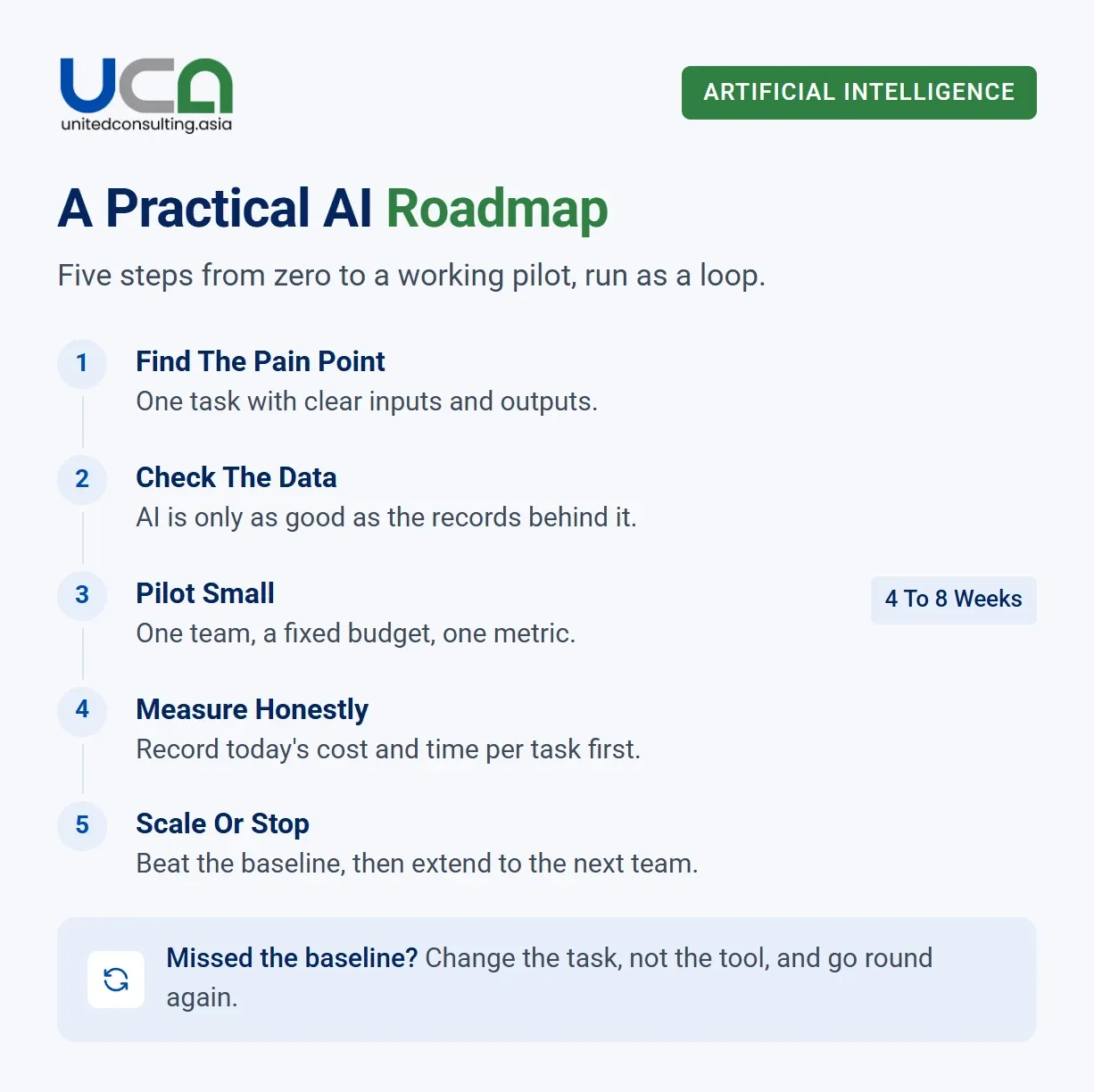
- Find the pain point. List where your team loses hours each week, then pick one task with clear inputs and outputs.
- Check the data. AI is only as good as the records behind it, so run a data readiness check before you build anything.
- Pilot small. Give one team four to eight weeks, a fixed budget and one metric that matters.
- Measure against a baseline. Record today’s cost and time per task before you start, then compare like with like. Tracking return on investment (ROI) properly has its own methods, covered in measuring AI returns.
- Scale or stop. If the pilot beats the baseline, extend it to the next team. If not, change the task rather than the tool.
What This Looks Like in Practice
Take a hypothetical import and distribution company in Ho Chi Minh City with 20 staff. Two people in the back office spend most of each Monday keying supplier invoices and delivery notes into the accounting system and matching them against purchase orders. A sensible first pilot is invoice data extraction: the tool reads each document, fills in the fields and flags anything that does not match, and a person approves every entry before it posts.
The team times the Monday work before the pilot, runs the tool for six weeks, then compares. If the hours fall and the error count holds steady, the approach moves on to customer order emails.
Can You Legally Use AI Tools in Vietnam?
Yes. Vietnam encourages AI use, but it attaches duties to it. Three risks matter most at SME scale: data privacy, inaccurate output and weak oversight. Vietnam’s rules make the first one concrete. The Personal Data Protection Law (Law 91/2025), in force since 1 January 2026, and its implementing decree (Decree 356/2025) set the rules for sending personal data across borders.
The Law on Artificial Intelligence goes further. Article 4 makes human oversight a fundamental principle of the law itself, not only a duty for critical decisions.
Risk tiers keep the response proportionate. The classification turns on a system’s impact and scale, not only the task, so treat the tiers below as a starting point for your own case.
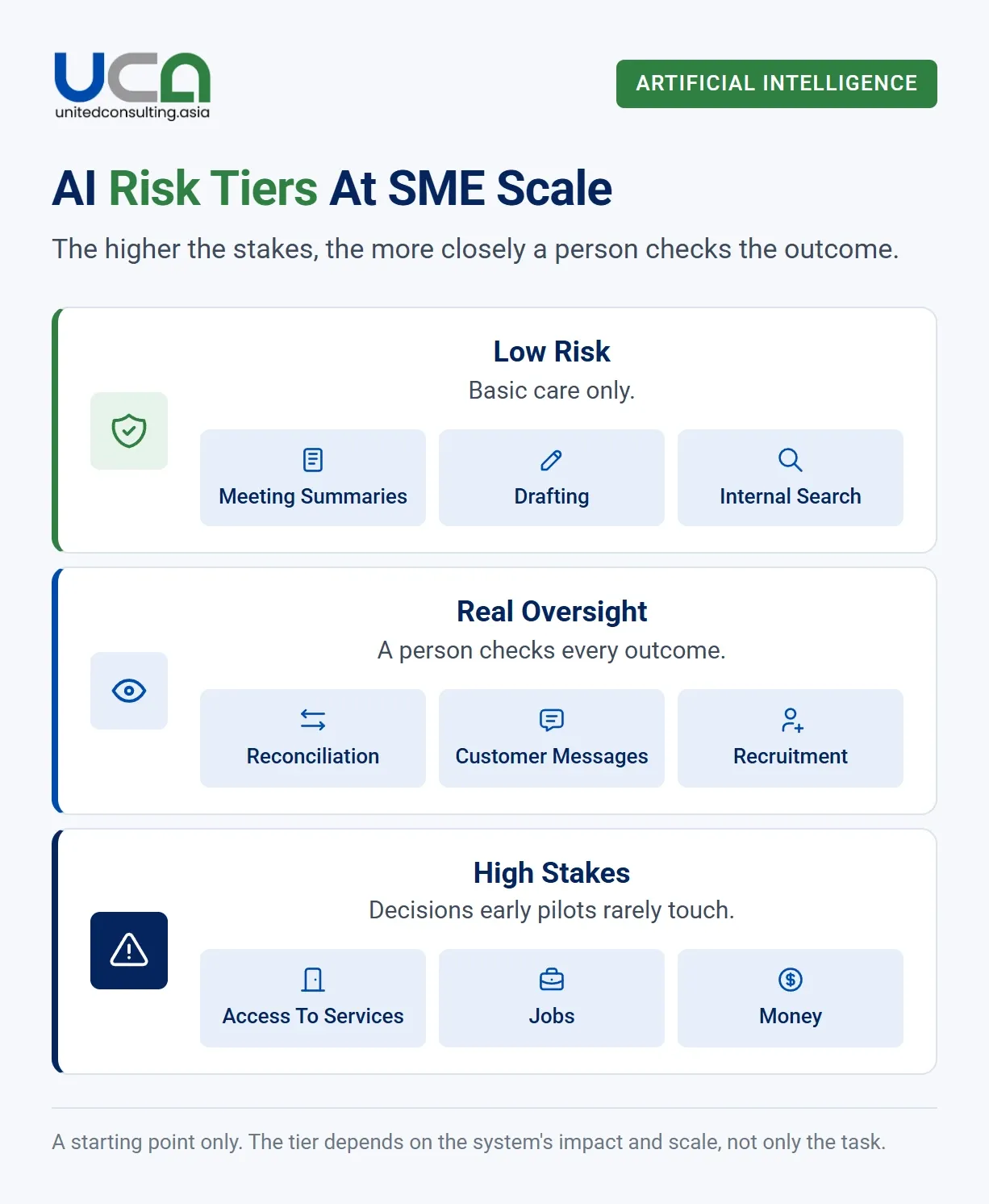
- Low risk. Back-office uses like meeting summaries, drafting and internal knowledge search usually need basic care only.
- Real oversight. Reconciliation (matching your records against the bank), customer communications and recruitment decisions need a human checking the outcome.
- High stakes. Decisions on access to services, jobs or money sit in the high-stakes tier. Early pilots rarely touch them.
The practical safeguards are simple. Keep personal data out of public chat tools. Keep a human approval step on anything customer-facing. Log what your systems do.
Comparing options for your own setup? Email info@unitedconsulting.asia and we will help you place the first pilot.
What Are the Main AI Use Cases for Businesses?
Day to day, AI does three jobs. It takes routine work off people, it connects the steps between your systems, and it can act on its own, under supervision. Each job has its own guide.
How Does AI Take Routine Work Off Your Team?
Most first wins come from workload relief: the tools take the first pass at routine documents and recurring reports, and a person checks the result. That is relief, not a process redesign. Setups and limits are covered in our guide to improving productivity with AI.
How AI Connects Your Business Systems
Behind the scenes, AI workflow automation connects the systems you already run. It reads invoices or contracts and routes each item for approval, so manual handoffs become monitored flows. The guide maps the journey from manual to automated.
Where Do AI Agents Fit In?
One step further, AI agents handle whole jobs such as chasing supplier quotes or updating records, pausing for a person at the checkpoints you set. Adoption is early but moving: in a 2026 survey of Vietnamese technology leaders, 35% of companies had already moved agents into production.
Our guide to AI agents for business shows how teams put them to work. Add agents only once the simpler tools run steadily, rather than buying everything at once.
How Is AI Changing Jobs and Business Functions in Vietnam?
AI changes tasks before it changes roles, and it lands differently in each function. People need new habits first. Finance and customer service show the biggest near-term wins.
What Changes for Employees First?
For employees, the job shifts from producing first drafts to reviewing them, and from hunting for information to asking for it.
As an owner, set clear rules on which tools staff may use and which data may go into them. Our guide to using AI at work covers those rules in more detail.
Where Do the Biggest Function Wins Sit?
In finance, AI reconciles transactions, extracts invoice data, flags odd entries and drafts management reports, while accountants keep the review and advice. It pairs especially well with outsourced accounting. Function-level guidance sits in AI in finance and accounting.
In customer service, the tools draft replies, answer routine questions around the clock and hand complex cases to people with the full context attached.
How to balance speed and judgement is covered in AI in customer service.
What Should You Decide Before Spending on AI?
Three decisions shape every rollout: where your AI runs, how you will know it is working, and whether your data is usable at all. In practice data comes first, so start there.
If invoices live in scattered PDFs, customer records are duplicated and nobody owns the master list, no tool will rescue the project. Records need to be clean, structured and accessible before any tool goes in.
Running AI locally keeps sensitive records inside your network, which can suit regulated work. Cloud AI is faster to start and cheaper at low volumes, so for a small team on a budget the first pilot usually lives in the cloud.
In Vietnam the question is cross-border data transfer, not data localisation. When personal data leaves the country, Article 20 of the Personal Data Protection Law requires an impact assessment.
Set the measuring stick before the project starts, not after. Early evidence is promising: in the same 2026 adoption study, 71% of adopters said AI had broken even or turned a profit, yet only 23% run a formal AI strategy.
What Are the Best AI Solutions for Businesses in Vietnam?
The best AI solutions in Vietnam share three traits: they fit one specific workflow, they leave a clear audit trail, and they respect Vietnam’s data rules. Tool lists are easy to find; knowing what good looks like is harder.
Start with build versus buy. If a ready-made tool does the job, buying is cheaper and faster than building. Build only when your workflow is unusual. A distributor with a non-standard order form, for example, may find that off-the-shelf tools cannot read it, and a small custom build can pay for itself.
Whatever you buy or build, a good first project has four marks: a cost you know before you commit, the freedom to stop paying if it does not work, a clear answer on how personal data and human oversight are handled under Vietnam’s data and AI laws, and a pass-or-fail result agreed before any rollout.
What Does an AI Consulting Firm in Vietnam Do?
Doing all of this alone is hard on top of a day job. A good AI consulting firm starts with your business case, not a software catalogue.
In practice that means mapping which processes are worth automating, running the build-versus-buy decision, selecting and testing tools, and keeping the rollout inside Vietnam’s data and AI rules. It also means telling you what not to buy.
The same tests apply if you are looking for an AI agent development company in Vietnam. Ask to see an agent working on a sample of your own data, where each human checkpoint sits, where the data is hosted and who maintains the agent after launch. A partner who cannot answer those questions clearly is not ready to build for you.
How United Consulting Can Help With AI in Vietnam
Most owners we meet already know AI could save them time. What they lack is the hours to work out where, and the confidence that the result will stay inside Vietnam’s rules. These are the three ways we usually start.
A Half-Day Workshop to Find Your First Use Case
We sit with one team and work through its real tasks, not a generic demo. By the end of the session you have a short list of jobs worth handing to AI, ranked by hours saved and risk, plus the prompt guides your people keep using afterwards. Which job in your business would you pick today?
One AI Agent Inside One Team
Once the first use case is clear, we build a single agent for it, for example chasing sales follow-ups or sorting supplier documents. It ships with a named owner, clear limits on what it may do alone and a log of every action, so your team stays in control while it proves itself.
The Foundations That Keep AI Safe to Scale
Behind the tools sit the questions that trip up growing firms: where your data is hosted, what staff may paste into AI tools and how that maps to the Personal Data Protection Law. We set up the hosting, the usage policy and the data controls so the second and third projects go faster than the first.
Every engagement starts the same way: a free 30-minute discovery session, then one pilot with the outcome agreed before we begin. A wider rollout follows only once the numbers hold up. Training runs on-site in Ho Chi Minh City or remotely, in English or Vietnamese. See the full range of AI enablement, agents and transformation services.
Conclusion
AI for business in Vietnam is not a moonshot. It is a set of practical tools aimed at the work that drains your team, and Vietnam’s fast-moving rules reward companies that plan for data protection and human oversight from the start.
Whatever you start with, pilot it in weeks rather than quarters, and let the evidence choose your next move.
Thinking about entering or expanding in Vietnam? Contact United Consulting at info@unitedconsulting.asia to map how AI for business fits your Vietnam plans.
Frequently Asked Questions
How is AI used in business in Vietnam?
Most Vietnamese businesses start with drafting, summarising, translation and customer replies, then move on to finance work such as invoice extraction and reconciliation. A 2026 study found that 26% of Vietnamese businesses, around 245,000 firms, already use AI. Small firms usually begin with AI features inside tools they already pay for, such as email and accounting software.
Is AI expensive for small businesses?
It does not have to be. Many useful AI features come free or at low cost inside email, office and accounting software, so a first pilot on one task needs only a small budget. Costs rise with custom builds, integrations and AI agents, which is why it pays to prove one win before spending more. Our guide to measuring AI ROI shows how to check the return.
Is there a law on AI in Vietnam?
Yes. Vietnam’s Law on Artificial Intelligence (Law 134/2025) was passed in December 2025 and has been in force since 1 March 2026. It takes a risk-based approach and makes human oversight a fundamental principle. Businesses that handle personal data must also follow the Personal Data Protection Law, in force since 1 January 2026.
Can businesses in Vietnam use cloud AI tools?
Generally, yes. For most SME uses of personal data, no rule forces every tool to be hosted in Vietnam, though some sectors have localisation duties. When personal data leaves the country, the Personal Data Protection Law requires an impact assessment for the transfer. Our comparison of local AI vs cloud AI sets out the trade-offs.
How do I choose an AI agent development company in Vietnam?
Look for a partner that starts with your business case rather than a product demo. Ask to see an agent working on a sample of your own data, where the human checkpoints sit, where the data is hosted and who maintains the agent after launch. They should also explain how the project meets Vietnam’s AI and data protection rules. Our AI services follow that approach.