Three advisory firms quote the same Vietnam company setup, and the totals can differ by thousands of dollars. None of them is necessarily wrong. So what is the cost of setting up a company in Vietnam? State fees come to well under US$500 for a standard company, the professional fee is the real variable, and a realistic first-year budget is the number to plan around.
This breakdown is for foreign founders, entrepreneurs and investors budgeting a Vietnam entry before the quotes arrive. It covers a foreign-owned limited liability company (LLC) first, then compares the branch and representative office routes. For the paperwork itself, see the guide to setting up a company in Vietnam, and if you would rather have a scope priced for your own plans, our company setup advisory team can do that before you commit.
TL;DR - Setting up a company in Vietnam costs little in state fees and most of the budget in professional fees and first-year running costs. State charges are small and fixed: the investment registration fee is VND 1.5 million to VND 3 million, enterprise registration is free online, and the business licence fee has been abolished since 2026. The professional fee varies with sector and scope, and the surprises are legalisation, work permits, accounting and employer contributions of 21.5% of salary. Plan the first year, not just the registration.
What Is the Cost of Setting Up a Company in Vietnam?
Less than most people fear, and more than the registration receipts suggest. For a standard foreign-owned company, everything the State charges adds up to a few million Vietnamese dong, roughly US$80 to US$200. The bill most people mean when they ask the question is bigger, because it includes the professional work of preparing and filing the dossier, and the setup costs that follow registration.
The clearest way to budget is in three buckets.
- State fees. Fixed by regulation, small, and payable per certificate. You can look every one of them up before you start.
- Professional fees. What an advisory firm charges to prepare the dossier, file it, follow it through the authorities and hand you a licensed company. This is the line that varies most between quotes.
- First-year running costs. Accounting, payroll, employer contributions, office and permits. These start the day the company exists, whether or not it earns anything yet.
Quotes that look expensive usually include bucket three. Quotes that look cheap usually do not. Read every quote against the same three buckets and the comparison becomes simple.
What Government Fees Will You Pay?
A short list, and one item on it has disappeared. The remaining fees come from the official schedule on the National Business Registration Portal and the investment registration fee schedule.
| Fee | Amount | Note |
|---|---|---|
| Investment registration | VND 1.5 million to VND 3 million | Per application; exemptions apply to some projects |
| Enterprise registration | VND 100,000 | Free when filed online through the national portal |
| Registration announcement | VND 300,000 | Published on the national portal after registration |
| Representative office licence | VND 3,000,000 | Per new licence; extensions and amendments VND 1,500,000 (Circular 143/2016/TT-BTC) |
| Business licence fee | Abolished | Gone since 1 January 2026 under Decree 362/2025/ND-CP |
What Happened to the Business Licence Fee in 2026?
It was abolished. Since 1 January 2026 companies and business households no longer pay the annual business licence fee. The change came in under Decree 362/2025/ND-CP implementing the Law on Fees and Charges and the National Assembly’s private economy resolution. For years it was a small annual line on every company and branch budget. Now it is zero, which matters more than its size: one recurring compliance cost is simply gone from the first-year plan.
Do You Need a Seal and Sector Licences Before You Trade?
Two items sit outside the fee table. A company seal (the official stamp that goes on contracts and filings) must still be made, and it costs a few hundred thousand Vietnamese dong at any seal maker.
And if your business line is conditional, such as food services, education or logistics, the sector licence carries its own fee and its own timeline. Those two lines are where first budgets leak, so check your business line against the market access rules before you fix any number.
What Do Professional Service Fees Cover?
They cover judgement and follow-through, not just paperwork. A proper engagement includes checking that your business line is registrable, drafting the charter and investment documents, filing both applications, answering questions from the licensing authority, and collecting the certificates. The scope, not the page count, sets the price.
Treat any published figure as indicative, not a quote. For a standard foreign-owned company, the market runs from a few hundred to a few thousand US dollars, and the spread comes down to four things.
- Sector. A plain consulting company is a standard dossier. A conditional business line adds assessments, sub-licences and time.
- Documents. Foreign corporate documents often need notarisation, legalisation and translation before Vietnamese authorities accept them, and that work is usually billed separately.
- Scope. Registration only, or registration plus bank account, tax initial registration, payroll setup and permits.
- Post-setup support. The first months of compliance are where a new company makes expensive mistakes, and some firms price that in from day one.
Put the scope in writing before comparing prices, and two quotes for the same scope become comparable. The company setup services we provide cover exactly this scoping work, and can help you pressure-test a quote before you sign it.
How Can You Compare Two Setup Quotes?
Line by line, against the same scope list. Ask each firm to price four things separately: the investment and enterprise filings, the document legalisation and translation, the bank and tax setup, and the first quarter of compliance support. Then ask who physically follows the dossier through the licensing authority, because that follow-up is where cheap quotes quietly turn into long timelines. A slightly dearer quote that covers all four lines usually costs less than a cheap quote plus the invoices that follow it.
Not sure which scope your Vietnam setup actually needs? Email info@unitedconsulting.asia and we will talk through the options before you commit.
What Hidden Costs Do New Companies Miss?
The costs that never appear on a registration quote. Each one is ordinary, and together they move the first-year budget more than the state fees do.
- Document legalisation and translation. Your parent company’s registration documents, bank letters and board resolutions usually need certified translation and legalisation before filing. Budget a few hundred US dollars and a couple of weeks.
- Work permits. Foreign founders and managers who will work in Vietnam need a work permit or an exemption certificate. The government fee is small, but the medical check, police check and document trail are not free. Our visa, licence and permit support keeps that file moving alongside the setup.
- Accounting and payroll. Vietnamese companies must keep accounting records and file monthly and annual reports from their first month. A bookkeeping service is a normal early hire or early contract.
- Annual audit. Foreign-invested enterprises must have their financial statements audited each year. The fee depends on size and revenue. The in-house versus outsourced accounting comparison shows how small companies usually cover it.
- Employer contributions. The day you hire, budget 21.5% of the contribution base on top of salary for social, health and unemployment insurance (Social Insurance Law No. 41/2024/QH15, in force since 1 July 2025), plus a trade union fee. The employee benefits guide separates what is required from what is competitive.
One warning sign deserves its own line. A setup quote that excludes legalisation, the seal and the first quarter of accounting is not cheaper. It is just unbilled. And the company seal is a document in its own right: what it is used for and when you need one is covered in the guide to stamping official documents.
How Much Does Each Company Type Cost?
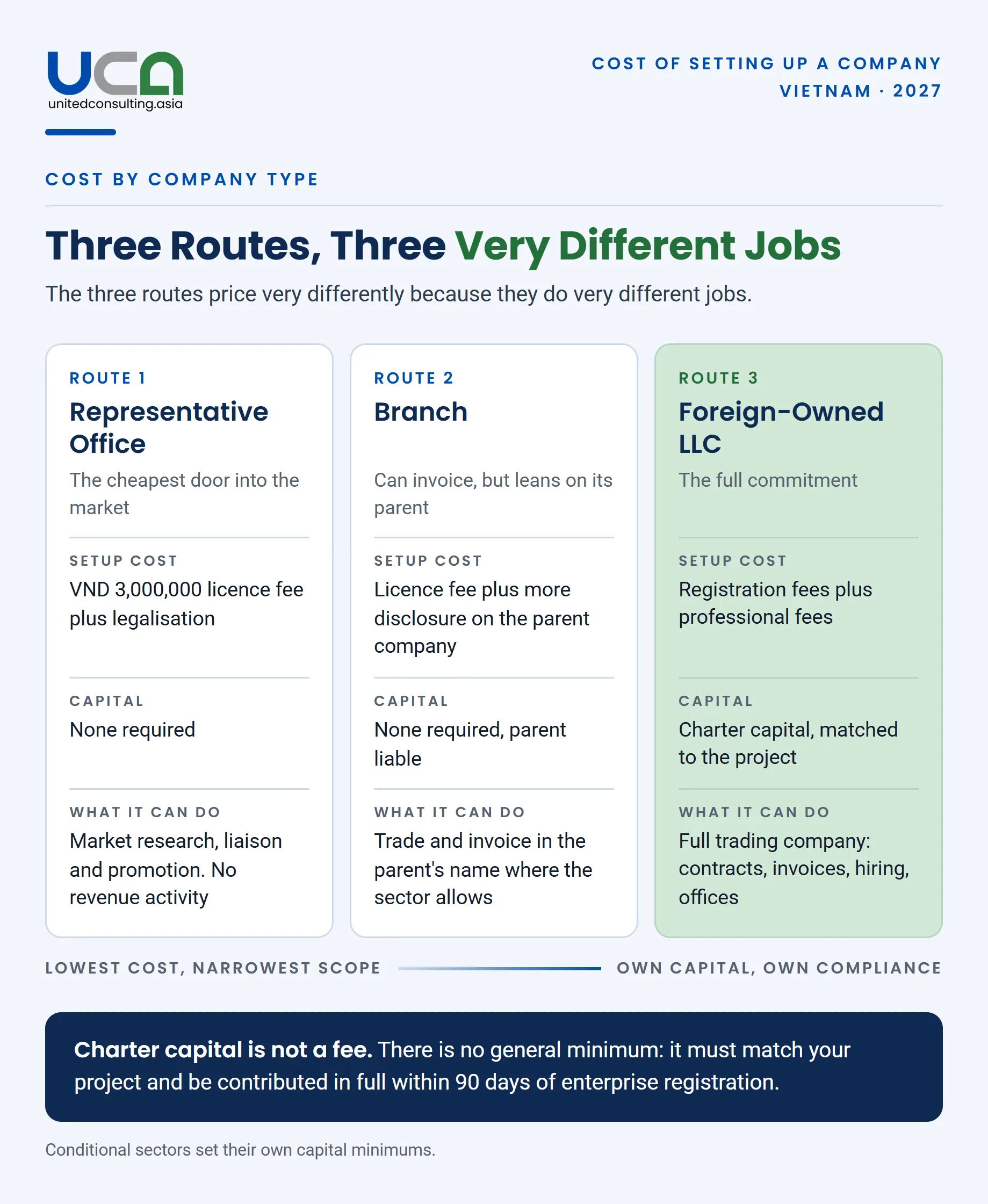
The three routes price very differently because they do very different jobs. A representative office is the cheapest door into the market and cannot invoice. A branch can invoice but leans on its parent company. A Vietnamese subsidiary is the full commitment, with its own capital and its own compliance.
| Route | Setup Cost | Capital | What It Can Do |
|---|---|---|---|
| Representative office | Lowest: VND 3,000,000 licence fee plus legalisation | None required | Market research, liaison and promotion for the parent company. No revenue activity |
| Branch | Licence fee plus more disclosure on the parent company | None required, parent liable | Can trade and invoice in the parent company’s name where the sector allows |
| Foreign-owned LLC | Registration fees plus professional fees | Charter capital, matched to the project | Full trading company: contracts, invoices, hiring, offices |
What Does a Representative Office Cost to Run?
The cheapest door in, and the narrowest. Set-up is the VND 3,000,000 licence fee plus legalisation of the parent company’s documents, and no charter capital is required. The real cost is the operating base behind it: a registered office address, a chief representative (who is usually already on payroll elsewhere), licence renewals, and simple bookkeeping. A representative office can research the market, host the parent company’s people and promote its business, but it cannot invoice, so none of that spend comes back as revenue in Vietnam. For a first market test, that limitation is often the point: you buy information, not a cost centre with tax filings.
What Does a Branch Cost to Set Up?
A middle route. The registration cost is similar to a representative office, with more disclosure, and no charter capital is required. The difference is commercial: where the sector allows it, a branch can trade and invoice in its parent company’s name. The flip side is liability, because the branch is not a separate company. Everything it signs, its parent carries, which is why foreign groups usually prefer a subsidiary once real contracts are in play.
How Much Charter Capital Do You Need?
Charter capital is the line people most often treat as a fee, and it is not one. Vietnamese law sets no general minimum for a foreign-invested company: the capital must simply match your project and business line. It is money that goes into your own company’s account and funds its operations.
What the law does enforce is a deadline. Under the Law on Enterprises 2020, capital must be contributed in full within 90 days of enterprise registration, and missing that deadline is its own legal problem.
Conditional sectors are the exception. Tourism, real estate distribution, lending and a handful of other lines carry minimum capital set by their sector rules. If your business line is conditional, the sector’s minimum, not your appetite, sets the number.
What Total Budget Should You Plan for the First Year?
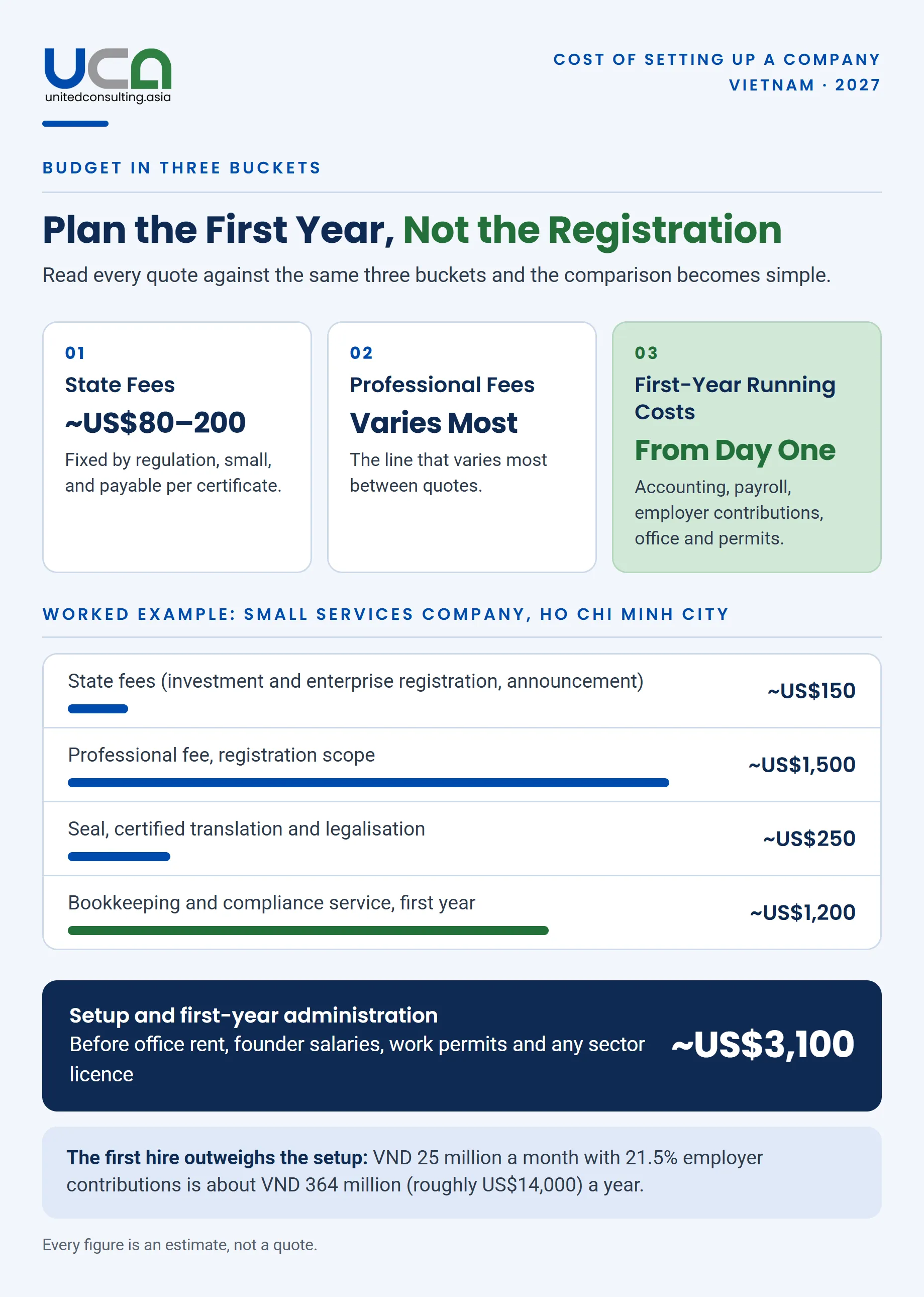
Plan the first year, not the registration. Say a small services company in Ho Chi Minh City, one foreign founder, one Vietnamese hire, a plain business line and no sub-licences. The honest version of that budget looks like this.
| Item | Estimate |
|---|---|
| State fees (investment and enterprise registration, announcement) | About US$150 |
| Professional fee, registration scope | About US$1,500 |
| Seal, certified translation and legalisation | About US$250 |
| Bookkeeping and compliance service, first year | About US$1,200 |
| Setup and first-year administration | About US$3,100 |
| First hire at VND 25 million a month, with 21.5% employer contributions | About VND 364 million (roughly US$14,000) a year |
Every figure in that table is an estimate, and the ranges above apply. Run the same lines with your own quotes and the answer stops being a mystery. What the table excludes matters just as much: office rent and deposit, founder salaries, work permits, and any sector licence.
Does Location Change the First-Year Cost?
Yes, mostly through rent and salaries rather than fees. Ho Chi Minh City and Hanoi carry the highest office rates and the deepest talent pools, while Da Nang and secondary cities run leaner on both. State fees are the same everywhere, and professional fees move little with geography. The honest way to use location in a budget is to decide where your customers and staff are first, then price the office and payroll for that city, not the national average.
How Long Does Company Setup Take?
Time is part of the cost. Under the current investment rules the investment registration certificate issues within 15 working days of a valid dossier (Decree 96/2026/ND-CP), and enterprise registration follows in a few working days more. Every week of delay is rent, salaries or founder time spent before revenue starts, so a dossier planned properly is worth more than a dossier filed quickly.
How United Consulting Can Help You Budget Your Vietnam Setup
A budget is only as good as the scope behind it. It is hard to price a Vietnam entry honestly when the business line, the documents and the first-year obligations are still moving, and that is where an outside view pays for itself.
The company setup services we provide start with scoping: what your company will do, which route fits it, what the State will charge and what the first year will cost. Then the filing itself follows the scope, with the fees fixed before we begin.
Conclusion
The cost of setting up a company in Vietnam has a small fixed floor and a wide practical range above it. State fees are minor. Professional fees buy the scope you actually need. The first year, with its accounting, permits and contributions, is where the real budget lives.
The decisive next step is simple. Write down what the company will do in its first year, get two quotes for the same written scope, and compare them against the three buckets in this guide. Do that and the cheapest quote and the right quote usually become the same one.
Thinking about entering or expanding in Vietnam? Contact United Consulting at info@unitedconsulting.asia to map how the cost of setting up a company fits your 2027 entry plans.
Frequently Asked Questions
How much should I budget to start a business in Vietnam?
For a standard foreign-owned company, state fees come to roughly US$80 to US$200, professional fees run from a few hundred to a few thousand US dollars depending on scope, and first-year administration adds accounting and compliance costs. A realistic all-in setup and first-year administration budget for a small services company is about US$3,000, before rent and salaries.
What is the minimum capital to set up a company in Vietnam?
There is no general minimum charter capital for a foreign-invested company in Vietnam. The capital must match your project and business line, and it must be contributed in full within 90 days of enterprise registration. Conditional sectors such as tourism and real estate distribution set their own minimums.
How much does a representative office in Vietnam cost?
The licence fee is VND 3,000,000 for a new licence, and no charter capital is required. The real costs are document legalisation, renting a small office and paying the chief representative, because a representative office can research and promote the parent company but cannot earn revenue in Vietnam.
What ongoing costs apply after company setup in Vietnam?
Monthly and annual tax filing, bookkeeping, the annual audit for foreign-invested enterprises, and employer contributions of 21.5% of the contribution base once you hire staff. Office rent and any sector licence renewals sit on top of those.
Is there a business licence fee for companies in Vietnam in 2027?
No. The business licence fee was abolished from 1 January 2026 under Decree 362/2025/ND-CP, so companies and business households no longer pay it. Registration, announcement and sector licence fees still apply.