It is 11pm in Ho Chi Minh City and a customer has just messaged about a wrong order. Nobody on your team will read it until morning. With an artificial intelligence (AI) assistant on the chat, she could have had an answer in seconds. That is what AI for customer service does.
Instead, by morning she has emailed twice, posted a public complaint and told three friends your support is hopeless. Response speed is the first thing customers judge you on. For the wider picture, see our guide to AI for business in Vietnam.
TL;DR - AI in customer service speeds up support when it takes the repetitive work: instant answers, ticket triage, after-hours cover and multilingual replies. Complaints, nuanced requests and high-value customers stay with people, which is what most customers still prefer. What decides the result is handoff design: the moment your system passes the full conversation to a human. Get that right and customers keep the speed without losing the human touch.
How Can AI Help in Customer Service?
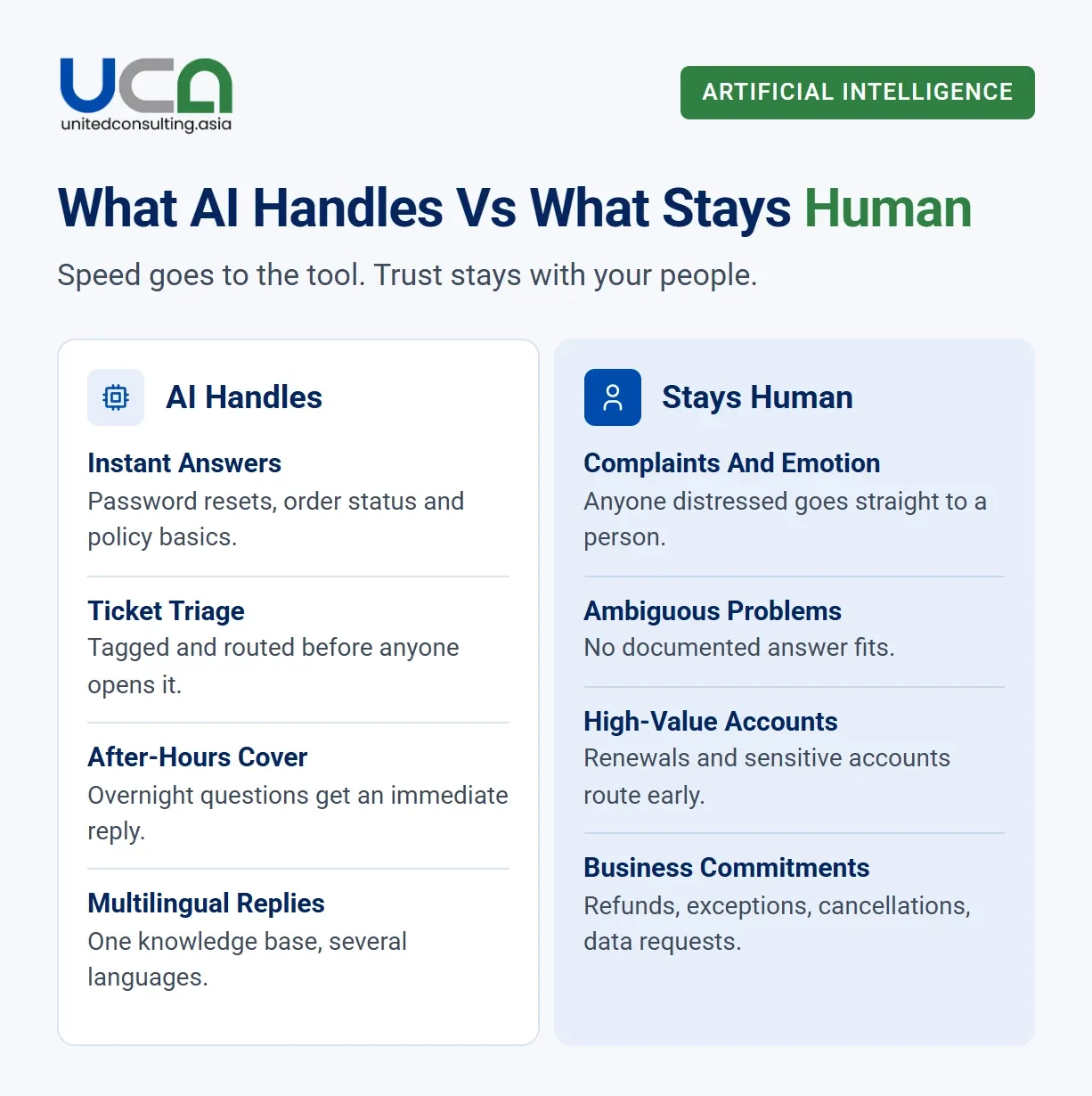
AI in customer service is good at routine, high-volume work, which makes it the natural place to start for a small team on a tight budget. Instant answers to common questions, ticket triage (sorting each request into the right queue), after-hours cover and multilingual replies are the four jobs an AI helpdesk does reliably today.
Which Jobs Does an AI Helpdesk Take On?
- Instant answers. Password resets, order status, opening hours and policy basics come back in seconds from documentation the bot already has.
- Ticket triage. The system reads each request, tags its category and priority, and routes it to the right queue before anyone opens it.
- After-hours cover. Questions that arrive overnight get an immediate reply.
- Multilingual replies. One knowledge base can answer in several languages without a speaker of each one on every shift.
Customers accept this in small doses. In a 2024 survey of 5,728 customers, 64% said they would prefer companies to skip AI in customer service, and 53% said they would consider switching to a competitor over it.
So use AI for the easy questions and keep the route to a person in plain sight. If you want software that takes actions on its own rather than answering questions, see our AI agents guide.
AI handles the four jobs above because none of them needs a judgement call. They need clear rules. For the wider picture, see the AI for business guide.
What Makes a Task Easy for AI?
These tasks share three traits: the correct answer already exists in writing, the request is common enough to recognise, and a rare mistake is cheap to fix. The less obvious win is consistency. The tenth customer asking about opening hours gets the same careful answer as the first.
For a small business, that consistency frees your people for the hard conversations. How much time it frees up is covered in the AI productivity guide.
What About Vietnamese and English Support Together?
This is where one tool can change things for a small team in Vietnam. A single queue might hold Vietnamese from the north, centre and south, plus English from foreign customers and partners. Ministry of Home Affairs figures put the number of foreign workers in Vietnam at 162,858 at the end of 2025, so bilingual demand is common.
AI helpdesk tools detect the language of each message and reply in it from a single knowledge base. Your people still own the difficult conversations in each language, but routine questions no longer queue behind the one bilingual colleague on shift. For a foreign-owned business in Vietnam, that means Vietnamese customers and English-speaking clients get the same first response.
Should Your AI Chatbot Start on Zalo, Messenger or Your Website?
In Vietnam, many customers never open your website chat. They message you where they already spend their day, and Zalo alone reports close to 80 million monthly users. Others reach you on Facebook Messenger, by phone or by email.
So start with the channel that already holds your queue, not the one that is easiest to set up. A website bot that answers perfectly does little if most questions arrive somewhere else.
- One knowledge base for every channel. Customers get the same answer whichever app they used.
- The same handoff rules everywhere. Someone who asks for a person on Zalo reaches one as fast as someone who emails.
Deciding what to automate and what to keep human? Email info@unitedconsulting.asia to talk through your support model.
What Should AI Customer Service Never Handle?
Complaints, anything that needs nuance or judgement, and your high-value customers.
Even when the bot handles the easy questions, an angry customer wants someone who will listen, and a conversation with a major account turns on tone as much as facts. Automation handles speed, but people handle trust.
Everything below belongs on one written list: your do-not-answer list, the subjects the bot must never touch. Keep it short and specific, and build it before launch, not after the first complaint.
- Complaints and emotion. A person who listens and apologises well repairs what a polite bot loop cannot. Anyone already distressed goes straight to a person.
- Ambiguous or novel problems. When a request matches no documented answer, a human works out what is needed.
- High-value and at-risk accounts. Renewals, sensitive accounts and anyone already upset route to a person early. A bad automated exchange costs trust.
- Anything that commits the business. Refunds, exceptions, cancellations and data requests go to a person however confident the bot sounds. Refunds above a set value, legal commitments and every active dispute belong on this list.
When Must a Chatbot Hand Over to a Person?
The rule is simple: at the first sign of any of the five triggers in the next section, the conversation moves to a person.
When the right answer is unclear, the honest reply is that a person will look at it. Put that in writing in your AI usage policy.
How Should an AI Chatbot Hand Over to a Human Agent?
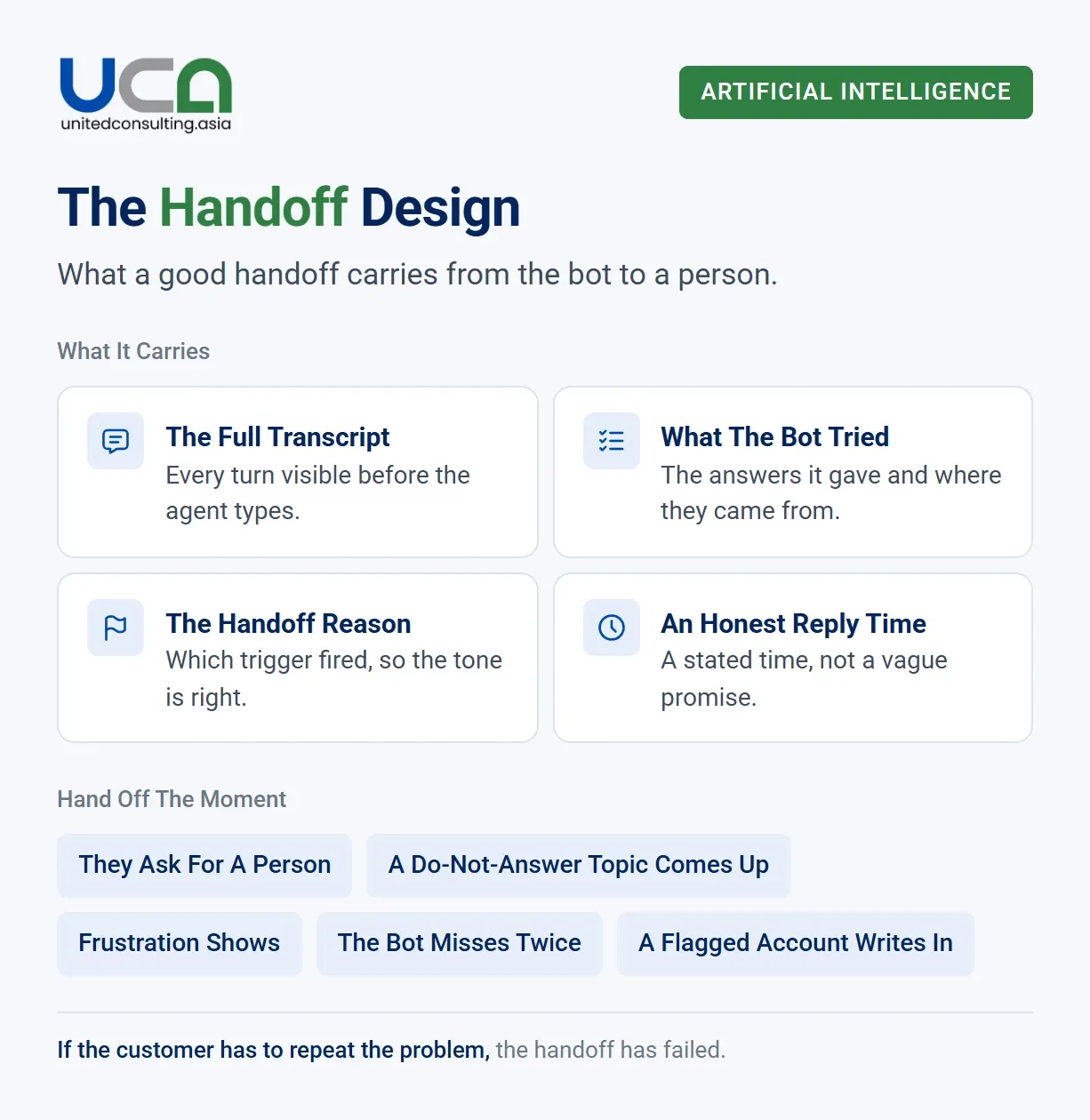
A good handoff happens early, carries the full conversation to a person and tells the customer what happens next. If the customer has to repeat the problem, the handoff has failed. Write the escalation rules before you switch the tool on.
Five triggers cover almost every case.
- The customer asks for a person. Move them at once, with no more bot answers.
- A do-not-answer topic. The request touches anything on your do-not-answer list.
- The bot detects frustration. Repetition, replies getting shorter and sharper, or someone calling the bot useless all count.
- A second failed attempt at the same question. One clarifying question is fair. After that, hand over with full context and no third try. Set that threshold before launch.
- A flagged account. The customer is on your high-value or at-risk list.
Whatever triggers the handoff, four things must travel with it.
- The full transcript. Every turn, visible to the agent before they type, not squeezed into a subject line.
- What the bot tried. The answers it gave and the sources it used, so the agent knows what the customer has already been told.
- The handoff reason. Which trigger fired, so the agent opens with the right tone.
- An honest expectation. A stated reply time, especially at night and at weekends, instead of a vague promise.
What Does a Good Handoff Look Like in Practice?
Take an illustrative case: an online homeware shop in Hanoi that handles most of its support on Zalo. A customer asks where her order is, and the bot checks the order status and replies in seconds. Ten minutes later she writes again. The vase arrived broken and she wants a refund.
Refunds are on the do-not-answer list, so the bot does not try. It tells her a member of the team will reply by 10am, then passes the conversation to the support inbox marked as a refund request, with the order number, her photo and the full chat attached.
The agent who picks it up the next morning can open with an apology and a decision on the refund, instead of asking her to explain everything again. The bot handled the quick question; a person handled the one that decides whether she buys again.
What Should the Bot Say After Hours?
After hours, the bot should say plainly that nobody is online, give a real reply time, and collect an email address so the conversation survives the night. Honesty late at night costs nothing. A false promise can cost you the customer.
How to Use an AI Chatbot Without Frustrating Customers
Make the route to a human visible, honour it instantly, and make it final. The quickest way to anger someone is to make them ask three times for a person, or to loop them through answers they have already rejected.
The evidence is blunt. In a customer experience survey of more than 600 US consumers, 75% had received a fast AI response that still left them frustrated.
Speed without a way out is the failure mode. Most customers do not object to a bot answering. They object when it becomes a wall.
- Keep the human option visible. A clear talk-to-a-person control in every conversation.
- Test before launch. Try the escalation rules yourself, out of hours and on a phone.
- End loops fast. If the bot has given the same answer twice, it hands over.
What Makes Customers Give Up on a Chatbot?
Customers give up when the bot does not understand their problem and keeps offering answers they have already rejected. A second miss on the same question is the cue to hand over.
How Do You Start With AI for Customer Service in Vietnam?
Start small: one channel, and the questions you already get most often.
- Pull last month’s questions. Export a month of chats and emails and sort them by topic. The most common questions become the bot’s first answers.
- Write the answers down first. The bot is only as good as the knowledge base behind it. If your policies live in people’s heads, fix that before launch; our checklist on whether your data is ready for AI can help.
- Write the do-not-answer list and the handoff triggers. Decide who receives escalations and how fast they reply, including at night.
- Launch on one channel. Start where your queue already is, and read the transcripts every week for the first month.
- Measure before you expand. Track response times, how often the bot hands over and how often customers come back with the same problem.
Comparing tools on price and payback is a separate exercise, covered in our guide to measuring AI ROI.
How United Consulting Can Help With AI for Customer Service in Vietnam
If late-night messages, repeat questions and slow replies sound familiar, the fix is usually smaller than owners expect. It starts with one channel and a clear line between what the AI answers and what your people handle.
A Support Agent for Your Busiest Channel
We build an AI agent for the channel where your queue already sits, whether that is Zalo, Messenger or your website, trained on the questions you get most. It answers in Vietnamese and English and hands over to a person, with the full conversation attached, the moment a case needs judgement.
Data Controls for Customer Conversations
Support chats are full of names, phone numbers and order details. We set up masking and data controls so personal data is handled in line with Vietnam’s data protection rules, and review the chatbot vendor before you commit.
Training Your Team to Work Alongside the Bot
A short workshop shows your support staff how to review transcripts, improve answers and take over smoothly. The bot gets better every week because the people closest to the customer are shaping it.
Every engagement starts the same way: a free 30-minute discovery session, then one pilot with the outcome agreed before we begin. A wider rollout follows only once the numbers hold up. See how AI agents for customer-facing teams fit your setup.
Conclusion
Fast support wins customers in Vietnam and keeps them. Let AI in customer service take the repetitive questions, keep people on anything that needs judgement, and write the handoff rules before launch.
Thinking about entering or expanding in Vietnam? Contact United Consulting at info@unitedconsulting.asia to map how AI in customer service fits your plans.
Frequently Asked Questions
How is AI used in customer service?
Mostly for instant answers to common questions, sorting and routing tickets, replying after hours and answering in several languages from one knowledge base. Complaints, refunds and sensitive accounts should still go to a person. The handoff between the two is what customers notice most.
Will AI replace customer service agents?
Not for the conversations that matter most. AI takes the routine, high-volume questions, which frees your people for complaints, unusual problems and important accounts. Many customers are wary of AI support, so a visible route to a human stays essential.
What is the difference between a chatbot and an AI agent?
A chatbot answers questions, usually from a knowledge base you give it. An AI agent can also take actions, such as updating an order, within limits you set. Our AI agents guide explains where each one fits.
When should a chatbot transfer to a human?
At once when the customer asks for a person, raises a topic on your do-not-answer list, shows frustration or is a flagged high-value account. It should also hand over after a second failed attempt at the same question. The full transcript should travel with the handoff so the customer never has to repeat themselves.
Is an AI chatbot worth it for a small business?
It tends to pay off when you get a steady stream of repeated questions, such as order status or opening hours, or a lot of messages after hours. Start on the channel where most questions already arrive, and measure response times and handoff rates before you expand.