You have found an artificial intelligence (AI) tool that promises to give your team back a day a week. Then someone asks where the customer records actually live, and the answer is three spreadsheets, a shared folder and one colleague’s memory. Before you buy anything, the first question is simple: is your data ready for AI?
That gap between the tool and your data is where many AI projects stall without a return. If you run a small business, you have probably seen it happen. This checklist shows you how to test your data, what to fix first and which privacy rules apply in Vietnam.
TL;DR - AI-ready data means accurate, consistent and complete records that sit in one findable place, carry clear labels, and have named owners and permissions. Most small and medium enterprises (SMEs) are not there yet, and the fixes are ordinary: consolidate, clean, define and assign ownership. Doing that before you buy a tool is far cheaper than debugging confident but wrong answers later. Vietnam’s personal data rules also apply the moment customer data feeds an AI system.
What Is AI-Ready Data?
AI-ready data is data fit for one specific job. It is accurate enough, complete enough and structured so a tool can use it without a person fixing every row. You judge readiness against the task, not against some universal standard of cleanliness. For the wider picture, read our AI for business guide.
That groundwork (data controls, permissions and vendor review) comes before any tool is chosen, and our AI enablement services can lay it with you.
How Is AI-Ready Data Different From Clean Data?
Clean data is a start, not the finish. Ordinary quality checks catch duplicates, blank fields and odd formats. The UK government, for example, judges data quality on six measures, including completeness, uniqueness and consistency.
AI asks harder questions. Does the data reflect the real situations the tool will meet? Are labels consistent enough for patterns to mean anything? Is this use permitted? A tidy spreadsheet that lists one customer under three spellings fails all three.
Is Your Data Ready for AI? A Four-Question Checklist
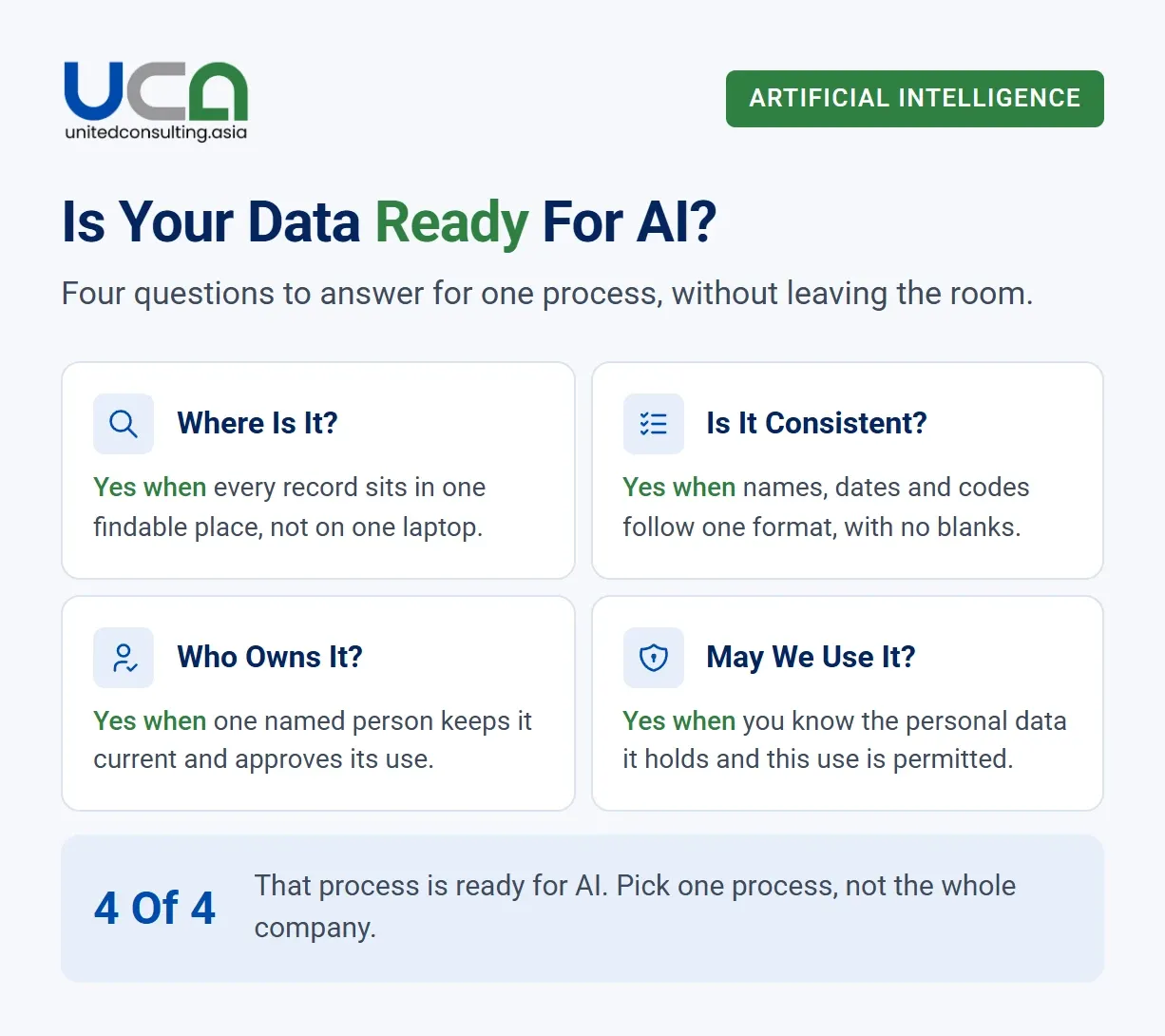
Your data is ready when you can answer four questions without leaving the room: where is it, is it consistent and complete, who owns it, and may we use it this way? You do not need to check the whole business. Pick one process, and if you can answer all four for it, that process is ready.
Is All Your Data in One Place?
List where that process’s records live: accounting software, customer relationship management (CRM) system, spreadsheets, chat threads, notebooks. If two systems disagree about one customer, or a key file exists only on one laptop, your data is not ready. A tool reads what it is given, and it cannot reconcile versions it never sees.
Is Your Data Clean and Consistently Labelled?
Pick five fields a tool would rely on (customer name, product code, date, amount, status) and sample 20 rows. Count the blanks, the mixed date formats and the drifting names (Nguyen Van A, A. Nguyen, Mr Nguyen). If more than a handful need a person to interpret them, the tool will guess instead, and it will guess confidently.
Who Owns Each Dataset?
Every dataset needs an owner, not just a file. Name one person per dataset whose job is keeping it current and approving its use. Without that, stale rows survive every clean-up, and each report restarts the argument about which version is true.
Are You Allowed to Use It This Way?
If the records include customers’ or staff members’ personal details, check what they agreed to when you collected them, and where the tool will send the data. Feeding a customer list into an overseas AI service is a different use from sending invoices. The privacy basics section below covers what Vietnam’s rules require.
Here is what that looks like in practice. Picture a small trading company in Hanoi that wants an AI assistant to draft customer follow-up emails. Its contacts sit in a sales spreadsheet, the accounting software and two salespeople’s phones. Sampling 20 rows turns up the same buyer under three names and no email address for a quarter of them. Nobody owns the list, and nobody has checked whether those customers agreed to marketing. On that evidence the process is not ready, and the fix comes before the tool: one merged contact list, one owner and a consent check.
Not sure whether your data is ready for AI? Email info@unitedconsulting.asia and we will map what to fix first.
Which Data Quality Problems Stop AI Projects?
The same five problems sink most small-business AI plans.
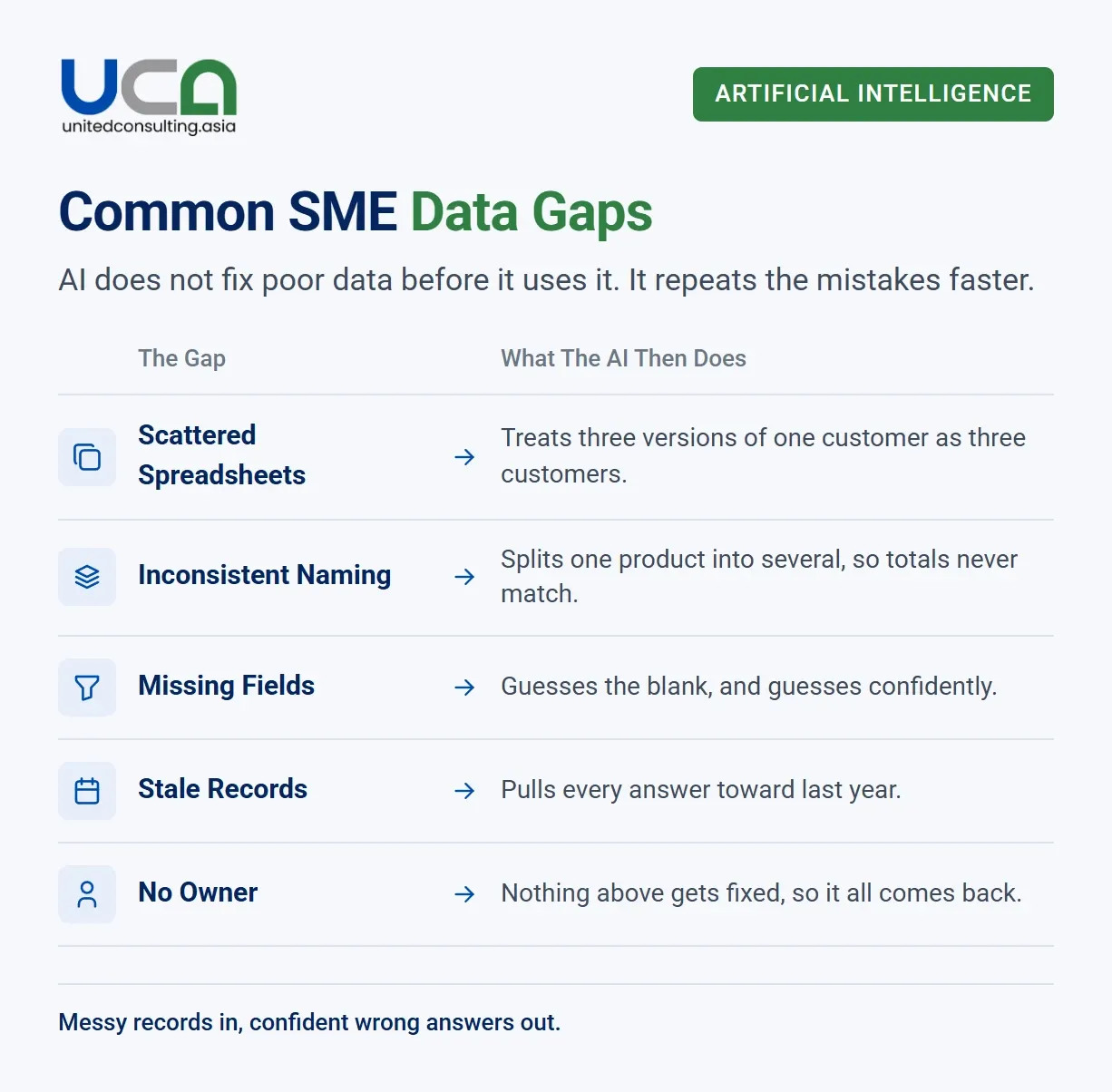
AI does not correct poor data before using it. Cleaning tools can flag duplicates, but people still have to confirm them. Feed a model messy records and it returns messy answers at speed, with every sign of confidence.
- Scattered spreadsheets. The same customer sits in a sales file, an invoice file and an old export, each slightly different.
- Inconsistent naming. Two people label the same thing differently, so your sales-by-customer total never matches the invoice list.
- Missing fields. The column a tool needs (email, product code, status) is blank exactly where it matters.
- Stale records. Old rows stay in the set and pull every answer toward last year.
- No owner. Nobody is responsible for fixing any of the above, so nothing changes.
Why Do These Problems Get Worse with AI?
People have been papering over bad data for years: the colleague who spots a typo, the one who knows a file is out of date. AI has none of that memory.
It can take every row at face value, with no person behind it to fill the gaps. It then scales the errors you had stopped noticing, which is why data quality matters more for an AI rollout than it ever did for spreadsheets.
How to Prepare Your Data for AI Before Buying Tools
Get your data ready before buying any tool, in this order:
- Pick a process. Choose the one job you would most like help with. Our guide to what to automate first can help.
- Map its data. List every place that process’s records live.
- Clean it. Merge duplicates and fill the fields that matter.
- Define it. Agree what each field means.
- Assign owners. Write down who owns each dataset.
- Set permissions. Know what personal data each dataset holds and who may use it.
Buying first simply locks the mess into a subscription. You are not aiming for a perfect database, just one trustworthy dataset for one job.
What Should You Clean Up First?
Start with the three to five datasets behind a single workflow. Then fix the front door: standardise how data is captured at entry, so new rows arrive ready for a tool.
Where your data should sit, on your own systems or in the cloud, is an infrastructure decision with its own trade-offs. Our guide to local versus cloud AI covers it.
For which tasks AI should take on first, see our practical use cases guide. For what a project should give back, see our guide to measuring AI ROI.
What If Your Data Is Just Spreadsheets?
Spreadsheets are a perfectly good start, and most small firms run on them. Keep yours if you must, but give each file one owner, one naming convention and one shared home rather than someone’s personal desktop.
What makes your data ready is not a new platform. It is consistent structure, and the habit of keeping it.
What Are the Data Privacy Basics for AI in Vietnam?
If AI touches customer or staff records, Vietnam’s personal data rules apply, whether your company is local or foreign-owned. Those rules changed recently. The Law on Personal Data Protection (Law 91/2025) took effect on 1 January 2026, with Decree 356/2025 as its guidance, and it replaced the earlier Decree 13/2023. Consent is not the only lawful basis for using personal data, and consent habits built on the old decree should be rebuilt on the new law.
What Does Valid Consent Look Like?
Consent must be explicit, informed and revocable. Before saying yes, the person must know what data is collected, why it is needed and who will process it. Silence and pre-ticked boxes do not count, and consent covers only the purposes stated.
These conditions now sit in Article 9 of the new law, with the right to withdraw consent in Article 10.
Three habits cover most of the risk:
- Know what personal data sits in each dataset before it reaches a tool, including sensitive categories such as health or financial details.
- Know where each tool sends that data before it goes live.
- Fix who can see and change each dataset, because a tool inherits every permission problem you feed it.
If the tool runs on an overseas platform, the cross-border transfer rules in Law 91/2025 and Decree 356 also apply. The people side matters as much as the data, and our guide to using AI at work safely covers it.
How United Consulting Can Help Get Your Data Ready for AI
Few owners enjoy the data clean-up that comes before AI, and it is easy to keep putting it off. We make it a short, defined project with a clear end, so the tool you buy next has something solid to work with.
A Data Readiness Review
We map where your customer, finance and operations data actually lives, who owns each set and which gaps would trip up the tool you have in mind. You get a ranked fix list, not a 50-page report.
Personal Data Controls for Vietnam
We set up the consent records, access rules and masking your AI tools need under the Personal Data Protection Law and Decree 356, and check any overseas platform before customer data goes near it.
Bringing Scattered Data Into One Place
Where records sit across spreadsheets, old software and personal inboxes, we connect or modernise those systems so the data lands in one findable place without a full rebuild.
Every engagement starts the same way: a free 30-minute discovery session, then one pilot with the outcome agreed before we begin. A wider rollout follows only once the numbers hold up. Read more about AI privacy and data services.
Conclusion
Getting your data ready for AI takes no data warehouse and no six-month programme. Consolidate what you already have, agree what the words mean, name an owner for each dataset, and know exactly what personal data you hold. Then keep it that way. Records drift back to old habits, so a named owner and a light monthly check keep the set trustworthy.
Do that, and every tool on your AI shortlist is judged first by one standard: whether the data behind it can be trusted. If you want that groundwork laid before any tool is chosen, the AI services we provide can help.
Thinking about entering or expanding in Vietnam? Contact United Consulting at info@unitedconsulting.asia to map how AI-ready data fits your implementation plans.
Frequently Asked Questions
What is AI-ready data?
AI-ready data is data fit for one specific task: accurate, consistent and complete enough for a tool to use without a person fixing every row. It sits in one findable place, has clear labels and a named owner, and you have permission to use it for that purpose. Readiness is judged against the job, not against a perfect database.
How do I know if my data is ready for AI?
Pick one process and answer four questions: where its data lives, whether it is consistent and complete, who owns it, and whether you may use it this way. A quick test is to sample 20 rows across five key fields and count blanks, mixed formats and duplicate names. If more than a handful need a person to interpret them, the data is not ready yet.
How do you prepare data for AI in a small business?
Work through one process at a time: map where its records live, merge duplicates, fill the fields that matter, agree what each field means, assign an owner and set permissions. Then standardise how new data is entered so the problems do not return. Do this before buying a tool, not after.
Can small businesses use AI with data in spreadsheets?
Yes. Spreadsheets are a reasonable starting point as long as each file has one owner, one naming convention and one shared location. Consistent structure matters far more than moving to a new platform.
Does Vietnam’s personal data law apply to AI tools?
Yes. If an AI tool processes customer or staff data, Vietnam’s Law on Personal Data Protection, in force since 1 January 2026, applies to both local and foreign-owned companies. Consent must be explicit, informed and revocable, and extra rules apply when data is sent to platforms overseas.