It is 7 pm and you are still clearing the inbox, chasing approvals and retyping figures between spreadsheets. If you run a small business in Vietnam, that scene is familiar. It is also where artificial intelligence (AI) earns its place, and the clearest answer to how to use AI in business: start with the work that keeps you late.
Most of that load is not skilled work. It is repetitive coordination that drains the people you hired for their judgement, and it is the first thing AI workflow automation takes on.
AI cannot add hours to the day, but it can take much of that low-value work off your team.
TL;DR - AI improves productivity when it absorbs repetitive drafting, summarising, scheduling and data handling, which is where most small business workload hides. In admin, sales, human resources (HR) and operations, staff can recover several hours a week. Vietnamese businesses already see results: 72% of local AI adopters report higher productivity. Start with one repetitive, low-risk task, keep people on review, then expand. The AI for business in Vietnam guide covers the full picture.
Does AI Improve Productivity for Businesses in Vietnam?
Yes, and the numbers now back it up. A 2026 study of 1,000 Vietnamese business leaders found 26% of businesses using AI, an estimated 245,000 firms. Among those adopters, 72% report productivity gains, up from 66% a year earlier.
Small firms are earlier in the journey, but they are moving. In a survey of more than 400 small and medium-sized enterprises (SMEs) in Da Nang from October 2026, nearly 66% still ran mainly on manual methods, while 63% wanted training in AI tools. Service businesses in the survey already use AI for appointment scheduling, customer feedback summaries and reminders about outstanding requests.
For a foreign-owned company, the practical gain is headcount discipline: handling more volume without matching hires.
That matters in a market where replacing experienced admin and finance staff is rarely quick or cheap. Local teams also get through bilingual admin faster when the tools draft the first version in both languages.
What Should Foreign-Owned Businesses in Vietnam Expect?
Expect enthusiasm from your team and a skills gap behind it. In the same Da Nang survey, 70% of firms cite financial pressure and 26% lack skilled technology staff. Imported playbooks rarely land unchanged, so the safest start is to train people alongside the tools, one team at a time.
When adoption works, the upside is measurable. In an International Labour Organization (ILO) productivity pilot in Vietnam, a precision-manufacturing SME used AI-assisted inspection to cut checking time from 20 seconds to 5 seconds per unit and lift defect detection accuracy from 95% to 99%.
Results like these still depend on tidy records and clear processes. Our checklist on business data readiness covers what good records look like.
How to Use AI to Increase Productivity in a Small Business
Productivity improves when you use AI in business to remove repetitive steps from work your team already does. Researchers at Stanford and MIT found that an AI assistant raised the number of issues resolved per hour by 14% on average, and by 34% for newer, less experienced staff, in a study of 5,179 customer support agents. For other functions, treat that as an indication of scale, not a promise.
How the tools connect to each other is covered in our guide to AI workflow automation.
Where Do the Productivity Gains Come From?
They come from task removal. The tools draft faster than people type and read faster than people scan, and they never get bored halfway through a task. That is where the hours come back to you.
An OECD review of the evidence on generative AI finds the largest gains among less experienced workers.
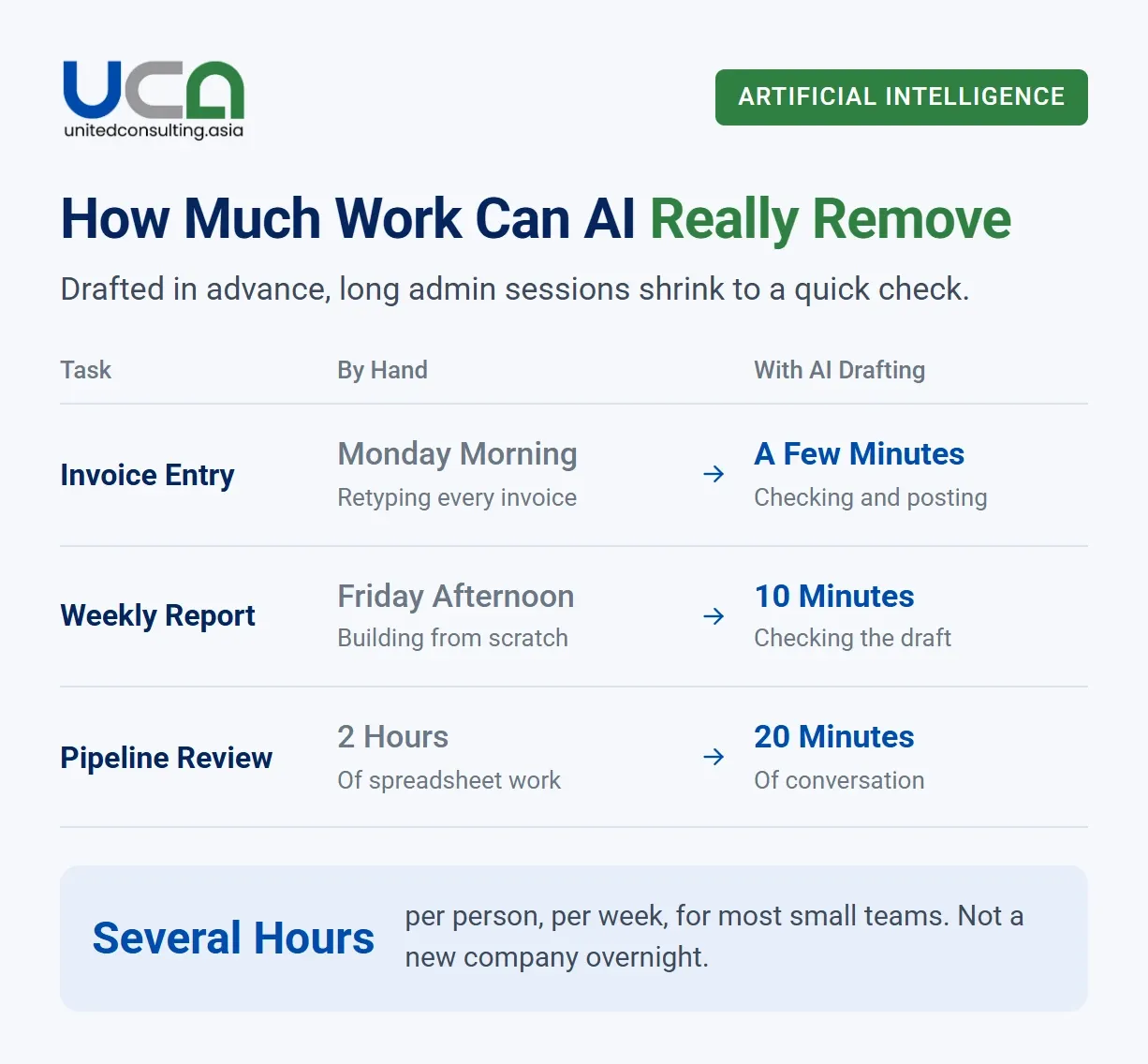
Take a small sales team where the Monday pipeline review takes two hours of spreadsheet work. With the reports drafted in advance, it becomes a twenty-minute conversation.
In practice, AI for business efficiency means output per person rises while the admin backlog shrinks.
Where a function stays mostly repetitive even after the tools arrive, a managed service is the other lever. In those cases the business process outsourcing we provide is often the simpler route.
How to Use AI in Business: Where Vietnam SMEs Should Start
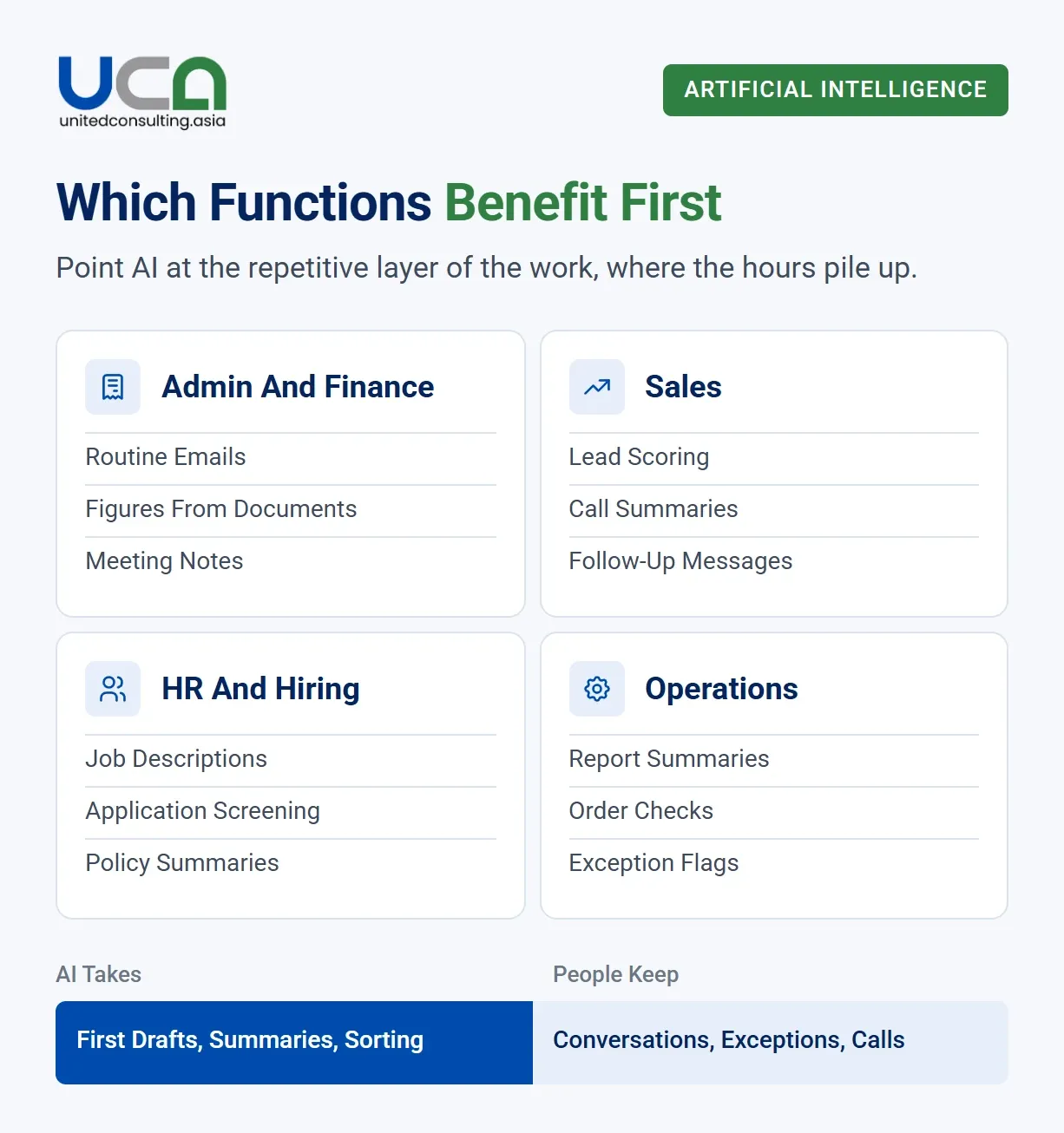
If you are asking how to use AI in your company, the best approaches are concrete and tied to a function. Point the tools at the repetitive layer of admin, sales, HR and operations, because that is where the hours pile up.
You do not need to rip out the systems you already have. Most gains come from using AI inside the software your team touches every day, which is why small firms often see results before large ones. Take invoice data entry: once the tools draft the entries from the documents, a Monday-morning session becomes a few minutes of checking and posting.
Which Business Functions Benefit First?
- Admin and finance support. AI drafts routine emails, summarises long threads, extracts figures from documents and prepares meeting notes. Bookkeeping and invoice prep are classic wins, and the wider finance picture sits in our outsourced accounting guide.
- Sales. AI scores leads, drafts follow-up messages, summarises calls and keeps records current. Reps spend their hours selling instead of updating systems, and customers get faster replies.
- HR and hiring. AI drafts job descriptions, screens applications, answers routine staff questions and summarises policy documents. Hiring admin that took days can shrink to hours, with people still making the decisions.
- Operations. AI summarises reports, checks orders against rules, flags exceptions and speeds up routine approvals. The gap between a request and the response shrinks, and customers notice.
The pattern holds across all four. The tools take the first draft, the summary and the sorting, while people take the conversations, the exceptions and the decisions. That split keeps the gains realistic.
If you want software to act on its own rather than draft for a person, that is the territory of AI agents for business.
Where Do the Hours Go in a Small Team?
In a small team, the hours go on the same handful of jobs: inbox triage, chasing approvals, weekly reports, call summaries and keeping records current. Hand those over first, because a person can check the result in seconds.
Picture a two-person office team that spends Friday afternoons building the weekly report. Once the numbers are pulled and drafted for them, that afternoon turns into a ten-minute check.
Whatever you hand over, keep human sign-off on anything touching money, contracts, staff decisions or an unhappy customer. Those cases stay with people until the tool has months of clean results behind it.
Working out which tasks to hand to AI first? Email info@unitedconsulting.asia to talk through your shortlist.
How Many Hours Can AI Save Your Team Each Week?
For most small teams, the gain from using AI in business shows up as several hours per person per week, not a transformed company overnight.
Add up the three examples in this guide and you can see how. The Monday pipeline review drops from two hours to about twenty minutes, the Friday report from an afternoon to a ten-minute check, and invoice entry from a morning to a few minutes of posting. For a small team, that one example week hands back roughly seven hours.
The savings land hardest in admin and customer-facing support. They show up as shorter response times, cleaner records and fewer late evenings.
Do not expect the full result on day one. Of Vietnamese AI adopters, 61% are still experimenting, and only 8% use AI in core workflows. Early gains are partial, and they grow as habits settle.
What Does the First Month Look Like?
A first month can be simple. In week one, ask each person to note where their hours go, then pick one task that is repetitive, low-risk and easy to check. In week two, set it up in a tool your team already has, such as the AI features in your email or office software, and write down how long the task takes today. In weeks three and four, run it with a person reviewing every output, then compare the time against your starting figure.
If the task got faster without new errors, move to the next one on the list. If it did not, change the task before you change the tool. Either way, you end the month with a measured result instead of a hunch.
What If AI Adds Work Instead?
It happens when you bolt the tools onto processes still designed around people. Staff retype data between steps, correct outputs and fight the tool instead of saving time. The fix is simpler starting points, human review and changing habits one task at a time.
Keep expectations realistic with your team as well as your board. Turning saved hours into money is a return on investment (ROI) question, and our guide to measuring AI ROI shows the method.
How United Consulting Can Help You Use AI in Your Business
Knowing where the hours go is one thing. Getting a busy team to change how it works, without the new tools becoming one more job, is where most small businesses in Vietnam get stuck. Here is how we help.
A Workshop Built Around One Team’s Week
In a half-day session we take one team’s real workload, such as a finance team’s monthly report or a sales team’s follow-ups, and rebuild it with AI tools on the spot. Your people leave with a working process and the worksheets to repeat it.
Short Upskilling Sessions That Keep Habits Going
Most productivity gains fade within a month because nobody practises. Weekly or monthly one-hour sessions, with separate tracks for team leads, keep skills current as the tools change and give managers a simple view of who is using what.
A First Agent for the Work Nobody Wants
When a task is repetitive enough, an AI agent can take it over end to end, with a person approving the result. We scope it, build it and hand it over with clear limits, so the hours you save show up in the calendar rather than in a report.
Every engagement starts the same way: a free 30-minute discovery session, then one pilot with the outcome agreed before we begin. A wider rollout follows only once the numbers hold up. If you are not yet sure which tasks to hand over first, AI enablement and training is the usual place to begin.
Conclusion
AI earns its place in a business one task at a time: take the repetitive layer off your team and keep people on the judgements that matter.
You can see the difference within weeks rather than quarters, and Vietnam’s adoption numbers point the same way. Small firms that use AI in business early build better habits and cleaner data as they go.
Thinking about entering or expanding in Vietnam? Contact United Consulting at info@unitedconsulting.asia to map how AI productivity fits your plans.
Frequently Asked Questions
How can AI be used in a small business?
Start with repetitive work that is easy to check: drafting emails, summarising meetings and calls, extracting figures from documents and preparing weekly reports. Sales, HR and operations teams use the same tools for lead follow-ups, job descriptions and order checks. Keep a person reviewing anything that touches money, contracts or customers.
How much time can AI save a small business?
For most small teams the gain is several hours per person per week rather than an overnight change. In a study of 5,179 customer support agents, an AI assistant raised issues resolved per hour by 14% on average and by 34% for newer staff. Results depend on tidy records and on choosing repetitive tasks first.
What business tasks should I automate with AI first?
Pick tasks that are repetitive, high-volume and quick for a person to check, such as inbox triage, invoice data entry, call summaries and weekly reports. Leave decisions on money, contracts, staff and unhappy customers with people until the tool has months of clean results. Our guide to AI workflow automation covers what to automate next.
Does AI really improve productivity?
The evidence says yes, with caveats. In Vietnam, 72% of businesses that use AI report productivity gains, and an OECD review finds the largest gains among less experienced workers. Gains are partial at first: most Vietnamese adopters are still experimenting, and only 8% use AI in core workflows.
How do I start using AI in my business?
Choose one repetitive, low-risk task, measure how long it takes today, and try an AI tool your team already has access to. Run it for a few weeks with a person reviewing every output, then compare the time against your starting figure. If it works, move to the next task. The AI for business in Vietnam guide covers the wider plan.