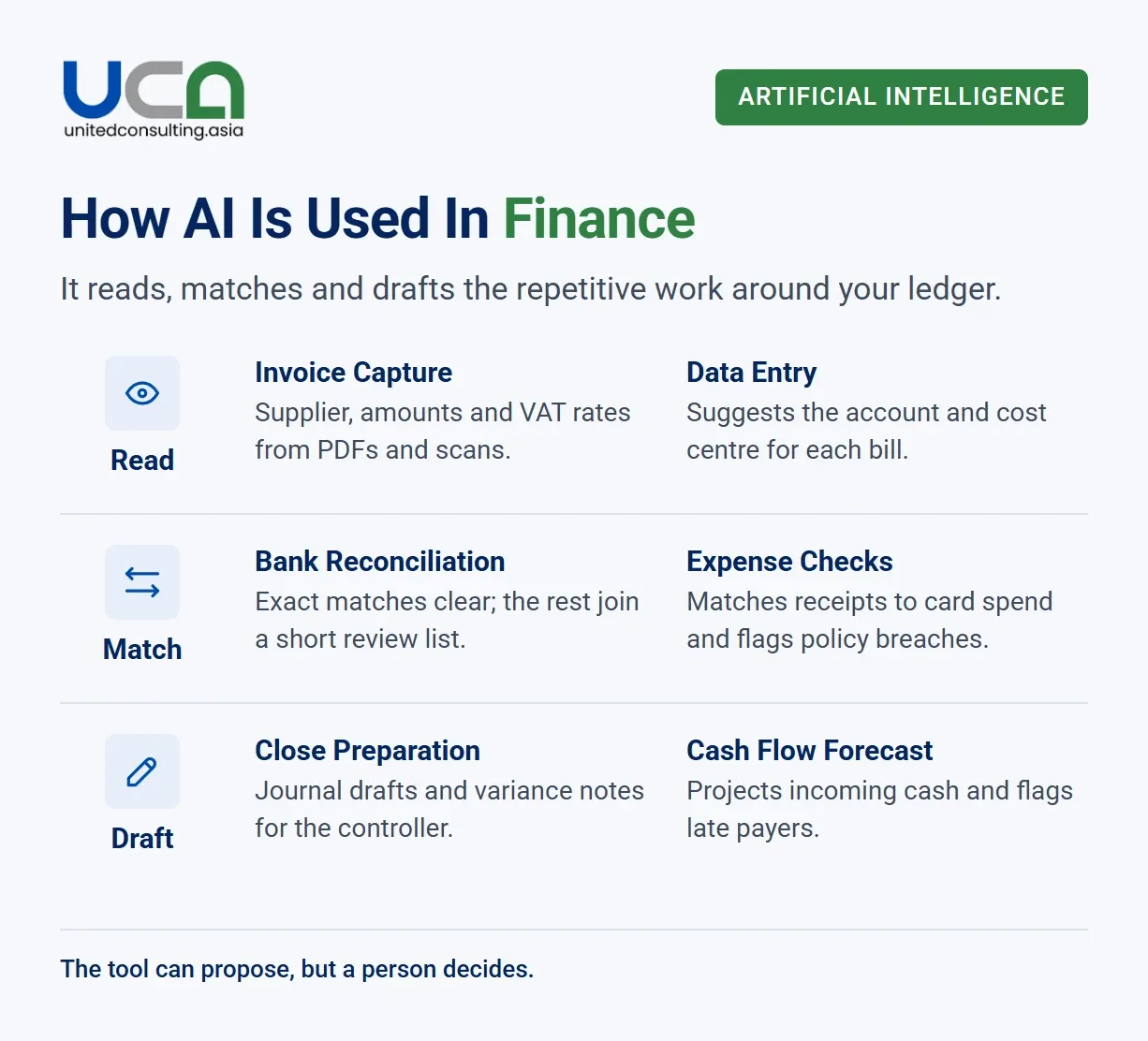
Supplier bills land in three inboxes, the bank feed never quite matches the ledger, and month end arrives with a pile of receipts nobody wants to read. If you run finance for a small team in Vietnam, that is where the month goes, and it is exactly the work AI in accounting and finance handles well.
The timing helps. Vietnam’s e-invoicing rules changed in July 2026, and the structured invoice data they require is far easier for software to read than a scanned PDF. This guide covers which workflows to automate first, what stays with people, and the deadlines to plan around. For the wider picture, start with our AI for business guide.
TL;DR - AI in finance and accounting does the reading, matching and first drafts: invoice capture, data entry, bank reconciliation, expense checks, close preparation and cash flow forecasts. People keep the judgement calls, approvals and sign-off. Start where errors stay visible and easy to reverse, and be clear about who owns the numbers, whether that is your own team or outsourced accounting support.
How Is AI Used in Accounting and Finance?
Mostly on the repetitive, rule-bound work around your ledger: reading invoices and receipts, matching transactions, and drafting variance notes for someone to check.
Not all of it is AI, strictly speaking. Capture and matching often run on rules-based automation (fixed if-this-then-that steps), with machine learning and generative AI layered on top.
Most products combine three capabilities.
- Machine learning. Classifies transactions from your posting history.
- Document capture. Reads PDFs and scans.
- Generative AI. Drafts commentary and answers plain-language questions about your numbers.
Which Finance Tasks Should Stay Human?
Anything that needs judgement or a signature. The tool can propose; a person decides.
That covers valuation calls, provisions, unusual tax treatments, payroll judgements, payment approvals and the final close sign-off. A model can notice that this month’s invoice looks different from last month’s. It cannot know the contract changed.
Can AI Automate Invoicing and Data Entry?
Yes, and for most small businesses it is the first win.
AI accounting tools can read supplier invoices in most layouts, though coverage depends on the tool. They pull out the supplier, invoice number, dates, amounts and value-added tax (VAT) rates, then suggest the account and cost centre.
That coding is what an outsourced accounting team would otherwise do by hand. The typing job becomes a checking job.
How Does Invoice Capture Work?
An invoice arrives as a PDF, a scan or a structured e-invoice. Capture software, often optical character recognition (OCR) plus a language model, extracts the fields, matches the bill to a purchase order where there is one, checks for duplicates and sends the odd ones (the exceptions) to a person.
Modern systems can also code the invoice and, depending on the product, learn from your corrections.
Accuracy is highest on clean digital files and lowest on poor scans and multi-line bills with mixed tax rates. So test any tool on a month of your own invoices before it touches the books.
If you want a second opinion on that first test run, our AI services team can help.
What Does This Look Like in Practice?
Take an illustrative case: a distribution company in Ho Chi Minh City with a two-person finance team and a few hundred supplier invoices a month. Most now arrive as e-invoices, with some PDFs from overseas suppliers. Before automation, one accountant spends the first week of every month keying them in.
With capture switched on, the e-invoices come in as structured data and are coded against each supplier’s usual account. The overseas PDFs go through OCR and land in a review queue. That week of typing turns into a short daily check of exceptions: a VAT rate that does not match the supplier’s history, a duplicate invoice number, a bill with no purchase order behind it.
The accountant still approves every posting. What changes is where the time goes: less keying, more attention on the few invoices that need a second look.
How Does AI Handle Bank Reconciliation?
The tool matches your bank feed against the ledger. Anything it cannot match, such as near matches, partial payments and missing references, lands on a short review list instead of in a month-end scramble.
Exact matches on amount, date and reference can clear themselves, though a clean match does not prove the transaction is right.
Modern bank feeds can also match payments to invoices automatically, so the daily work shrinks to a review.
What Happens to Unmatched Transactions?
The tool suggests an explanation (a timing difference, a missing entry, a duplicate payment) and drafts the adjustment for someone to approve.
Keep the match rules written down and open to review. An automatic match nobody can explain is worse than a manual one.
Can AI Manage Expenses and Receipts?
Yes, and it is one of the safest places to start, because every check stays visible.
For a small team the gain is simple: receipts stop living in personal inboxes and arrive in one place, coded the same way.
Expense management tools photograph receipts, extract the merchant, date, amount and tax, match them to card transactions and flag policy breaches before anyone is reimbursed.
In Vietnam that also gives you cleaner support for deductible costs under Vietnam tax compliance rules.
Three checks matter before anything posts.
- Genuine receipt. The document is real and matches the claim (flags surface duplicates and altered totals, but proving a document is genuine stays human).
- Right tax treatment. The category fits how the cost is treated for tax.
- Real approval. Someone other than the claimant signs off.
Each check is quick for a person to verify, but the tool cannot settle any of them on its own. Write your policy rules down so the software flags what your finance lead would.
Working out how much oversight your finance tools need? Email info@unitedconsulting.asia to talk through your controls.
Does AI Speed Up the Month-End Close?
Yes, mostly by clearing the backlog before the month-end close deadline rather than by anything clever on the night.
Reconciliations run through the month, journal entry drafts arrive with support attached, and variance commentary comes pre-written for the controller to edit. Teams that match transactions daily close faster, because most of the drafting is already done. Someone still reviews the exceptions, but they start from a tidy file instead of a hunt.
Much of the close still goes on chasing missing documents, waiting on approvals and rewriting the same explanations every month.
Software helps most with the first two: it flags gaps early and tracks the checklist. Keep a named reviewer for each account and a documented sign-off.
Can AI Support Cash Flow Forecasting?
It can support cash flow forecasting, but it should not own it.
Models read your payment history, invoice due dates and seasonal patterns to project incoming cash and flag customers who tend to pay late. The forecast becomes something you keep up to date, not a spreadsheet rebuilt from scratch each quarter, and the draft stays useful because people can question it quickly.
Every forecast has three parts.
- Baseline projection. Built from payment history and invoice due dates.
- Assumptions. Your estimates for timing and amounts.
- Scenario inputs. A late payer, a delayed contract, a tax payment date.
The machine does the arithmetic. Treat the output as a starting point, not a number to publish. To check whether the time saved justifies the tool, our guide to measuring AI ROI sets out a simple method.
How Do You Keep AI Accounting Accurate and Audit-Ready?
Before any tool goes live, ask for three things: who approves what, what gets logged, and how a number traces back to its document.
Your accountant can work with AI-assisted books when the controls are visible and easy to follow.
The business still owns the accuracy and compliance of its records under Vietnamese accounting requirements, so a good trail supports your accountant’s acceptance; it is not a guarantee.
Auditors look for maker-checker workflows (one person prepares, another approves) and a record of every change to the tool’s rules. In practice, keep these four records.
- Source and output. A timestamped record of what the tool saw and what it produced.
- Reviewer sign-off. Evidence of what a person checked before posting.
- Override log. Every case where a person changed or rejected the suggestion.
- Version notes. What changed when the tool or its rules were updated.
Never let a machine-generated entry post without a named reviewer, and write that rule into your team’s AI usage policy.
What Do Vietnam’s E-Invoicing Rules Mean for Your Books?
Vietnam’s e-invoicing rules are why structured invoice data is now the default. The current framework (Decree 254/2026 and Circular 91/2026) took effect on 1 July 2026, replacing the earlier Decree 123/2020 rules.
Businesses must register with the tax authority to use e-invoices. Most invoices also need a tax authority code, though some eligible businesses can issue them without one.
For your books, this is good news. E-invoices arrive as structured data, so capture tools read them cleanly and your records line up with what the tax authority receives. If your other records are still scattered across spreadsheets and inboxes, our checklist on whether your data is ready for AI is a good next step. For the tax side, see our Vietnam tax compliance guide.
What Are the Key Deadlines?
Three transition dates matter right now.
- 1 July 2026. Invoices printed by the tax authority stopped being valid.
- 31 December 2026. The last day paper receipts from the old framework may be used, so anything still printed on paper needs a plan this quarter.
- 1 January 2027. Unused paper receipts must be destroyed, and electronic receipts take over.
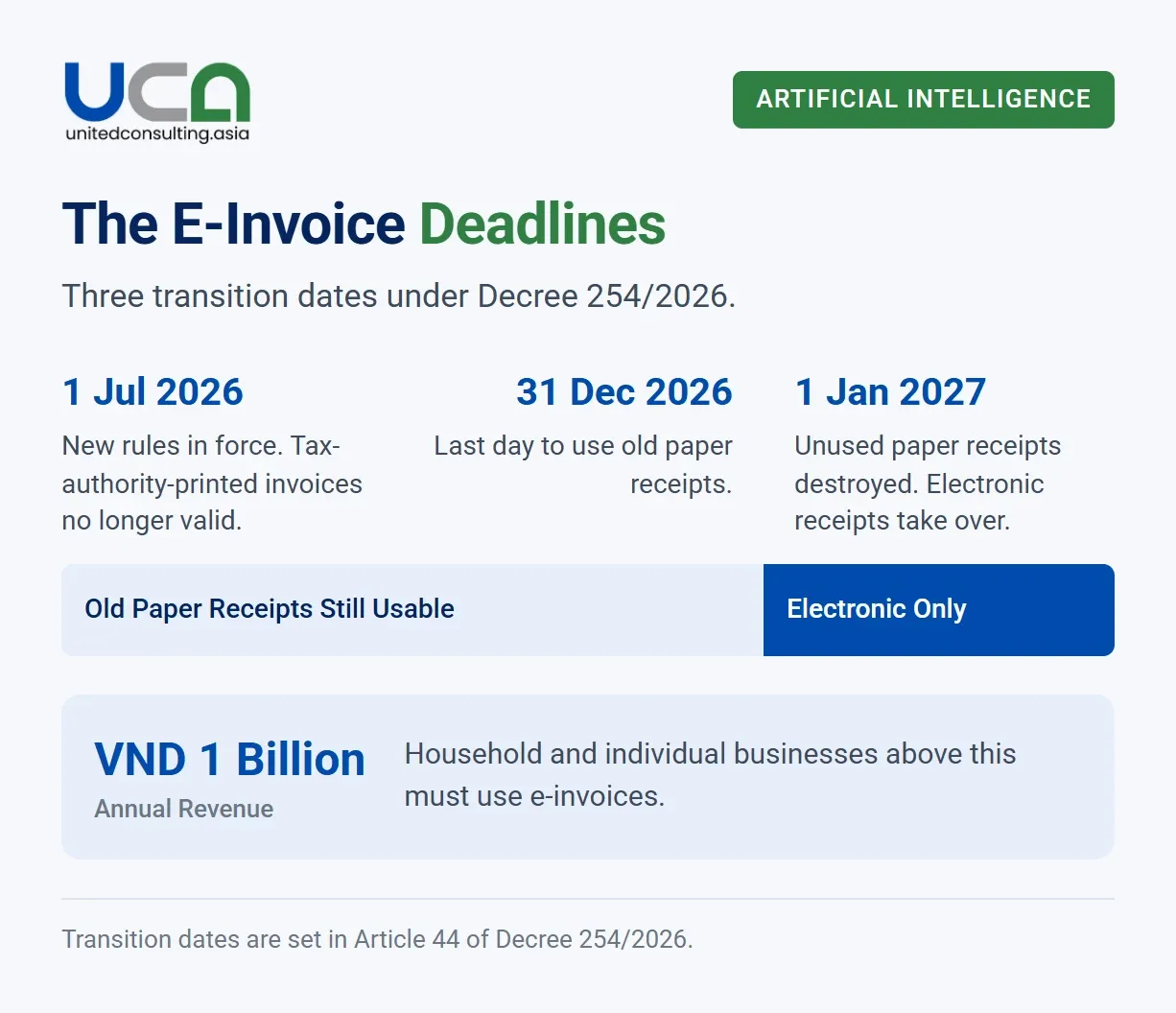
Invoices must also be issued on defined triggers, such as customs clearance or completion of a service. Household and individual businesses with more than 1 billion Vietnamese dong (VND) in annual revenue must use e-invoices.
Businesses that sell straight to consumers, such as retailers, restaurants and hotels, may also issue e-invoices through connected cash registers, under the decree’s registration arrangements.
The transition dates are set out in Article 44 of Decree 254/2026. If you are unsure whether your setup meets these requirements, we can help you check it.
How to Use AI in Accounting: Where to Start
Start where documents pile up and the rules are clear. For most small businesses, that means accounts payable: capture, coding and approvals.
- Pick one process, one reviewer and one month. Invoicing and reconciliation are the safest bets because mistakes stay visible and reversible.
- Run the new workflow beside the old one. Keep both going for a close or two, and keep every correction your reviewers make.
- Compare before you widen. Check the hours spent and the errors caught against the old process before you move to the next workflow.
On tools that learn from corrections, those edits also improve the next pass.
How United Consulting Can Help With AI in Accounting in Vietnam
Most finance teams we speak to are not short of ideas. They are short of time to set things up while still closing the books every month. Our FinAI work takes that setup off your plate, with a person approving anything that posts to the ledger.
Invoice Capture and Matching
We connect AI invoice capture to the accounting system you already run, so supplier invoices, including the structured XML data Vietnam’s e-invoicing rules now require, are read, coded and matched to purchase orders before anyone touches them.
Bank and Ledger Reconciliation Through the Month
Instead of a month-end scramble, reconciliation runs continuously and unmatched items land on a short review list. The result is a faster close and audit-ready reporting your accountant or auditor can follow line by line.
Cash Flow Forecasting Your Finance Lead Can Trust
We set up forecasts built on your own payment history and invoice due dates, with your finance lead reviewing every projection. A half-day workshop gets the team comfortable with the new tools before they rely on them.
Every engagement starts the same way: a free 30-minute discovery session, then one pilot with the outcome agreed before we begin. A wider rollout follows only once the numbers hold up. Read more about FinAI for finance and accounting.
Conclusion
AI in finance and accounting works best on document-heavy, rule-bound work: invoices and data entry, reconciliation, expenses and forecast drafts.
Keep judgement, approvals and signatures with people, keep a review trail your accountant can follow, and plan for Vietnam’s e-invoicing deadlines.
Thinking about entering or expanding in Vietnam? Contact United Consulting at info@unitedconsulting.asia to map how AI in finance fits your plans.
Frequently Asked Questions
How is AI used in accounting?
AI is mostly used for the repetitive work around the ledger: reading invoices and receipts, coding transactions, matching bank lines to the books and drafting variance notes. Machine learning classifies transactions from your posting history, and generative AI drafts commentary. A person still reviews and approves what gets posted.
Will AI replace accountants?
No. AI takes over data entry, matching and first drafts, but judgement calls, tax treatments, approvals and the final sign-off stay with people. For most small businesses, the accountant’s job shifts from typing to checking.
Which accounting tasks should a small business automate first?
For most small businesses, accounts payable comes first: invoice capture, coding and approvals. Mistakes there stay visible and easy to reverse. Run the new process beside the old one for a close or two before you rely on it.
Is e-invoicing mandatory in Vietnam?
Yes, for most businesses. The current rules under Decree 254/2026 took effect on 1 July 2026, and household and individual businesses with annual revenue above VND 1 billion must also use e-invoices. Paper receipts from the old framework may be used only until 31 December 2026.
Is AI accounting software accurate?
It is most accurate on clean digital files and structured e-invoices, and least accurate on poor scans and multi-line bills with mixed tax rates. Test any tool on a month of your own invoices before it touches the books, and keep a named reviewer for every posting.