The demo impressed you. The invoice did not. Between the subscription, the setup and the hours your team spends getting the tool to behave, the monthly bill keeps growing while the promised savings stay vague. That gap is the return on investment (ROI) question for artificial intelligence (AI), and this guide shows you how to measure AI ROI before the bill makes the decision for you.
It is written for small-business owners in Vietnam working to a budget: what AI really costs, which numbers to track, how to run a pilot and when to walk away. For the wider picture, see our AI for business guide.
TL;DR - AI is worth the investment when you treat it like any other purchase: measure the work before you buy, count every cost, and judge results against a number set in advance. The real spend covers tools, setup, training and your team’s time. Most corporate pilots fail because teams never learn to use the tools well, not because the technology breaks. Pick one workflow from our practical AI use cases, freeze a baseline, run a small pilot, and scale only what beats the numbers.
How Much Does AI Cost a Small Business?
More than the sticker price, and less than the scare stories. For most small firms the realistic first-year figure is the subscription plus setup, training and the staff time that never appears on a vendor invoice. The monthly price is usually the smallest part of that total.
Start with the tools. Off-the-shelf AI tools run from tens of dollars a month for a simple assistant to a few hundred for something like a customer-service chatbot, and prices change often. Then add the cost of your team.
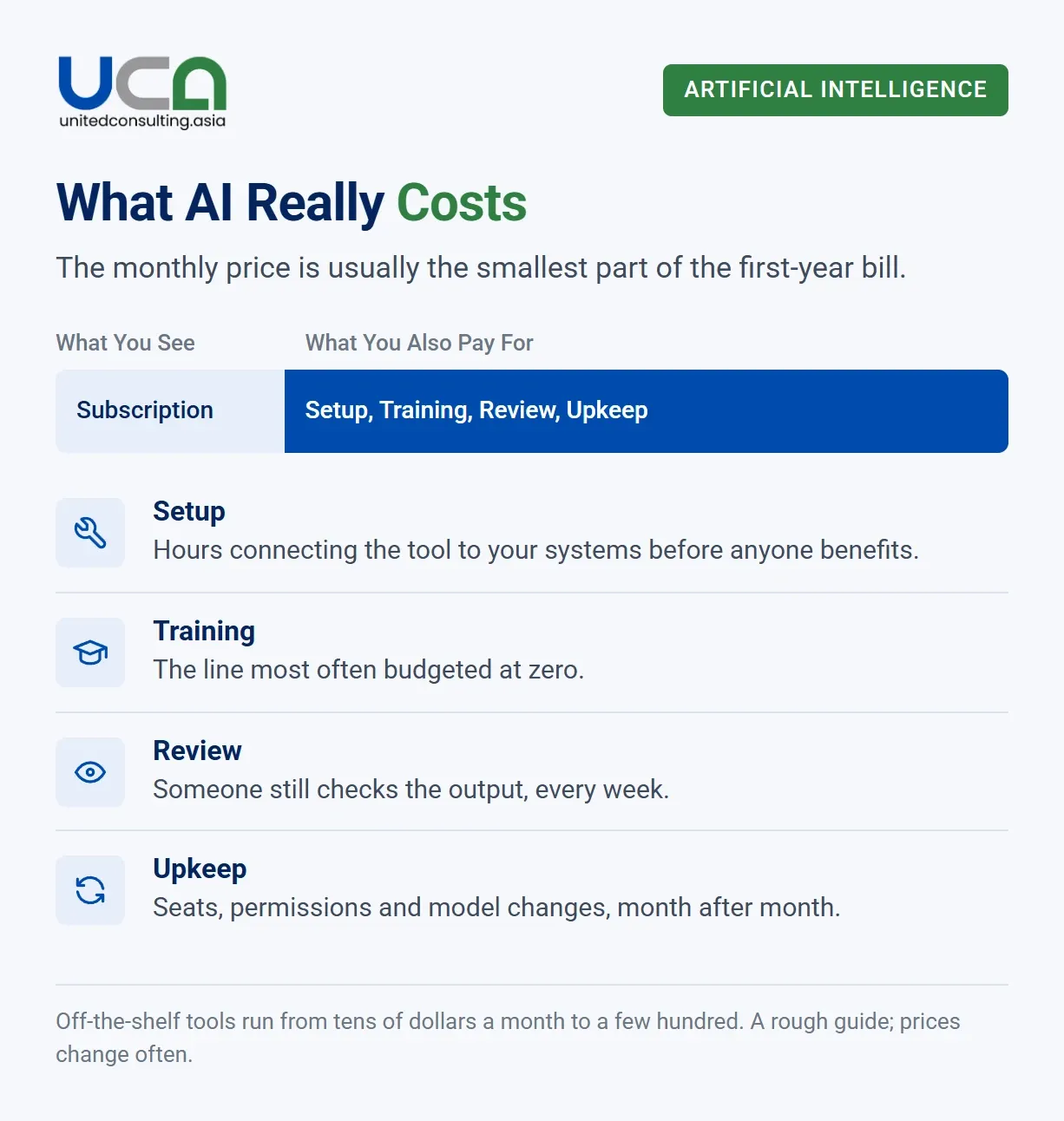
- Setup and integration. Connecting the tool to your systems takes someone’s hours before anyone benefits. No invoice shows those hours, but they are still a cost.
- Training. A small team needs real time to learn the tool, sometimes with outside help, and this is the line most often left at zero. Our guide to using AI at work covers what that training should include.
- Human review. Someone still has to check the output, so review time belongs in the cost column, not the footnotes.
- Ongoing upkeep. Seats, permissions, model changes and admin carry on after launch, month after month.
How to Measure AI ROI in Your Business
Measure the work, not the tool. Choose one business process, record how it performs today, then compare the AI-assisted version against that record. Every useful small-business ROI metric is a before-and-after number.
Freeze that baseline (the before-numbers for the task) before anyone touches a tool. Record volume, minutes per item, error rate and cycle time over 2 to 4 weeks, because memory tends to exaggerate how painful the old way was. If the pilot has already started, rebuild the baseline from timestamps, ticket logs or samples of earlier work.
What Metrics Should You Track?
Track five numbers and stop there. Each one tells you something the others cannot, and one number you actually check beats a dashboard nobody reads.
- Time saved. Baseline minutes per item minus new minutes per item, including review time, times weekly volume.
- Error and rework rate. The share of items needing a correction, a resend or a second touch, before and after.
- Throughput. Work finished per person or per week while quality holds.
- Cycle time. Clock time from trigger to done, such as a lead arriving to the first response going out.
- Revenue impact. Extra conversions or retained customers, judged on contribution margin (what is left from each sale after the extra costs of that sale) rather than gross revenue.
Two sums turn those metrics into money. ROI is the benefit minus the cost, divided by the cost. The payback period in months is the total cost divided by the net monthly gain, once ongoing costs are counted.
Here is how that works with round numbers. Invoice processing takes 10 hours of admin a week, and that time costs about $10 an hour once pay and employment costs are included. A tool cuts the job to 6 hours, review included. That saves 4 hours a week, or roughly $170 a month.
Take off a $30 subscription and $40 a month of upkeep and about $100 a month is left, so a $600 setup pays back in around 6 months. Over the first year that is roughly $2,040 of time saved against $1,440 of total cost (the setup plus twelve months of subscription and upkeep), an ROI of about 42%. Your own figures will differ, so run the same sums on your numbers. Our guide to AI in finance and accounting covers invoice work like this in more depth.
What If the Savings Are Not Mostly Hours?
In Vietnam, where average monthly incomes are around 8 million VND, the hours saved can look small once you put a dollar figure on them. That does not mean the tool is failing. The bigger return is often somewhere else.
- Faster turnaround. Replies, quotes and invoices go out sooner. Value that as cash arriving earlier, or as deals you stop losing to slow responses.
- Fewer errors. Count the rework, refunds and late fees that stop happening, and value each at what it cost you last time.
- Volume without a new hire. If the same team now handles more orders or tickets, value it as the salary you did not have to add.
Here is what that looks like in practice. Picture a small distributor in Ho Chi Minh City that answers 40 quote requests a month, usually by the next afternoon. An AI drafting tool gets replies out within the hour. At local wages the hours saved are worth little, but if faster replies win two extra orders a month, the margin on those orders can cover the tool on its own.
Give each of these benefits a cautious figure and mark it as estimated, not measured, until your sales or order data confirms it. A pilot that pays back on hours alone is a bonus. One that also pays back on these three makes a strong case.
Working out the numbers for your own first AI project? Email info@unitedconsulting.asia and we will map your baseline.
How Do You Run a Small AI Pilot Before Committing?
Pick one workflow with a clear unit of work and one named owner. If you are not sure which, our guide to what to automate first will help you choose.
Then keep the test fair. Hold the people and the volume steady, decide the success number in advance, and count every cost at the end.
If you would rather buy that discipline than build it, see the AI services we provide. We run discovery, pilot and rollout as fixed stages, with the measurement designed in from day one.
Run the pilot in three steps.
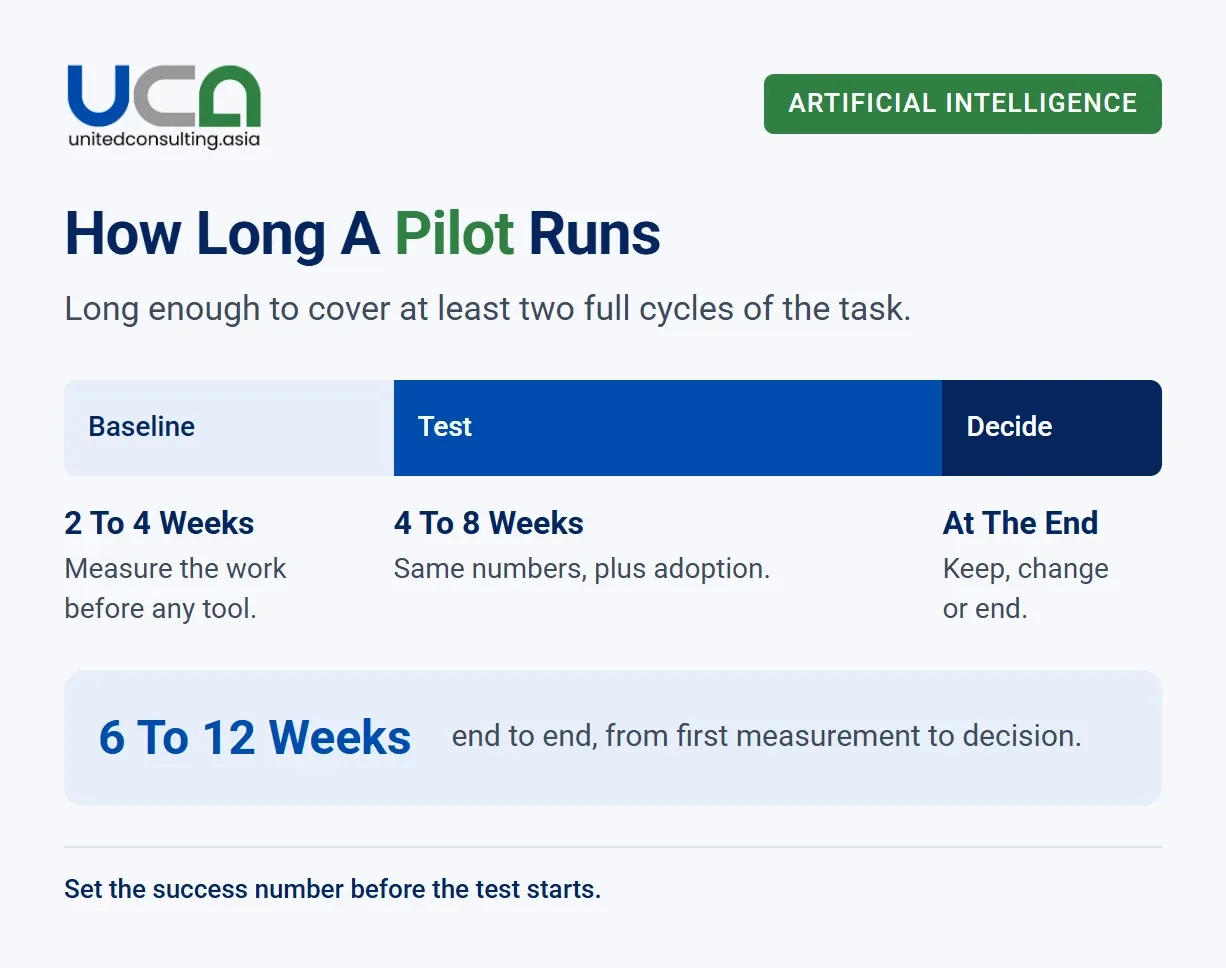
- Baseline. Measure the work itself, not the goal: minutes to first response, hours of admin per week, cost per task.
- Test. Measure the same numbers afterwards, including adoption: what share of eligible work actually went through the new flow.
- Decide. Keep, change or end the test. Keep it if it beats the target at full cost. Change it if it comes close and one fixable problem, such as slow review or low adoption, is holding it back. Otherwise, end it.
How Long Should an AI Pilot Run?
Long enough to cover at least two full cycles of the task. In practice that means a 2 to 4 week baseline followed by a 4 to 8 week test, so 6 to 12 weeks end to end.
How Do You Know If AI Is Worth the Investment?
AI is worth the investment when it beats the number you set before the pilot, at full cost, with ordinary staff using it under normal conditions. Anything that cannot show that when the window closes is a waste.
This matters more than it sounds. About 95% of enterprise generative AI pilots showed no measurable impact on profit and loss in MIT research based on around 300 public AI deployments and interviews with business leaders.
Read that as a signal from large companies, not a survey of small and medium-sized enterprises (SMEs). The researchers traced the failures to a learning gap in how firms used the tools, not to the models themselves.
What Are the Warning Signs an AI Tool Is Not Working?
Watch how the work behaves, not the mood in the demo. Four patterns show up early, and each one appears in the numbers you already track.
- Adoption stalls. Only the champion uses it, and eligible work slips around the new flow.
- Review eats the savings. Checking the output takes as long as doing the job by hand.
- Error rate creeps up. You bought speed and started paying for corrections.
- The target keeps moving. Success gets redefined after the results come in.
What ROI Can a Small Business Realistically Expect From AI?
Expect a clear edge in one workflow, not a transformed company. The same research points one way on buying versus building: among the firms interviewed, buying from specialist vendors or partnering succeeded about 67% of the time, while in-house builds succeeded only about a third as often, roughly 22%. So buy before you build, and expect the return to show in months rather than weeks.
A realistic first year looks modest: one measured win, a shortlist of experiments that failed cheaply, and the habit of checking the numbers before renewing a subscription. The tools will change. Your baseline discipline stays.
When Is AI Not Worth the Investment?
When the task is low volume, when no single person owns the outcome, or when nobody can say what better looks like before you start. It is also too early if the records the tool needs are scattered or unreliable, so check whether your data is ready for AI first.
If you cannot name the number that would justify continuing, changing or ending the test, you are not ready to buy. Mark every input as measured, estimated or unknown before you trust the answer.
How United Consulting Can Help You Measure AI ROI
It is hard to judge a tool fairly when the same people who chose it are the ones too busy to measure it. An outside view keeps the numbers honest and the decision quick.
A Baseline Before You Spend
In a focused review we record how one workflow performs today, in hours, errors and cost per task, and agree the number that would justify continuing. That number is fixed before any tool is bought.
A Pilot Measured With You
We run one pilot, whether that is a workshop, a single agent or one automated workflow, with weekly progress logs against the baseline. At the end you get a clear keep, change or stop decision.
Costs That Stay Predictable as You Scale
If the pilot works, we plan the capacity and hosting the next stage needs, so the monthly bill grows in line with the value and does not surprise you three months in.
Every engagement starts the same way: a free 30-minute discovery session, then one pilot with the outcome agreed before we begin. A wider rollout follows only once the numbers hold up. Find out more about how AI pilots and rollouts work with us.
Conclusion
AI earns its place one workflow at a time. Freeze the baseline before you spend, count the full cost, and let the AI ROI numbers decide what gets scaled. That habit keeps a pilot fair, whatever the size of your budget.
Thinking about entering or expanding in Vietnam? Contact United Consulting at info@unitedconsulting.asia to map how measuring AI ROI fits your plans.
Frequently Asked Questions
How do you calculate the ROI of AI?
Subtract the total cost from the benefit, then divide by the total cost. The cost should include the subscription, setup, training, review time and upkeep, and the benefit should come from before-and-after measurements of one workflow, such as hours saved, fewer errors or faster turnaround. The payback period is the total cost divided by the net monthly gain.
How long does it take to see ROI from AI?
For a small business, expect months rather than weeks. A fair pilot takes 6 to 12 weeks: a 2 to 4 week baseline and a 4 to 8 week test. A simple tool that saves a few hours of admin a week can pay back its setup in around six months.
Why do most AI projects fail to deliver ROI?
In MIT research, about 95% of enterprise generative AI pilots showed no measurable impact on profit and loss. The main cause was a learning gap in how firms used the tools, not the technology itself. Projects without a baseline, an owner or a target set in advance rarely show a return.
Is AI worth it for small businesses?
It is when the task is frequent, one person owns the outcome, and you can say in advance what success looks like. It is usually not worth it for low-volume work, or when the data the tool needs is scattered and unreliable. Start with one workflow and a small pilot rather than a company-wide rollout.
What metrics should you use to measure AI success?
Track five numbers: time saved (including review time), error and rework rate, throughput, cycle time, and revenue impact judged on contribution margin. Measure each one before and after the AI tool is introduced. Also track adoption, the share of eligible work that actually goes through the new process.