Two promising leads went quiet this week because nobody followed up. Closing gaps like that is what artificial intelligence (AI) agents are built to do, and this guide to AI agents for business shows how.
If you run a small business in Vietnam or elsewhere in Southeast Asia, the gap usually hides in one repetitive corner of the week. A shortlist of candidates sits unread. The operations dashboard only gets checked once something has already gone wrong.
It explains what an AI agent is, which jobs it can run for you, and where your team stays in the loop, which Vietnam’s Law on Artificial Intelligence treats as a basic principle.
TL;DR - An AI agent pursues a goal end to end: it reads the situation, picks the next step and acts. A chatbot only replies and scripted automation only repeats a fixed flow, while an agent works the whole loop and adapts, within fixed tools and permissions. Agents can take on sales follow-up, human resources (HR) screening and operations monitoring while people keep the judgement calls. Our guide to AI for business in Vietnam gives the wider picture.
What Is an AI Agent for Business?
An AI agent is software that works towards a goal on its own. It takes in data, works out the next step and carries it out through connected tools such as your customer relationship management (CRM) system or your inbox.
Ordinary software follows the steps it was given. An agent reasons about what it sees, uses tools to act and changes course when conditions change. The umbrella term for this is agentic AI: systems in which agents plan and act towards goals instead of waiting for instructions.
Building agents is a different job from turning a manual process into an automated flow. If you want the workflow side first, start with AI workflow automation.
How Is an AI Agent Different From a Chatbot?
A chatbot answers questions inside a conversation and stops when the chat ends, although modern chatbots can also call tools and trigger workflows.
An agent treats the conversation as input and then acts on it. It updates a record, sends a drafted reply, books a meeting or flags an exception for review. Put simply, chatbots write replies and agents complete work across your tools.
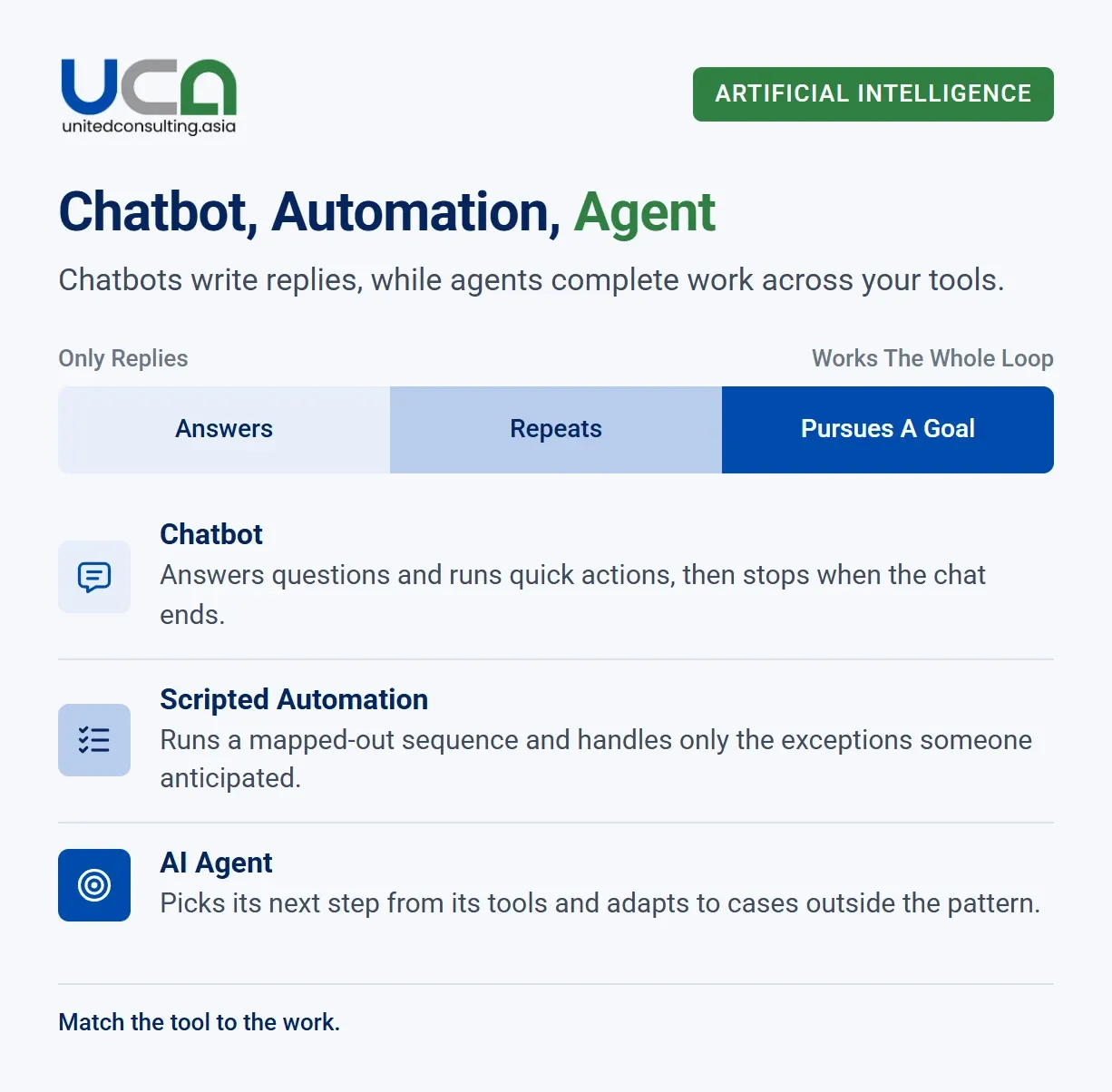
- Chatbot. Answers questions and can run quick actions like booking a meeting, but stops when the chat ends.
- Scripted automation. Repeats a mapped-out sequence and handles only the exceptions someone anticipated.
- AI agent. Works towards a goal, picks its next step from the tools it has and adapts to cases outside the pattern.
Match the tool to the work. If the steps never change, scripted automation is cheaper and easier to trust.
What Can AI Agents Do for Your Business?
An agent can own a complete task loop. It notices the trigger, gathers the context, decides, acts and follows up until the task closes or a person takes over.
What it cannot own is the judgement around the loop. It can propose the discount, draft the contract email or rank the shortlist. Anything that spends money, commits the company legally or reaches a customer still needs approval, and the next section shows where those checkpoints go.
Where Do the Human Checkpoints Go?
Put checkpoints where mistakes become expensive or hard to reverse. A common way to grade agents runs from simply watching to acting alone: observe, advise, act with approval and act autonomously.
The more an agent does without help, the more deliberate the guardrails and human spot checks need to be.
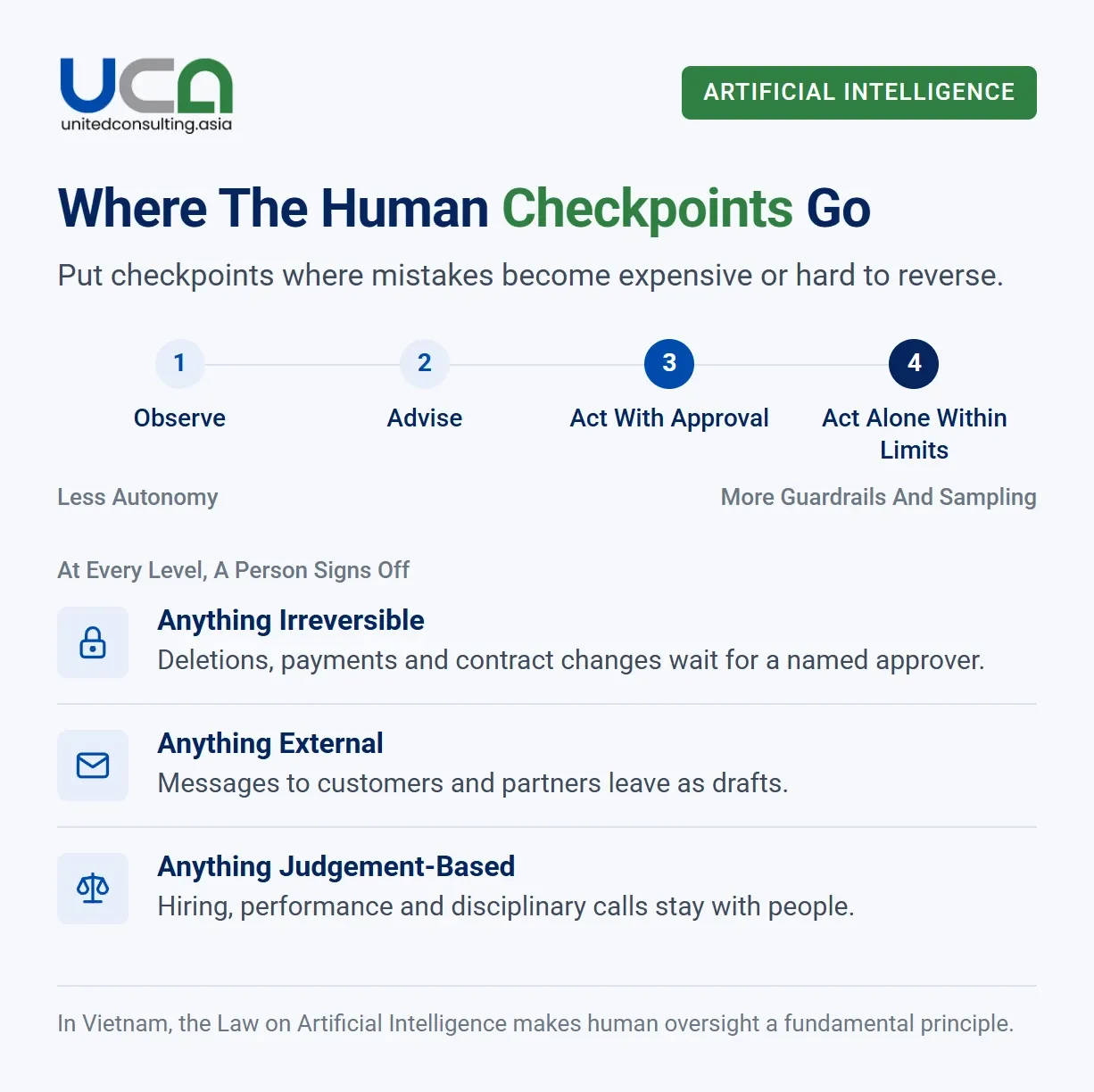
- Anything irreversible. Deletions, payments and contract changes wait for a named human approver.
- Anything external. Messages to customers and partners leave as drafts until a person releases them.
- Anything judgement-based. Hiring, performance and disciplinary calls stay with people, with the agent limited to gathering and summarising evidence.
In Vietnam, checkpoints are also a legal expectation. The Law on Artificial Intelligence (Law 134/2025), in force since 1 March 2026, makes human oversight a basic principle and applies to foreign organisations running AI activities in the country.
Outside those three areas, agents can run with lighter oversight matched to the actual risk: proportionate checkpoints, continuous monitoring and a way to roll back.
Not sure where an AI agent would fit in your operations? Email info@unitedconsulting.asia to talk through a first use case.
What Are the Best AI Agent Use Cases for Small Businesses?
Today, AI agents for business handle three jobs well: sales follow-up, HR screening support and operations monitoring.
Each is high-volume, close to clear rules and easy to check, which suits a small business where nobody has time to babysit a tool. Work like that is where an agent earns more responsibility.
Which Jobs Do AI Agents Handle Well Today?
In sales, an agent watches the pipeline for leads that have gone quiet, researches the account and drafts a personalised follow-up in your tone.
It stops when a reply lands and hands the conversation to a salesperson. It also flags deals past their expected close date, so nothing depends on someone remembering. For a five-person sales team, that alone can stop leads going cold in a busy week.
In HR, screening shows the pattern. The agent reads each application as it arrives, pulls out the skills and experience, and scores candidates against a consistent rubric with its reasoning on the record. Recruiters review a ranked shortlist, and every hiring call stays human.
Candidate data carries duties of its own. Article 25 of Vietnam’s Personal Data Protection Law requires the data to be relevant to the purpose, collected with consent and deleted when a candidate is unsuccessful, unless agreed otherwise. Uploading CVs to an overseas AI platform also brings cross-border transfer duties.
In operations, a monitoring agent watches stock levels, invoices or service dashboards, compares them with normal patterns and raises a flagged case with the evidence attached.
It proposes the fix, such as moving stock between locations, and a person approves it. Monitoring only works when the underlying records are consistent, so clean master data comes first.
What Should an AI Agent Not Own Yet?
Even a proven agent should hold back on anything that rests on unreliable records or needs real human sympathy.
Customer promises that carry legal weight, such as refunds, price commitments and contract terms, stay with people too. Our guide to AI in customer service covers where that human handover should sit.
What Are the Risks of Using AI Agents in Business?
Agents fail in predictable ways: confident wrong answers, actions taken on stale data (facts that have since changed), endless loops and permissions far wider than the job needs. Plenty of real-world AI breakdowns follow these same patterns.
That is a reason to design the boundaries first, not a reason to avoid agents.
The risk compounds quietly. One wrong action looks harmless, but an agent working at machine speed can repeat it across hundreds of records before anyone notices.
Which Guardrails Actually Work?
- Scoped access. The agent gets only the tools and records the job needs, under its own identity rather than a shared login.
- Verification before action. Consequential steps re-read the live value from the system of record (the database that holds the official version) instead of trusting the agent’s memory.
- Full logging. Every decision and tool call is recorded, so a wrong outcome can be traced and corrected.
Add a kill switch and a review habit: sample the agent’s output weekly and widen its access only while the sample stays clean. Our AI services team can help you put these controls and human checks in place before an agent touches real work.
How to Use AI Agents for Business: Where to Start
Start small and prove the pattern before you widen it. For a small business that usually means one agent, one task and one person checking its work.
- Pick one bounded, high-volume task. Choose work where a mistake is cheap to reverse, and give the agent a narrow goal rather than a vague mandate.
- Run it beside the current process. Keep the old path going for a few weeks before the agent acts without a reviewer on every step.
- Decide the checkpoints before launch. Write down which actions need approval, who gives it and what the agent does when it is unsure.
While trust is being built, stopping and escalating is the safe default. Teams that get this right also agree how staff should question an agent’s output, which our guide to using AI at work covers.
What Makes a Good First Agent?
- A clear trigger. The task starts from an obvious event, such as a new lead arriving or a new application landing.
- A measurable finish. You can say when the task is done and whether it was done well, which makes measuring the return straightforward.
- A cheap mistake. If the agent gets one case wrong, a person can spot it and undo it in minutes.
What this looks like in practice. A distributor with a five-person sales team might start with the quiet-lead follow-up described above. The trigger is a lead with no reply after a set number of days. The finish is a drafted follow-up that a salesperson approves and sends. A bad draft costs one click to discard. After a few weeks of clean samples, the team can let the agent send routine reminders on its own and keep approval for anything involving price.
How Do You Choose an AI Agent Development Company in Vietnam?
Many businesses in Vietnam will not build agents in-house, so the choice of partner matters. Judge an AI agent developer on how it handles the risks above, not on the demo.
- Checkpoints in the proposal. A good partner shows where approvals, logging and the kill switch sit before quoting a price.
- A small first scope. Expect a pilot on one task with a measurable finish, not a company-wide rollout.
- Vietnamese compliance. The partner should explain how the build meets the Law on Artificial Intelligence and the Personal Data Protection Law, including where data is processed.
- Clear ownership. Agree in writing who owns the code, the prompts, the logs and the system access once the project ends.
How United Consulting Can Help You Build AI Agents in Vietnam
The gap between a demo agent and one your team trusts with real customers comes down to ownership, limits and monitoring. That is where we put most of our effort.
Your First Agent, Scoped Around One Job
We start with the team that feels the pain most, whether that is sales follow-up, HR screening or operations monitoring, and build one agent for one bounded task. You agree the success measure with us before any build begins.
Guardrails Built In From Day One
Every agent ships with a named owner, clear limits on what it can do alone and a log of what it did. We design its access so it can touch only what the job needs, and test it for prompt injection and other agent-specific risks before it goes live.
From One Agent to Several Teams
Once the first agent has proved itself, we extend the pattern to the next team, from go-to-market and HR to operations and software development, with weekly progress logs. The same approach reaches the finance function too, where AI in accounting starts with invoices and reconciliation.
Every engagement starts the same way: a free 30-minute discovery session, then one pilot with the outcome agreed before we begin. A wider rollout follows only once the numbers hold up. See how agentic AI for enterprises works in practice.
Conclusion
AI agents for business are neither a bigger chatbot nor a replacement for your team. They work best on clearly defined jobs.
Keep judgement calls human and every action traceable. Start narrow, widen deliberately, and any failures stay small enough to fix.
Thinking about entering or expanding in Vietnam? Contact United Consulting at info@unitedconsulting.asia to map how AI agents fit your plans.
Frequently Asked Questions
What are AI agents used for in business?
The most common uses today are sales follow-up, screening job applications and monitoring operations such as stock levels or invoices. In each case the agent watches for a trigger, gathers context, drafts or proposes an action and hands anything consequential to a person for approval.
What is the difference between an AI agent and a chatbot?
A chatbot answers questions inside a conversation and stops when the chat ends. An AI agent works towards a goal across your tools: it updates records, drafts replies, books meetings and flags exceptions. Chatbots write replies; agents complete work.
Can AI agents replace employees?
Not for work that needs judgement. Agents take over repetitive steps such as chasing leads or sorting applications, but hiring decisions, customer commitments and anything irreversible should stay with people. In Vietnam, the Law on Artificial Intelligence also makes human oversight a basic principle.
How do I choose an AI agent development company in Vietnam?
Look for a partner that proposes a small pilot on one task, shows where human approvals and logging sit, and can explain how the build complies with Vietnam’s AI and personal data laws. Agree in writing who owns the code, logs and system access. United Consulting’s AI services cover agent builds with these controls in place.
Are AI agents safe for small businesses?
They are safe when the boundaries are set first. Give the agent only the access its task needs, log every action, keep a kill switch and review a sample of its work each week. Start with a task where a mistake is cheap to undo.