It is Monday morning, and your newest hire has just pasted a customer complaint into a free artificial intelligence (AI) chatbot to draft a reply. Nothing exploded. But customer data has left the building, and nobody can say whether that was allowed under Vietnam’s data protection law. Learning how to use AI at work safely is mostly about preventing moments like this one.
This is the people side of AI: literacy, rules and habits. For the wider picture, our guide to AI for business in Vietnam sets the scene.
TL;DR - Employees can use AI safely when three things are in place: clear rules on what staff may and may not do, basic AI literacy training so people can spot weak output, and hands-on practice on real tasks rather than one-off lectures. A one-page AI usage policy beats a legal-style document nobody reads. One habit covers the most common risk: never paste personal or confidential data into a public tool.
How to Use AI at Work: Where Employees Should Start
Used well, AI saves hours. Used blindly, it can cost you a client.
Point it at first drafts, summaries, research and repetitive writing, and have a person check every output before it leaves the building. Treat it as a fast junior colleague who never gets tired and never admits doubt. The checking stays with you.
Once you want AI to run whole processes rather than single drafts, the mechanics start to matter. Our guide to AI workflow automation explains how that works.
Three habits keep a small team safe from day one.
- Check everything. AI output is a draft. Facts, figures and promises need a human before they go out.
- Stay on approved tools. Consumer accounts without data controls are the fastest route to a data leak.
- Say when AI helped. If AI drafted part of a client deliverable, tell the team, so reviewers know where to look first.
Which Tasks Are Safe to Start With?
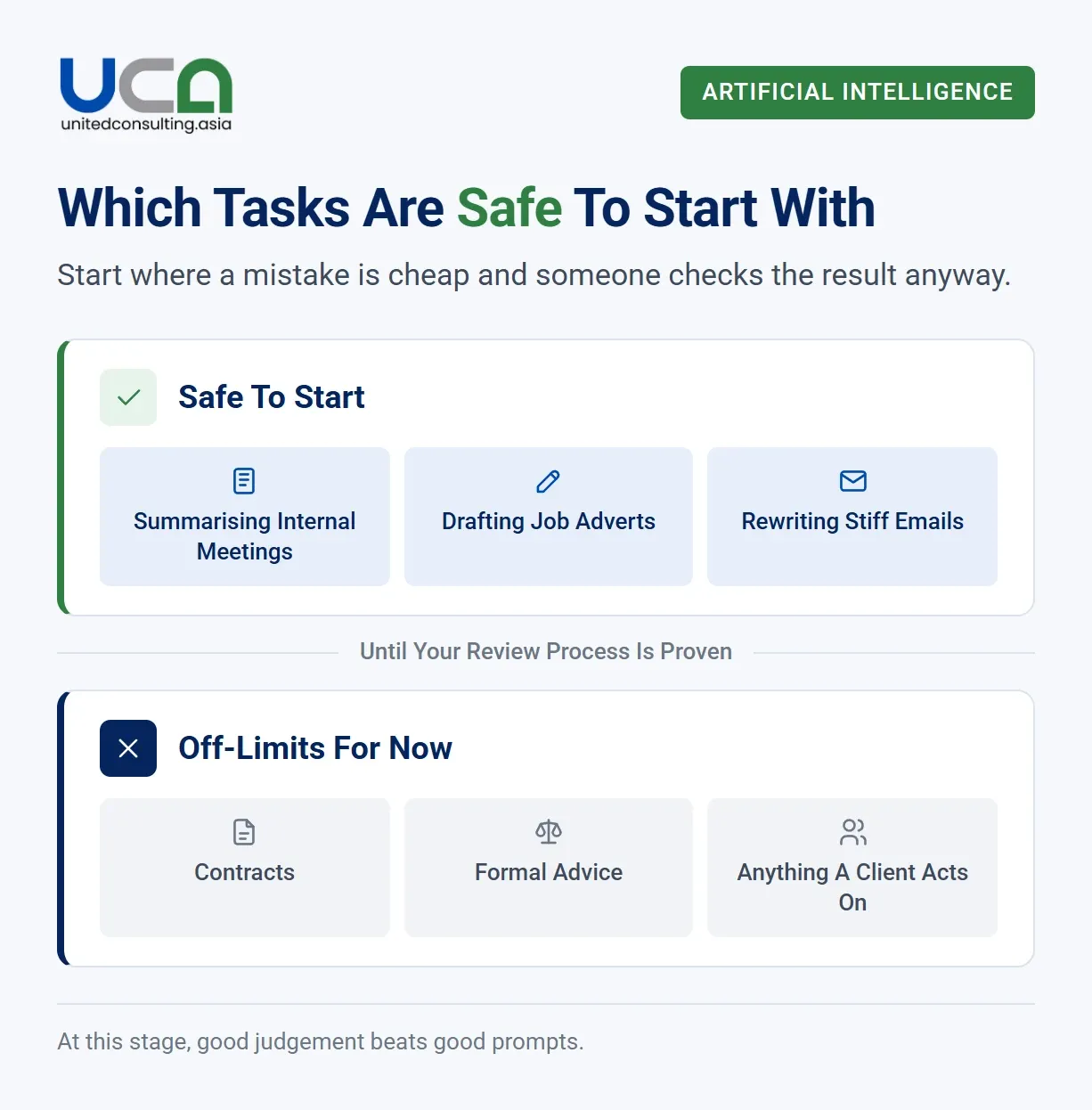
Start where a mistake is cheap and someone checks the result anyway. Summarising internal meetings, drafting job adverts and rewriting stiff emails all qualify.
Keep contracts, formal advice and anything a client acts on out of scope until your review process is proven. At this stage good judgement matters more than clever prompts, and judgement is what AI literacy builds.
In practice, that might look like a sales coordinator at a Hanoi distributor turning rough call notes into a tidy follow-up email in Vietnamese and English, or a finance assistant summarising a long supplier thread before a meeting. Both use the company’s approved tool, and both read the result before anything goes out.
What Is AI Literacy and Why Does Your Team Need It?
One confident, wrong paragraph can cost you a client. AI literacy is the ability to use AI with judgement: knowing what these tools do well, where they fail, and how to check their work.
Everyone on the team needs it, not just the tech team. European Union law defines it simply as the skills, knowledge and understanding people need to use AI responsibly, and that plain definition fits a small business better than any engineering syllabus.
The trouble is that fluent output hides weak thinking. A paragraph can read perfectly and still be wrong, out of date or lifted from another website. People who cannot tell the difference will send it anyway.
What Does AI Literacy Cover in Practice?
Four skills carry most of the value, and they are the ones that stop the expensive mistakes.
- Knowing the limits. AI is strong at drafting and summarising, and weak at numbers, local law and anything that changed last week.
- Writing useful instructions. Vague prompts get vague answers. Good prompts give context, a format and a clear task.
- Spotting invented facts. AI will confidently cite sources that do not exist, a failure known as hallucination.
- Handling data safely. Literate staff know which data a tool may touch and which it may not.
None of this needs a computer science degree. It takes a few hours of guided practice and a shared vocabulary. The AI literacy training we provide covers all four skills, using your own work as the material.
What Should Employees Never Do With AI at Work?
Four careless habits carry most of the risk. Each takes seconds, and any one of them can cost you a customer.
- Never paste personal or confidential data into a public tool.
- Never publish unreviewed output.
- Never hide AI use where a client expects human judgement.
- Never let a model make the final call on legal, financial or people decisions.
Vietnam’s AI Law (Law 134/2025), in force since 1 March 2026, makes human oversight a fundamental principle. That is exactly what the last rule protects.
The data rule is more than housekeeping, and it applies to foreign-owned companies exactly as it does to local ones. Under Vietnam’s data protection law (Law 91/2025) and its guiding Decree 356/2025, in force since 1 January 2026, sending customer or employee data through an AI tool counts as processing personal data, and your business stays responsible for protecting it. Staff files, contracts and identity numbers all fall under it.
Using AI tools with real business data and unsure where the line is? Email info@unitedconsulting.asia to talk through your safeguards.
How Do You Write an AI Policy for Employees in Vietnam?
A policy on how to use AI at work protects nobody until people read it. Start with one page of plain English, not a legal appendix. Five things belong on that page.
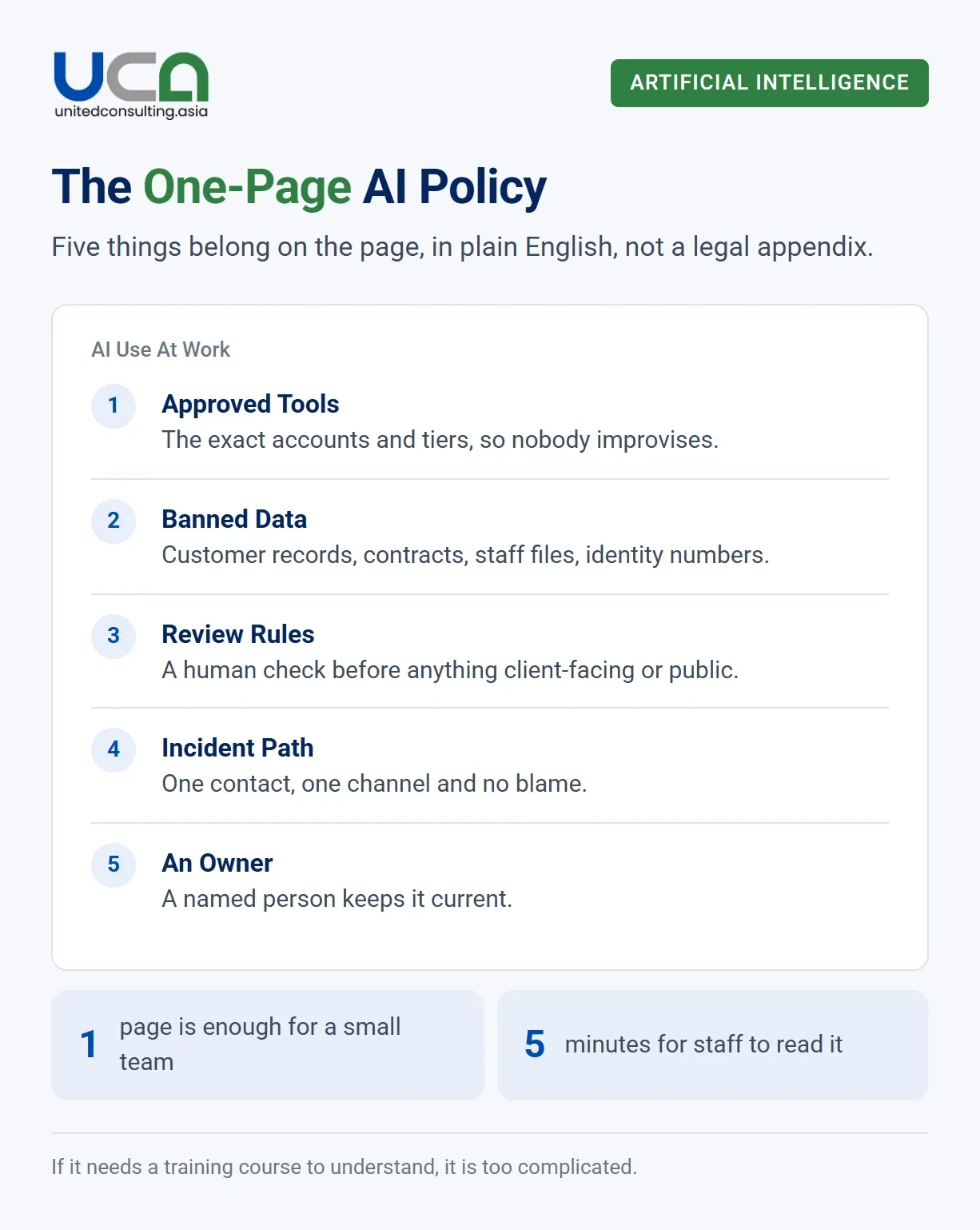
- Approved tools. Name the exact accounts and tiers staff should use, so nobody improvises with a free signup.
- Banned data. Customer records, contracts, staff files and identity numbers never go into a prompt.
- Review rules. Anything client-facing or public gets a human check before release.
- Incident path. One contact, one channel and no blame. After a leak, speed matters more than paperwork.
- An owner. A named person keeps the policy current as tools and rules change.
If you would rather not draft the rules yourself, United Consulting can help with AI usage policies and data controls designed for Vietnam, including the personal data duties above. The aim is a document people follow, not one that wins a legal review.
How Detailed Should the Policy Be?
One page is enough for a small team. Staff should be able to read it in five minutes and find the rules that apply to them. If the policy needs a training course to understand, it is too complicated.
If your team works in both Vietnamese and English, publish the policy in both languages. A rule that half the office reads in its second language is a rule that gets misread.
How Do You Train Employees to Use AI at Work?
Training pays back only when people change how they work. A one-off lecture on AI theory changes nothing at anyone’s desk. The goal is changed behaviour: fewer unreviewed drafts, safer data habits and prompts that save real time.
Employers everywhere are still working out the rules of good AI use. A useful benchmark is the UK government’s AI Playbook, where one of the ten principles is meaningful human control at the right stage.
- Use real work. Run sessions on last week’s reports, real proposals and real inboxes.
- Keep it short and repeated. Short sessions across a month beat one marathon workshop.
- Grow internal champions. For daily questions, the colleague three desks away beats the visiting expert.
- Measure adoption. After four to six weeks, check what people actually use, not what they enjoyed.
What Does a Good First Session Look Like?
A good first session runs 90 minutes and ends with something finished.
- Pick one painful task.
- Work through it with an approved tool.
- Write down how the team should handle that task from now on.
Our AI training includes bootcamps, workshops, upskilling sessions and hackathons, all built around the work your business already does.
Will AI Replace Jobs at Your Company?
For a small business, the practical answer sits at task level: redesign roles around the work only people can do, and let the tools take the rest.
The bigger risk to your business is a competitor whose team drafts faster and checks just as carefully.
AI rarely removes whole roles overnight. It changes the tasks inside them first, and the roles that shrink are the ones where nobody adapts.
As the saying goes, AI will not take your job, but someone using it might. Read it calmly: it is an argument for learning these tools, not a reason to panic.
What Should You Do With Roles That Change?
Map which tasks change, not which roles disappear, then retrain around the gap. As drafting gets cheaper, review skills, data judgement and client communication grow in value.
Businesses that reskill keep the people who know their customers, and those are the hardest people to hire back.
How United Consulting Can Help Your Team Use AI at Work
Your staff are probably using AI already, with or without a policy. The question is whether they are doing it in a way that saves time without putting customer data or your reputation at risk. These are three practical ways we help.
A One-Page AI Usage Policy for Vietnam
We map where personal and company data flows today, then write a short, plain-English policy covering which tools are approved and what must never go into them, aligned with Vietnam’s personal data rules. We also review the AI tools and vendors your team already uses.
Training That Uses Your Own Work
Workshops and bootcamps run on the tasks your people already do, from drafting client emails to summarising reports. For larger teams, a train-the-trainer track leaves you with internal champions who keep good habits going after we leave.
A Hackathon to Find Your Best Ideas
In one or two days, mixed teams compete to solve real company problems with AI and pitch working prototypes to your leadership. It is a quick way to surface the use cases worth funding and the people who should lead them.
Every engagement starts the same way: a free 30-minute discovery session, then one pilot with the outcome agreed before we begin. A wider rollout follows only once the numbers hold up. Sessions run in English or Vietnamese, on-site or remotely. Read more about AI enablement for teams.
Conclusion
Using AI at work is a people problem before it is a technology problem. Clear rules, basic AI literacy and training on live tasks will take you further than any tool purchase.
Start with a one-page policy and one hands-on session with your team. A written policy protects your staff too: when the boundaries are visible, nobody has to guess whether using a tool will get them in trouble. When you are ready to judge the spend, the AI ROI guide shows how to measure it before you commit.
Thinking about entering or expanding in Vietnam? Contact United Consulting at info@unitedconsulting.asia to map how using AI at work fits your plans.
Frequently Asked Questions
How can I use AI at work safely?
Use only the AI tools your company has approved, keep personal and confidential data out of public tools, and check every output before it reaches a client or goes public. AI drafts quickly but can state wrong facts with confidence, so a person stays responsible for the final version.
Is it okay to use ChatGPT at work?
Usually yes, if your employer allows it and you use an approved account with data controls. Never paste customer records, contracts, staff files or identity numbers into a free consumer account, and review everything it writes before you send it. For sensitive work, some businesses choose to run AI locally instead of in the cloud.
What should be included in an AI policy for employees?
A short AI policy should name the approved tools, list the data that must never go into a prompt, set review rules for client-facing work, give one contact for reporting incidents and name an owner who keeps it current. For a small business one page is enough, as long as staff can read it in five minutes.
What is AI literacy?
AI literacy is the ability to use AI tools with judgement: knowing what they do well, where they fail and how to check their output. EU law describes it as the skills, knowledge and understanding people need to use AI responsibly. For most teams it takes a few hours of guided practice on real work, not a technical course.
Will AI replace jobs in small businesses?
AI rarely removes whole roles overnight; it changes the tasks inside them first. Small businesses do best when they map which tasks change, retrain staff around the gap and keep the people who know their customers. Our guide to using AI in your business shows where the time savings usually come from.