Once a Vietnam business starts weighing up AI tools, the first real argument is about where the AI should run. That is the local AI vs cloud AI question: one person wants a cloud subscription, someone else wants a server in the office.
On a tight budget, the answer sets your costs for years. So before you spend anything, get clear on the trade-offs that matter: cost, control, data location and speed.
TL;DR - Cloud AI is the sensible default for most small and medium businesses: no hardware, instant setup and access to the strongest models. Local AI wins when data cannot leave your systems, when usage is heavy and steady, or when you need to work offline. Many firms end up hybrid, and our AI infrastructure services can help you design the mix. Vietnam adds one more filter: sending personal data to an overseas platform counts as a cross-border transfer.
What Is the Difference Between Local AI and Cloud AI?
Local AI runs a model on hardware you control, such as an office server, so prompts and documents stay inside your network. Cloud AI sends each request over the internet to a provider’s data centre and sends the answer back. With cloud, you rent the capability instead of owning it.
For the person typing the prompt, the case for keeping AI on your own device is mostly about privacy and independence from a connection. Some firms are also moving AI workloads back on-premise after starting in the cloud.
So the core difference is where your data is processed, not how clever the model is. One caveat before any of this: no deployment model fixes poor-quality data, which is why getting your data AI-ready comes before any tooling decision.
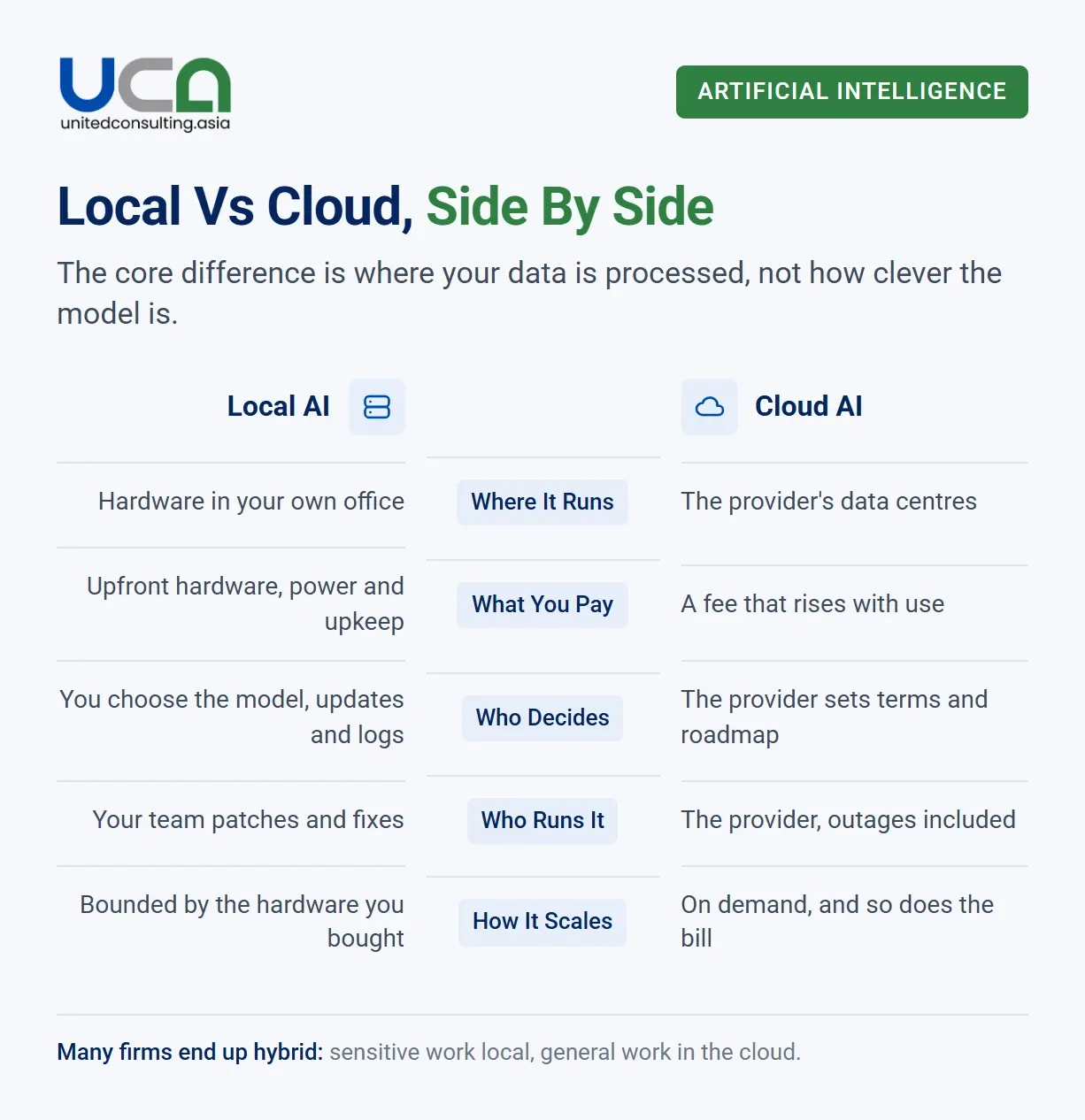
In practice, the differences come down to five questions:
- Where it runs. On hardware in your own office, or on the provider’s cloud.
- What you pay. Upfront hardware plus power and maintenance, or a subscription or per-use fee that rises with activity.
- Who calls the shots. You choose the model, updates and logs, or the provider sets the platform terms and roadmap.
- Who keeps it running. Your team patches, monitors and fixes it, or a provider handles that for you, along with its outages and changing terms.
- How it scales. Bounded by the hardware you have bought, or the cloud expands on demand (and the bill with it).
Where Does Hybrid Fit?
Hybrid is the practical middle: sensitive work runs on hardware you own, while general or low-volume tasks go to a cloud model. For small teams in Vietnam that handle both confidential and everyday content, it is often the answer that sticks.
For a small team, hybrid usually looks something like this:
- Cloud for everyday work. Drafting emails, summarising meetings, research and translation run on a cloud plan, because the content is general and the volume is uneven.
- One local machine for the sensitive slice. Staff files, client contracts and anything holding personal data go through a model on hardware you control.
- A written routing rule. One line in your AI policy says which data goes where, so nobody has to decide case by case.
Start with the rule, not the hardware. The sensitive slice is often smaller than it first looks, so map it before you buy anything.
Is Local AI Cheaper Than Cloud AI?
Not by default. At low or irregular usage, cloud is cheaper, because you pay only for what you use.
Local AI pulls ahead when the same work runs constantly at high volume. Once the hardware is paid for, each extra task costs little beyond power and upkeep.
Price both options on your own workload. A local machine is a one-off purchase plus running costs; cloud is a bill that grows with use. Each hides costs in different places:
- Cloud adds up through usage. Per-task fees, storage, data transfer and support tiers all grow with use, which makes forecasting hard.
- Local adds up through ownership. Graphics hardware, power, cooling, patching and the staff time to run it all sit on your side of the ledger.
- Both hide line items. Migration work, training and integration with existing systems land in whichever column you chose.
When Does Owned Hardware Pay for Itself?
Roughly when usage is high, predictable and continuous, such as all-day document processing or constant question answering. The test is sustained use plus the full running bill, not the sticker price.
One cost rarely priced in is the connection itself. Cloud AI stops when your internet does. For teams outside the big cities or on shared office links, that dependency belongs in the decision, because local processing keeps working when the line goes down.
Working out whether owned hardware pays off for you? Email info@unitedconsulting.asia and we will run the numbers.
Is Local AI More Secure Than Cloud AI?
Local is more private, but not automatically more secure. Keeping data in-house means it is never processed on someone else’s systems, but your team then owns every backup and access control.
Cloud providers run hardened, audited environments. What you give up is direct control over who can reach your data.
For businesses in Vietnam, the question turns legal at data residency: where your data physically lives. Under the 2025 Law on Cybersecurity and its implementing decree (Decree 333/2026), some businesses must store certain service-user data in Vietnam, depending on how the rules apply to them.
The Personal Data Protection Law, in force since 1 January 2026, goes further. Using an overseas platform to process personal data collected in Vietnam counts as a cross-border transfer, and you have to file an impact assessment dossier for it.
Where Does Sovereign Hosting in Vietnam Fit?
Sovereign hosting sits between the two: cloud convenience, on infrastructure located and operated under local rules.
For foreign-owned firms that need this arranged in Vietnam, our AI infrastructure services cover cloud setup, data residency and sovereign hosting. Sovereign hosting does not remove your compliance duties, but it settles the question of where things run.
Is Local AI Faster Than Cloud AI?
Often, but not always. Local answers start sooner because they skip the network round trip, the journey a request makes to the provider and back, so real-time tools feel snappier.
Cloud responses carry that round trip plus any queuing at the provider’s end. Even so, an undersized local server queues requests under load, and a well-planned cloud service can beat it.
Speed only settles the argument for real-time work such as voice support, factory-floor alerts or live customer chat. For overnight document processing or first-draft writing, a slower response changes nothing.
How Should You Benchmark Speed?
Test on your own requests for a week, not on vendor demos.
- Measure the right things. Track how long until the first words appear and how long the full answer takes.
- Test at your busiest hour. Quiet moments flatter every option.
- Include retrieval and database calls. Users wait for those too.
Local AI vs Cloud AI: How Should a Business in Vietnam Choose?
There is no universal winner, only the right home for each workflow. Answer five questions and the placement usually becomes obvious.
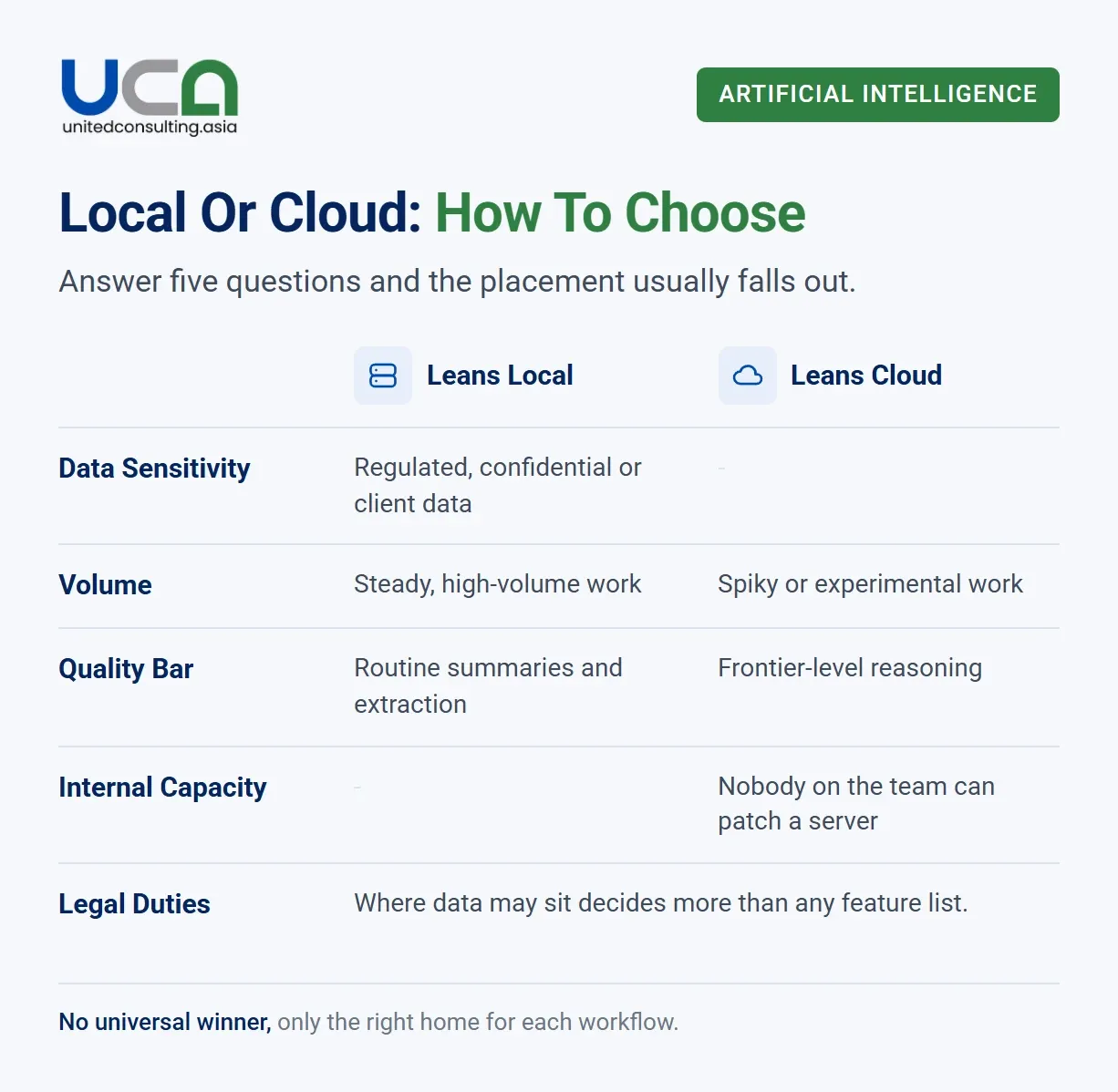
- Data sensitivity. What data does the AI touch? Regulated, confidential or client data points to local or a tightly controlled private setup.
- Volume and predictability. How steady is the work? Steady, high-volume work favours owned hardware, while spiky or experimental work favours the cloud.
- Quality bar. What quality does the task need? Frontier-level reasoning and multimodal work (across text, images and audio) still lean cloud. Routine summarising and extraction run well locally.
- Internal capacity. What can your team maintain? If nobody can patch a server, renting beats owning at almost any price.
- Legal duties. What do the rules require? Where data may sit and what you must file decides more than any feature list.
What This Looks Like in Practice
Take a hypothetical 25-person recruitment agency in Ho Chi Minh City. Most of its AI use is drafting job adverts, translating client emails and summarising calls: general content at uneven volume, so cloud is the obvious fit.
Candidate CVs are different. They are personal data collected in Vietnam, so sending them to an overseas model triggers the cross-border transfer duties above. The agency has two clean options: screen CVs on a local machine, or keep them in the cloud and do the paperwork. Nobody on staff maintains servers, which argues for the second, or for sovereign hosting.
Either way, the decision is made per workflow, not for the whole firm. And the habits of the people using the tools matter as much as the hardware, which is the focus of our guide to using AI at work safely.
What Is a Sensible First Step?
Do not buy infrastructure first. Test before you own anything.
- Pick one workflow. A single process, not a whole department.
- Run both options side by side. Use a cloud plan and a trial local setup.
- Compare for a month. Judge quality, speed and cost on real tasks.
If you are unsure which process to test, start with what to automate first. That trial usually ends in the hybrid set-up described above.
How United Consulting Can Help You Choose Between Local and Cloud AI
Where your AI runs sets your costs, your risks and your options for years. Getting it wrong usually means paying twice: once for the first setup and again to move off it. We help you make the call once.
A Hosting Plan for Each Workflow
We look at the workflows you want to run and design the cloud, hybrid or in-country setup that fits each one, including on-premise options where data must stay inside your network. You get one architecture that avoids locking you into a single vendor.
A Clear Answer on Vietnam’s Data Rules
We map which personal data each tool would touch and where it would travel, then show where a cross-border transfer impact assessment applies and which sector rules might require local storage. You see the compliance picture before you sign a contract.
Cost Planning and Security Testing
We model what each option costs as usage grows, so the bill stays predictable. Before launch, we test the setup for the new risks AI brings, such as prompt injection and agents with too much access, alongside access control and monitoring.
Every engagement starts the same way: a free 30-minute discovery session, then one pilot with the outcome agreed before we begin. A wider rollout follows only once the numbers hold up. Find out more about AI infrastructure and data residency.
Conclusion
The local AI vs cloud AI choice splits like this. Local AI buys control and predictable costs at high volume. Cloud AI buys frontier capability and an instant start.
For most small and medium firms in Vietnam, local or foreign-owned, the workable answer is cloud for general work and local for the data that must stay close. Check the legal position before either goes live.
Thinking about entering or expanding in Vietnam? Contact United Consulting at info@unitedconsulting.asia to map how your AI infrastructure choice fits your plans.
Frequently Asked Questions
Is it safe to use cloud AI with business data?
For most everyday business content, yes, provided you use a business plan with clear terms on how your data is stored and used. Major cloud providers run hardened, audited environments. The bigger risk is usually what staff paste in, so set a simple rule on which data may go to cloud tools and which must stay local.
Can I run AI locally on my own computer?
Yes. Smaller open-weight models run on a recent desktop or laptop with plenty of memory, and the data never leaves the machine. They handle summarising, extraction and drafting well, but they are less capable than the largest cloud models for complex reasoning.
What hardware do you need to run AI locally for a business?
For a single user, a capable workstation with a modern graphics card (GPU) is often enough. For a team sharing one model, you need a dedicated server with enough GPU memory for the model you choose, plus power, cooling and someone to maintain it. Size the hardware to your busiest hour, not your average day.
Does Vietnam require business data to be stored locally?
Some of it. Vietnam’s cybersecurity rules can require certain service-user data to be stored in the country, depending on how they apply to your business. Separately, the Personal Data Protection Law treats processing Vietnamese personal data on an overseas platform as a cross-border transfer, which needs an impact assessment dossier.
What is hybrid AI?
Hybrid AI means running sensitive work on hardware you control and sending general or low-volume tasks to a cloud model. A written routing rule tells staff which data goes where. For many small businesses it is the most practical set-up, because the sensitive slice of work is usually small.