Navigate the stamping process and keep your documents on the right side of Vietnamese practice
So, you’ve registered your company in Vietnam – and now you’re holding a stamp? Stamping done properly still matters for contracts and hard-copy filings, even in a year when most of your invoicing and tax work runs through screens. The seal (or “con dấu”) remains the visual mark of corporate authority on paper, and counterparties look for it. Here is how the stamping process works in 2027, and where the e-invoice rules changed the rules of the game.
Correct Way to Stamp and Sign the Signature Page of a Vietnamese Document

Sign in blue ink. The company seal should overlap the signature without covering it.
1. Types of Company Stamps in Vietnam
Since the Law on Enterprises 2020 took effect on 1 January 2021, companies decide for themselves what seals they keep – there is no state registration of seal specimens and no official seal card. What you will encounter in practice:
- Company Seal (Con dấu công ty): The round company seal, usually carrying the company name and tax code. It goes on official business documents such as contracts, agreements, and financial paperwork.
- Signature/Title Seal (Con dấu chức danh): A smaller seal bearing the legal representative’s name and title (for example, Director), applied alongside that person’s signature where their personal authority is being exercised.
Because seals are no longer registered with authorities, the discipline sits with you: keep a clear internal record of which seals exist, who may use them, and what they are used on. The Law on Enterprises 2020 sets the framework; your internal rules make it work.
2. Getting and Controlling Your Seals
When your business is established, you order your seal from a licensed seal maker – the design, quantity, and form are your company’s decision, typically confirmed by the owner or members’ council. There is no registration step at the Department of Planning and Investment and no seal card to keep safe; the registration-era documents some guides still mention have not existed since 2021. What replaces them in practice is paperwork: banks and counterparties verify your company through the Enterprise Registration Certificate and the signatory’s authority, so keep signed specimen records and an internal seal log with your corporate documents at the registered office.
3. When to Use Stamps
Where a physical stamp still shows up in 2027:
- Contracts and Agreements: Leases, employment contracts, distribution agreements – stamping a hard copy remains the market convention and signals that the signatory binds the company.
- Invoices and Receipts: This one has changed. Since July 2022, e-invoices are mandatory for essentially all businesses (Decree 123/2020/ND-CP, as amended), and they are authenticated with a digital signature or e-signature account, not a physical seal. Paper stamps survive on printed quotations, payment requests, and hand-signed internal documents.
- Tax Documents: Most tax filings are submitted electronically through the tax authority’s portal using a digital signature certificate from a licensed provider – VNPT-CA, Viettel-CA, and FPT-CA are the common ones. Wet-ink stamped copies appear mainly when an authority or bank specifically asks for a certified hard copy.
- Official Communication: Formal letters and notices to government bodies, partners, or clients – especially anything that creates or reserves a legal right – still go out stamped.
4. Stamping Etiquette
- Place the Stamp Correctly: Customary practice – not a statutory rule – is for the stamp to overlap about one-third of the signature on the left side, clear enough that both the signature and the seal remain legible. What matters legally is that the document is genuine and the signatory was authorized; this placement is simply how Vietnamese counterparties expect to see it. Do not obscure text, other signatures, or the company name.
- Multiple Pages: For multi-page documents, use the overlapping (cross-page) stamping method: fan the pages out and lay stamps across the right-hand margin so every page carries part of the impression. You may need more than one stamp application to reach every page. The point is that no page can be swapped out later without it being obvious.
Correct Way to Stamp Multiple Page Vietnamese Document
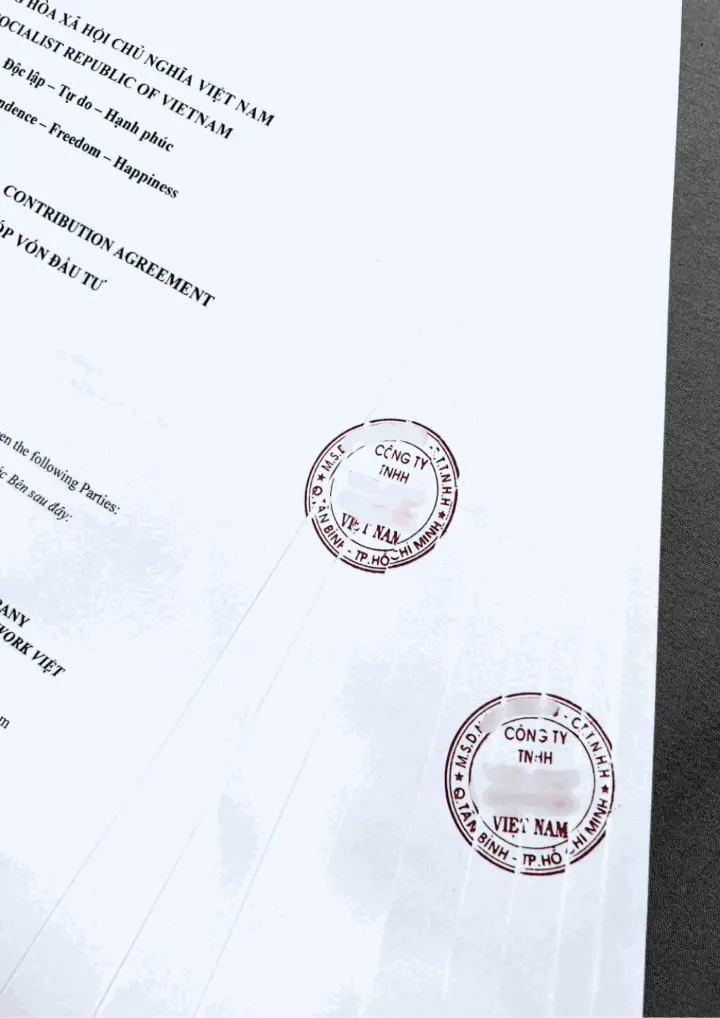
- Avoid Overuse: Do not stamp reflexively or indiscriminately. A seal applied to something the company never agreed to is a dispute waiting to happen, and misuse can undermine the document rather than validate it.
- Proper Maintenance: Keep the impression clean and sharp. A worn seal that produces an unreadable mark will be rejected by banks and partners; replace it through your seal maker and update your internal seal log.
5. Handling the Stamp Safely
The seal is only as safe as its custody:
- Secure Storage: Locked drawer or safe at the registered office, with access limited to named people.
- Authorized Use: Only the legal representative or specifically authorized senior staff should apply it, and every use should be logged.
- Keep it in Vietnam: Banks, notaries, and government offices may ask for the physical seal to be presented in person. Taking it out of the country for extended periods can stall your own transactions.
6. What Happens If You Make a Mistake?
If a document is stamped incorrectly, fix it immediately: cancel and reissue the document rather than trying to correct it in place. Keep a stamped-document register so you can show what was signed, when, and by whom.
Conclusion
Stamping in Vietnam is a formality, but it is a legal one. The core habits have not changed: place the seal correctly, stamp every page of multi-page documents, and control who holds it. What has changed is the paperwork around it – self-managed seals since 2021, e-invoices and digital signatures for everything tax-related. Get both sides right and your documents hold up when someone actually reads them.
Talk to United Consulting if you need help with business registration – or if you just want a second pair of eyes on how your documents are being stamped and filed.