Overview of Employee Benefits in Vietnam
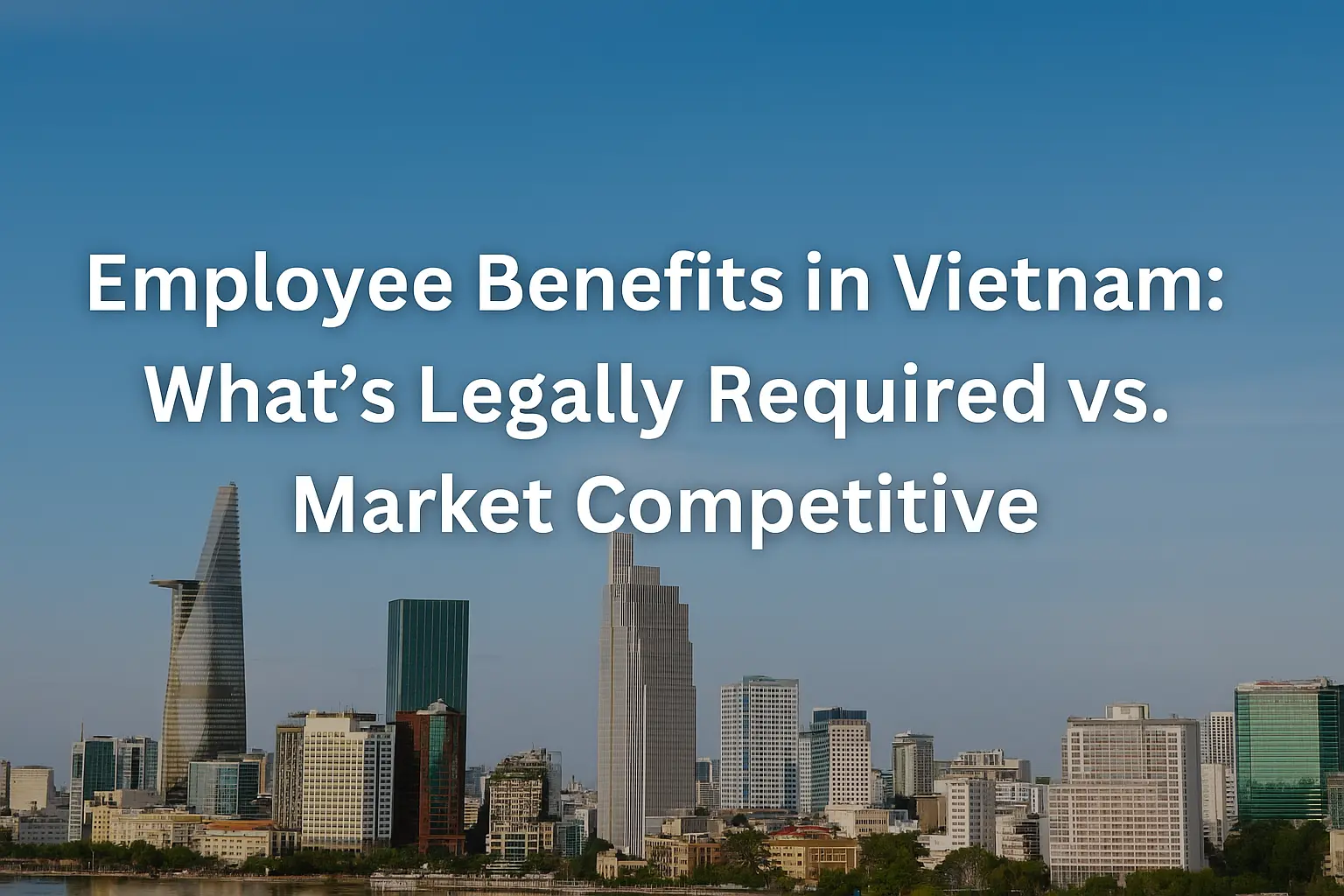
Are you an HR manager or foreign SME navigating employee benefits in Vietnam? This guide clarifies mandatory benefits under Vietnam labor law – such as social insurance, health and unemployment insurance, annual leave, maternity/paternity leave, and paid time-off – and contrasts them with competitive employee benefits like 13th-month salary, private insurance, wellness stipends, flexible work options, and extra leave days. With the Social Insurance Law (Law No. 41/2024/QH15) in force since July 1, 2025 – including expanded coverage for part-time and probationary workers – understanding what employee benefits law requires while offering attractive packages is critical to hiring, retaining, and engaging talent.
Employee Benefits Law and Updates (Current Through 2027)
The reforms that took effect in July 2025 continue to shape the hiring and retention landscape:
- Expanded Social Insurance: Part-time, probation, managers, gig workers included – opening access to a wider, compliant talent pool.
- Reference Salary System: Replaces base salary as the contribution basis for certain groups; the reference salary is VND 2,530,000 per month from 1 July 2026 (Decree 161/2026/ND-CP), and contributions are capped at 20 times that amount.
- Pension Eligibility at 15 Years: Supports mid-career retention.
- Voluntary Insurance for Non-Full-Time Staff: Now includes maternity, pension, and accident cover.
- Lump-Sum Withdrawal Restrictions: Encourages long-term retention.
- Digital Records: Social insurance books are issued electronically as standard (mandatory since 1 January 2026), and day-to-day employee procedures run through VNeID and the e-social insurance platform.
- Stricter Penalties: 0.03% per day interest on arrears, plus fines under Decree 283/2026/ND-CP, highlight the need for automated compliance tracking.
- Clearer Core Rules: Statutory clarity on written contracts, probation, overtime, and retirement age reduces legal risk for employers.
Hiring Benefits:
- Access to legally compliant talent (probationary, part-time, contract workers)
- Predictable labor costs thanks to reference salary and pension reforms
- Increased retention via pension benefits and restricted withdrawals
- Faster onboarding for expats via digital IDs (will need a TRC)
- Stronger employer brand through compliance and benefits transparency
Mandatory Employee Benefits in Vietnam (Vietnam Labor Law)
Social Insurance Law and Compliance Requirements
Effective July 1, 2025, the Social Insurance Law (No. 41/2024/QH15) extended mandatory coverage to part-time staff earning at least the minimum wage, non-salaried managers, and household business operators – and to probationary staff where the probation sits inside a labor contract of one month or more.
- Employers contribute 17.5% and employees 8% of the contribution salary toward social insurance.
- The contribution salary is capped at 20 times the reference salary – VND 50,600,000 per month from 1 July 2026.
- Late contributions accrue 0.03% per day interest and can trigger fines under Decree 283/2026/ND-CP.
Health Insurance and Unemployment Insurance
Contributions cover medical care, maternity, unemployment support, workplace accidents, and occupational hazards.
- Health insurance: 3% from the employer and 1.5% from the employee, covering medical care at registered facilities.
- Unemployment insurance: 1% from each side – for Vietnamese employees only; foreign employees are exempt.
- Occupational accident and disease cover: 0.5% from the employer, on top of workplace safety duties under the Labor Code.
Annual Leave and Paid Time Off
Under Vietnam labor law, full-time employees with at least 12 months’ service receive:
- A minimum of 12 days of paid annual leave (14-16 days for hazardous roles)
- One extra day every five years of service.
Unused leave must be compensated at exit; carry-over rules are employer-defined.
Maternity, Paternity, Sick Leave & Other Statutory Allowances
- Maternity leave: 6 months at 100% of the social insurance contribution salary, plus 30 days per additional child in a multiple birth and paid leave for prenatal check-ups.
- Paternity leave: 5 working days (7 for a cesarean section or premature birth, more for multiple births), usable within 60 days of the birth.
- Sick leave: 30-60 days per year in normal working conditions (40-70 in hazardous roles), scaled by contribution history under Law No. 41/2024/QH15. The old 180-day cap for long-term illness no longer applies; treatment beyond the entitlement continues at a reduced benefit rate.
- Employers must uphold documentation, anti-discrimination practices, and severance protections.
Market Competitive Employee Benefits Packages for Vietnam SMEs
To thrive in Vietnam’s competitive talent landscape, many employers are enhancing their employee benefits in Vietnam packages with perks that distinctly align with employee priorities:
- 13th-Month Salary (Tet Bonus)
2023-era market data found over 85% of employees expecting this bonus before Lunar New Year. It is a powerful retention tool in the absence of any legal requirement – and it counts as taxable income under Law No. 109/2025/QH15 (five PIT brackets, applicable from the 2026 tax period). - Private Health, Life & Supplementary Insurance
2023-era market data found more than 90% of surveyed companies providing private plans covering dental, vision, critical illness, and family members to support overall employee health. - Housing & Transport Allowances
These stipends and commuter benefits address the rising cost of living in urban centers, making roles in those areas more attractive to top talent. - Flexible / Hybrid Work & Extra Annual Leave
2023-era market data found about 35% of firms offering flexible work; many employers also grant 2-5 extra leave days (for birthdays, wellness, mental health), promoting strong work-life integration. - Wellness Perks & Team-Building Activities
2023-era market data found 71% of employers prioritizing health benefits; typical packages include gym access, mental health support, meal vouchers, and team retreats. - Professional Development & Career Pathing
2023-era market data found nearly half of companies investing in mentorship, certification, and training as core retention strategies.
Why These Perks Matter: WTW’s 2023 Benefits Trends Survey recorded 60-80% of employers boosting benefits spend, focused on health, flexibility, and development. These 2023 benchmarks predate the 2025-2026 legal reforms and the 2026 wage increases, so treat them as a baseline and re-survey your talent market before setting 2027 packages.
Blending these with statutory elements under Vietnam labor law helps SMEs attract and retain talent, competing with larger firms.
Employee Benefits Compliance for HR in Vietnam
Payroll Audits and Digital Record-Keeping
Vietnam’s push toward digital governance – through systems like VNeID and the national e-social platform – requires that companies shift fully to electronic labor records.
All payroll and benefits documentation (e.g., social insurance contributions, leave accruals, employment status) must be digitized and stored in compliance with the Ministry of Labor, Invalids and Social Affairs (MOLISA) and Vietnam Social Security (VSS) standards.
Quarterly and annual internal audits should verify contributions, proper contract classifications, and accuracy of payroll data. Employers are advised to integrate their Human Resource Information System (HRIS) and payroll software with Vietnam Social Security (VSS) application programming interfaces (APIs) to ensure seamless reporting and real-time compliance tracking.
Compliance Pitfalls & Solutions
Common errors include:
- Misclassification of contracts: Failure to classify part-time or probationary workers accurately can trigger audits or backpay demands.
- Late or missed contributions: These incur a statutory penalty of 0.03% per delayed day.
- Non-VND payments: Payroll must be processed in Vietnamese dong (VND); paying in foreign currency breaches labor regulations.
Solutions:
- Conduct monthly internal compliance checks
- Establish robust audit trails with timestamps and supporting documents
- Outsource complex payroll functions to local experts to mitigate risk
Keeping Policies Current After the 2025 Reforms
Employment policies, contracts, and HRIS systems should already meet Law No. 41/2024/QH15 (in force since July 1, 2025); review them at least annually and after every payroll-relevant decree. Keep HR and finance staff trained on expanded coverage, contribution rules, and digital submission of records via e-social platforms.
Building a Competitive Employee Benefits Package in Vietnam: Practical Steps
Designing for Vietnamese Talent
To design a compelling package, HR leaders should begin with direct employee engagement – gathering feedback via surveys, focus groups, or suggestion boxes to understand what benefits matter most.
In Vietnam, health-related perks, flexible leave, and financial incentives (like Tet bonuses and transport support) rank highly. Partnering with local vendors (e.g., Bao Viet, Liberty Insurance) helps build customized group packages for health, wellness, and supplemental insurance.
Additionally, integrating mental health support, upskilling opportunities, and childcare subsidies can make a substantial difference for working parents.
2027 HR Checklist
- Update labor contracts: Ensure contracts reflect the latest Social Insurance eligibility rules for probation, part-time, and freelance staff, and revise job descriptions in line with new statutory role classifications.
- Digitize payroll systems: Align payroll software with VNeID and Vietnam’s e-social security platform, integrating automated contribution tracking, electronic signatures, and leave management workflows.
- Train internal teams: Host cross-functional workshops, simulate digital onboarding scenarios, and engage certified compliance professionals to train HR, finance, and payroll departments, with refresher sessions at least once a year.
- Review vendor and insurer agreements: Reassess group benefit providers and payroll vendors to ensure they comply with current legislation and integrate with national systems.
- Conduct trial audits: Perform mock compliance audits quarterly to identify issues with classification, enrollment, or documentation early – before official inspections.
- Check wage floors and caps: Re-validate salary floors against Decree 293/2025/ND-CP regional minimum wages (in force 1 January 2026) and contribution caps against the current reference salary whenever either changes.
Managing Enrollment & Claims
Establish standardized enrollment procedures for Social Insurance (SI), Health Insurance (HI), and Unemployment Insurance (UI), ensuring new hires are registered within 30 days of employment.
Designate HR leads to track eligibility and coverage timelines. Provide onboarding materials in Vietnamese and English to explain benefit portability – especially for contract staff, returning nationals, or expats.
Use visual SOPs and checklists to demystify the SI claim process. Equip HR with tools to help employees complete paperwork, submit claims digitally, and track status. Implementing service-level targets (e.g., claim response in 3 days) and maintaining a single HR contact point improves employee experience and reduces administrative delays.
Set clear timelines and educate staff on benefit portability – especially for job transitions or those returning from overseas – with multilingual guides for SI claim procedures. Employees must be enrolled within 30 days of hire.
Vietnam Employee Benefits: FAQ & Best Practices
- Do foreign workers get the same benefits? Yes – on contracts of 12 months or more, foreign staff receive social and health insurance coverage (unemployment insurance is for Vietnamese employees only).
- Is the 13th-month salary mandatory? No – it’s a cultural norm and market expectation, not a legal requirement.
- Are part-time/probation staff insured? Part-time staff earning at least the minimum wage on contracts of one month or more are compulsory; probation counts when it sits inside such a labor contract, while a standalone probation contract is not subject to compulsory social insurance.
- Can benefits substitute salary? No – legal benefits must be provided separately under Vietnam labor law.
- How quickly must new employees be enrolled in insurance? Within 30 days of their start date – delays may result in penalties or denied claims.
Advanced HR Tips: On-the-Ground Guidance
- Prepare for Digital Inspections – Vietnam’s labor inspections now include digital audits. Partnering with provider experts ensures you’re audit-ready and compliant without extra internal resources.
- Communicate Benefits Visibly – Town halls, e-ID guides, transparent pay-slips, and a benefits FAQ will build trust, clarity, and employee engagement.
- Culture + Compliance = Loyalty – Top recruiters emphasize combining legal benefits with cultural perks like team meals, Tet bonuses, and career progression to foster greater belonging and retention.
Ready to Hire in Vietnam?
Use our headhunting and payroll outsourcing services to secure top talent fast – fully compliant, with zero overhead:
- Executive Search & Headhunting: We find and attract the best-fit professionals for your team.
- Payroll & HR Outsourcing: Scale your business confidently with compliant payroll, insurance, and tax management (for local & foreign employees).