Vietnam has a new rulebook for foreign traders. Decree No. 342/2026/ND-CP, issued on 3 September 2026 and effective from 18 October 2026, now governs how foreign investors and foreign-invested economic organisations (FIEs) buy and sell goods in the country. It replaces Decree No. 09/2018/ND-CP after eight years and aligns with the Law on Investment No. 143/2025/QH15. Whether you import, distribute, retail or operate a sales platform, this decree decides which activities need a licence, who grants it and how long the process takes.
TL;DR – Nine activity groups now require a Business Licence, the Economic Needs Test (ENT) is tied to treaty commitments, licensing authority moved to provincial People’s Committees, and platform businesses are named in the rules for the first time. Existing licences stay valid for the activities already licensed, but business changes now trigger the new procedures.
Two earlier guides frame the ground this decree builds on. The market-access breakdown explains which sectors a foreign investor may enter at all, and the sub-license primer covers what still stands between a licence and opening day. The conditional-lines guide sits behind both.
What Changed under Decree 342/2026?
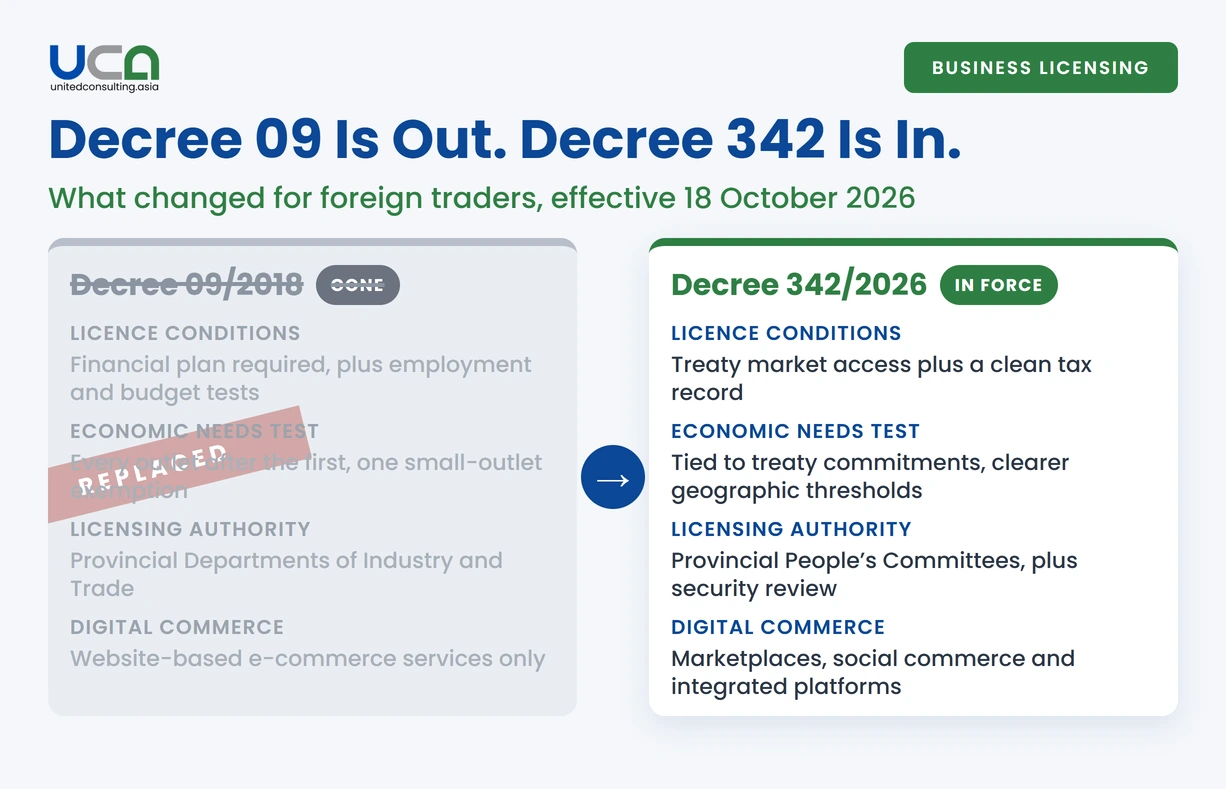
The short answer: Almost everything about the procedure, and surprisingly little about the principle. Decree 342/2026 keeps Vietnam’s treaty-based approach to foreign trading rights, so what you may do still depends on the market-access commitments Vietnam has made to your home country. What it changes is how you prove it, who decides and what happens after licensing. Four shifts matter for day-to-day operations.
The Four Shifts That Matter
- Licensing conditions are simpler. The 2018 financial plan requirement is gone, but that was a licensing criterion. The five-year business plan remains a required dossier document. For investors covered by treaty commitments, the key questions are market-access conditions and tax compliance: The conditions are the treaty’s trading limits, and tax compliance means a record clean enough to certify. Different conditions may apply outside those commitments.
- Authority is decentralised. Provincial People’s Committees now grant, amend and revoke Business Licences and Retail Outlet Licences, replacing the provincial Departments of Industry and Trade. Expect decisions to track local development priorities more closely. In plain terms, the provincial government now signs the licence.
- Digital commerce is named. The marketplaces section below covers what that means.
- National-security review exists. Defined cases trigger consultation with the Ministry of Public Security and the Ministry of National Defence before a licence is granted.
These changes follow the Law on Investment No. 143/2025/QH15, which took effect on 1 March 2026. The effective date of the decree itself was covered in the week in review for 26 October.
Which Activities Need a Business Licence?
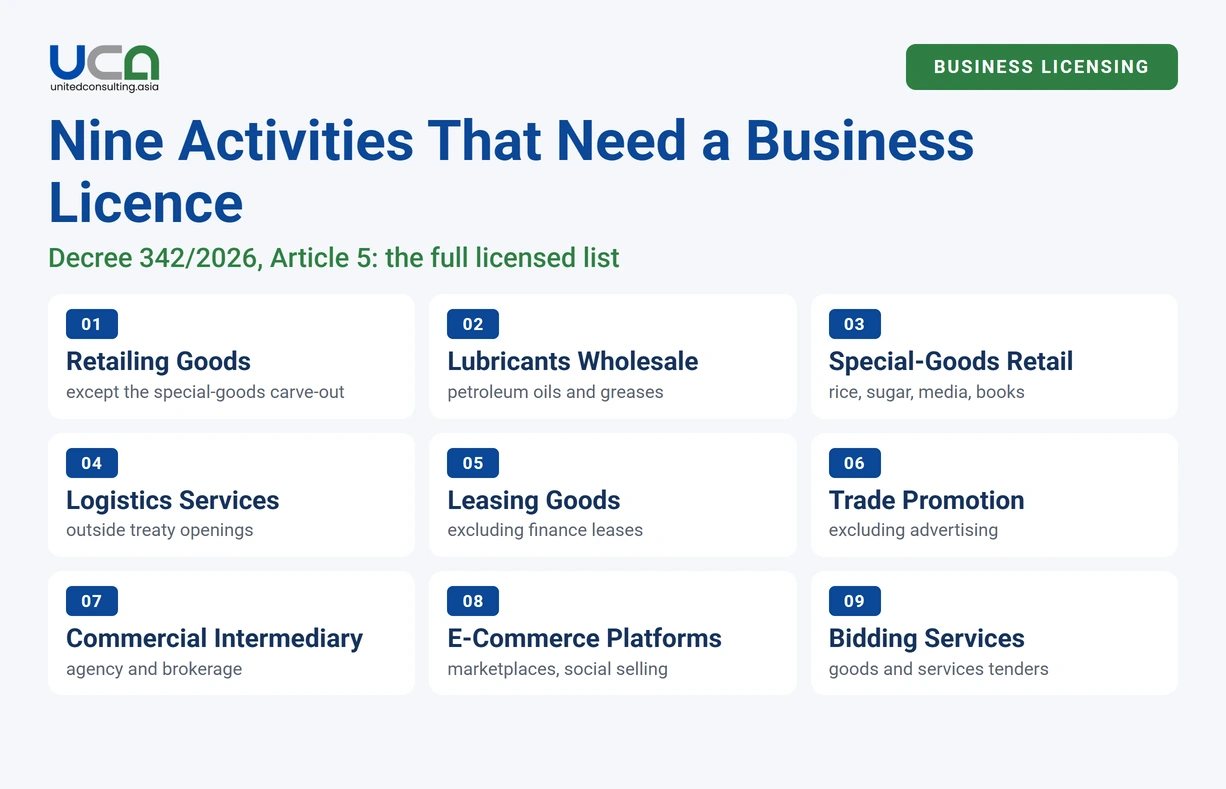
The trigger is the activity, not the channel. Decree 342/2026 attaches business licences to nine named groups of goods and services, and the question for any FIE is what it sells.
The Nine Licensed Groups
Article 5 of the decree lists nine activity groups. If a FIE does any of the following, it needs a Business Licence before starting:
- Retailing goods (one special carve-out below).
- Importing and wholesale distribution of petroleum-based lubricants and greases.
- Retailing rice, sugar, recorded media, and books, newspapers and magazines (only through convenience stores, mini-supermarkets or supermarkets).
- Providing logistics services, except sub-sectors Vietnam has opened under its international treaties.
- Leasing goods, excluding finance leases and construction equipment leased with an operator.
- Providing trade promotion services, excluding advertising.
- Providing commercial intermediary services.
- Operating intermediary e-commerce platforms, e-commerce social networks and integrated commercial platforms.
- Organising bidding for goods and services.
Activities outside these nine groups may not need a Business Licence here, but market-access, goods and sector-specific licensing rules may still apply. Exporting, importing and wholesaling outside the list proceed on your registrations. That makes the three-question test for business lines the right place to start, followed by the market-access list and the current conditional business lines.
What If You Sell to Companies Rather Than Consumers?
Then look at the transaction, not the channel. A sale to another company still counts as retail when that company buys the goods for its own use. The licensing position follows what actually happens in the deal, so a new sales channel can pull an activity into the licensed list even when your registration covers import and wholesale.
When in doubt, the safe reading is the narrower one, and the post-setup sub-licenses on top of a Business Licence checked at the same time.
Do Existing Foreign Traders Need a New Licence?
No. The decree does not require existing businesses to replace their licences when it took effect on 18 October 2026. Previously issued licences continue to support the activities already licensed, subject to their terms and conditions. Applications that were already filed before the effective date are generally processed under the old rules.
The trap is drift. A new product line, a different sales model or a change in ownership can move a company beyond its licensed activity, and updating your enterprise registration does not update your trading permissions. In those cases the new procedures under Decree 342 apply, whether that means adjusting the licence or applying afresh.
The practical question is not “is our licence still valid” but “does our licence still describe what we actually do”.
Not sure which of these applies to your business? Email info@unitedconsulting.asia and we will map your licensing position.
What Happened to the Economic Needs Test?
It is narrower, not gone. The Economic Needs Test (ENT) is a market-access check: Before a foreign retail outlet may open, the authorities weigh whether the market calls for it. Under the 2018 rules, the test generally applied to every retail outlet after the first, with a limited exemption for small outlets inside shopping centres.
Decree 342 links the test to treaty commitments instead: If the investor comes from a treaty partner committed to abolishing the ENT, additional outlets can open without it, subject to the remaining licensing requirements. The small-outlet exemption below 500 square metres in shopping centres is retained, provided the outlet is not a convenience store, mini-supermarket or supermarket.
When the Test Still Applies
Where the test still applies, the rules are clearer about geography. An outlet with a sales area below 5,000 square metres is assessed at commune or ward level, larger ones at provincial level. The assessment weighs the outlet’s impact on market stability and existing retailers, local demand, socio-economic contribution, and security and public-order considerations.
For retail groups planning multi-store expansion, confirming treaty status and the applicable commitment early is part of the licensing analysis, not an afterthought. The full picture for first-time entrants sits in the retail market entry guide.
What Do Retail Outlet Licences Require Now?
Each outlet needs its own Retail Outlet Licence, granted by the provincial People’s Committee where the store sits, while the Business Licence is granted where the head office sits. If your first outlet is in the same province or centrally run city as the head office, both applications can be filed at once.
Location Tests and Licence Terms
The financial-plan condition for outlets is gone, but location compliance still matters. Premises must satisfy requirements on land management, planning, investment, construction, fire prevention and fighting, traffic safety and environmental sanitation. Site due diligence therefore belongs before you commit to a lease or a fit-out, not after.
One detail deserves special attention: The outlet licence’s validity follows the shorter of the remaining investment registration certificate (IRC) term and the premises lease. A short lease directly shortens the licence. Renewal applications belong in the three months before expiry, and an activity that expires without a renewal request simply ends.
What If You Are Acquiring a Vietnamese Retailer?
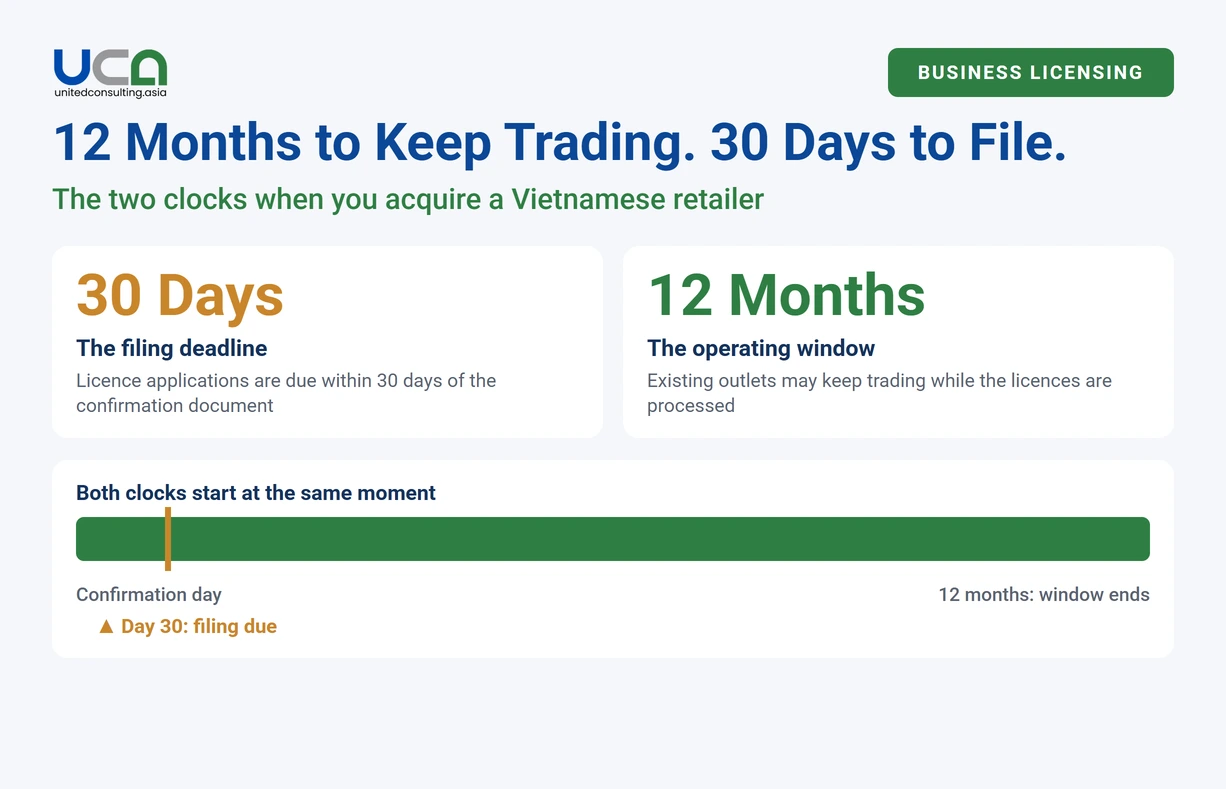
Decree 342 gives M&A deals a clearer transition than before. When a company operating retail outlets becomes foreign-invested through a capital contribution or share purchase, it must obtain the licences under the new rules. The existing outlets may keep trading while the applications are processed, for up to 12 months from the document confirming the investor met the conditions.
The Two Deadlines
Two deadlines hide inside that comfort, and they run on different clocks.
The first clock is the filing deadline. The application is due within 30 days of the confirmation document. Worked example: A confirmation letter dated 1 November means the file must reach the authority by 1 December. There is no extension for being busy with the handover.
The second clock is the keep-trading window. The outlets may keep trading for up to 12 months while the applications are processed, so those same stores can trade on to the following November. The trap is treating that window as breathing room for the paperwork. A buyer who files in month ten has missed the filing deadline by nine months, even though the doors never closed.
Buyers should map the licences before closing, including treaty status, exposure to the Economic Needs Test and any security review, and reflect the position in the deal documents. The related share transfer rules remain relevant where existing foreign shareholders are involved.
What About Online Marketplaces and Social Commerce?
They are named for the first time. The decree expressly recognises intermediary e-commerce platforms, social networks conducting e-commerce and integrated commercial platforms, covering marketplace ecosystems, social commerce and livestream selling as they operate today. The dividing line is whose goods are being sold. Selling your own stock through your own website is retailing. Inviting third-party sellers onto the service is platform operation, which sits in the licensed activity list and needs its own assessment before the first seller joins.
A Business Licence for platform activity does not replace the other e-commerce registrations and obligations that apply to the site, and foreign control of a large covered platform operator can trigger the national-security consultation below. For an online retailer growing into a marketplace, settle the licensing position before the business model changes, not after.
Who Decides the Application, and How Long Does It Take?
The provincial People’s Committee decides. Business Licence applications go to the committee where the head office is located. Retail Outlet Licence applications go to where the store will stand, so multi-province expansion means separate decisions per location. Applications can be filed at the single-window division, by post, through an agent or online via the National Public Service Portal.
What Goes in the Dossier
The dossier is leaner than under the 2018 rules:
- The prescribed application form.
- A written explanation of how the conditions are met.
- A five-year business plan.
- A tax document confirming no overdue tax where the route requires it (dated no more than six months before filing, treaty investors with an FIE established at least one year).
- Copies of the enterprise registration certificate (ERC) and IRC where needed.
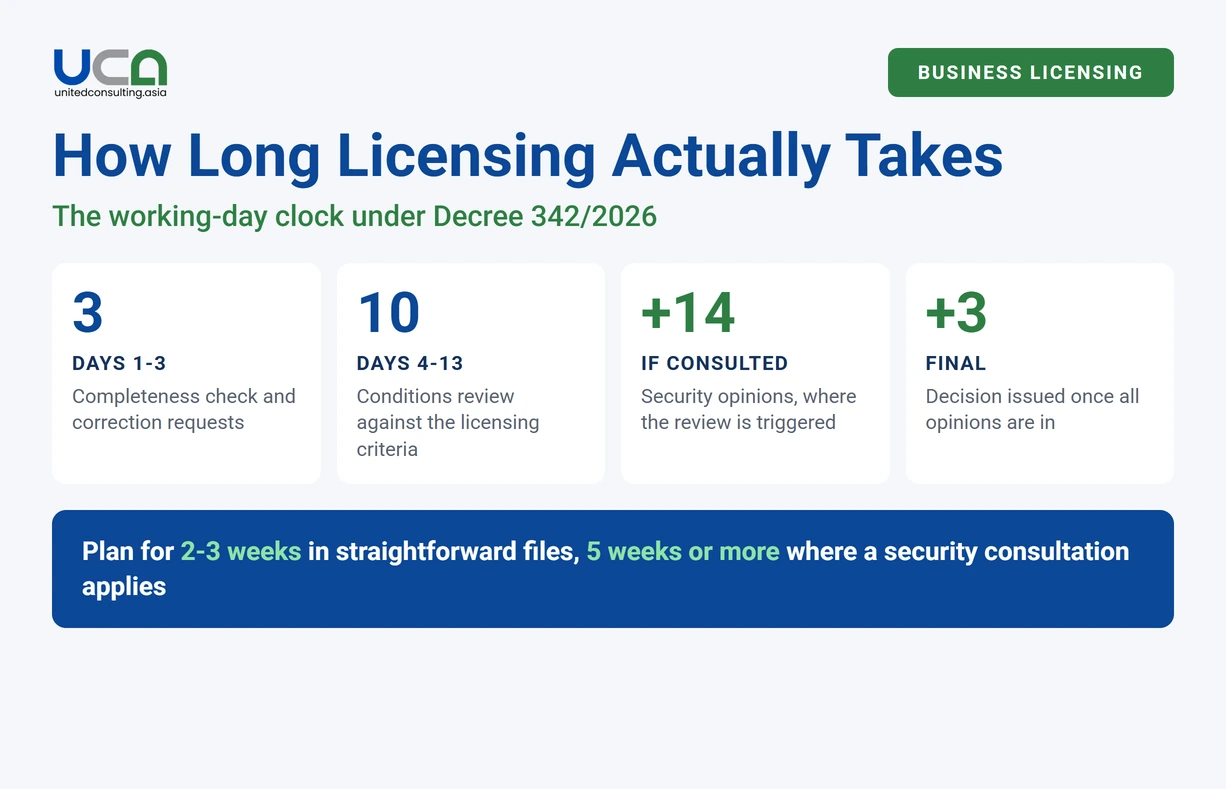
If the national databases can retrieve those records, the copies are waived. The clock then runs as follows:
- 3 working days for the authority to check completeness and request corrections.
- 10 working days to review the applicant’s satisfaction of the licensing conditions.
- 14 working days for the two ministries to reply where consultation applies, followed by 3 working days for the final decision.
Plan for roughly two to three weeks in straightforward files, and five weeks or more where a security consultation is triggered.
What Happens If the File Triggers a Security Review?
Consultation is targeted rather than universal. It applies in four cases:
- Investors from countries without relevant treaty commitments.
- Activities and goods outside Vietnam’s market-opening commitments.
- Foreign-controlled operators of large covered platforms.
- Retail networks reaching the prescribed scale: 100 outlets below 500 square metres, 50 outlets of 500 to under 3,000 square metres, or 30 outlets of 3,000 square metres and above.
If your expansion plan lands in one of these cases, build the consultation period into the opening timetable from the start.
What Should Foreign Traders Do Now?
A working checklist for the first quarter under the new rules:
- Map the actual sales model. List who buys, how goods reach them and through which channels, then compare each activity against the nine licensed groups.
- Confirm treaty status. The nationality of the investor and the applicable commitment decide both market access and ENT exposure.
- Re-read existing licences against current business. Validity is not the issue. Description is. Divergence calls for an adjustment under the new procedures.
- Calendar the compliance dates. Periodic reports fall before 15 January and 15 July each year, and renewal windows open three months before each licence expires.
- Treat inactivity as a risk. An unreported stoppage of more than 12 months can cost the licence, and a refusal applies to any new application for the same licence for two years.
- Sequence M&A licensing before closing. The 12-month operating window is generous, but the 30-day filing deadline is not.
The broader routine sits in the annual compliance checklist for foreign-owned companies.
Conclusion
Decree 342/2026/ND-CP is a modernisation rather than a crackdown. The new framework simplifies several licensing conditions while retaining formal review periods and additional procedures for national-security consultation or the Economic Needs Test. Retail expansion gets easier where commitments exist, and the state’s attention shifts to what happens after licensing: Accurate descriptions, active operations and targeted security scrutiny for the largest networks. Foreign traders who know their model, their treaty position and their licence descriptions should find the new framework friendlier than the old one.
Every step above sits on top of the business-line groundwork in our three-question test. Getting the categories right first turns every step behind it into filing, not firefighting.
Thinking about entering or expanding in Vietnam? Contact United Consulting at info@unitedconsulting.asia to map how the new licensing rules apply to your business model.