The certificates are in your hands and the keys are yours. You still cannot legally open. Between company setup and commercial operations sits a second layer of permits that Vietnamese practitioners call Giấy phép con, or sub-licenses.
This layer sits on top of the Law on Investment No. 143/2025/QH15 and Decree No. 96/2026/ND-CP, and it is where founders get burned. If you have read our three-question test, you know which category your line falls in.
Our guide to the two documents that create a project covers the first half. This article covers what comes after.
TL;DR – An Investment Registration Certificate (IRC) and an Enterprise Registration Certificate (ERC) create your company. They do not authorize it to trade. Six permit families are the usual set: Fire safety, Food safety, Security and order, Environmental protection, Goods trading, and Work permits for foreign staff. Which ones bite you depends on the activity and the premises. Each is issued by a different authority and keyed to your registered lines and your premises. For qualifying projects, industrial parks can replace several approval steps with a single written commitment, while the sector duties behind them remain. Apply before you open, not after the first inspection.
This is our eighth article in our ongoing legal series. You may refer to the others here:
- The Three-Question Test: Is Your Business Line Prohibited, Conditional, or Actually Allowed in Vietnam?
- The Two Documents That Create a Project in Vietnam: Investment Policy Approval and the IRC
- CPC vs VSIC Codes in Vietnam: The Mismatch That Can Derail Your Registration
Why Does the IRC Not Let Me Open?
Because the IRC and the ERC answer two different questions. The IRC says the State accepts your project. The ERC says your company exists.
Neither says your company has met the conditions attached to what it plans to do. Those conditions are a separate legal layer, and they are the reason a registered company can still be shut down for operating without permission.
What Is a Giấy Phép Con?
The phrase literally means “child license”. It is the everyday name for any operational permit issued after your company exists. Not a legal term of art. A description of the second half of market entry.
Article 7 of the Law on Investment sets out five ways a business investment condition can be fulfilled. They are a license, a certificate, a practice credential, a written confirmation or written approval, and simply meeting the requirements with no paper issued. Sub-licenses are the first four of those five.
Which Sub-Licenses Does Your Business Need?
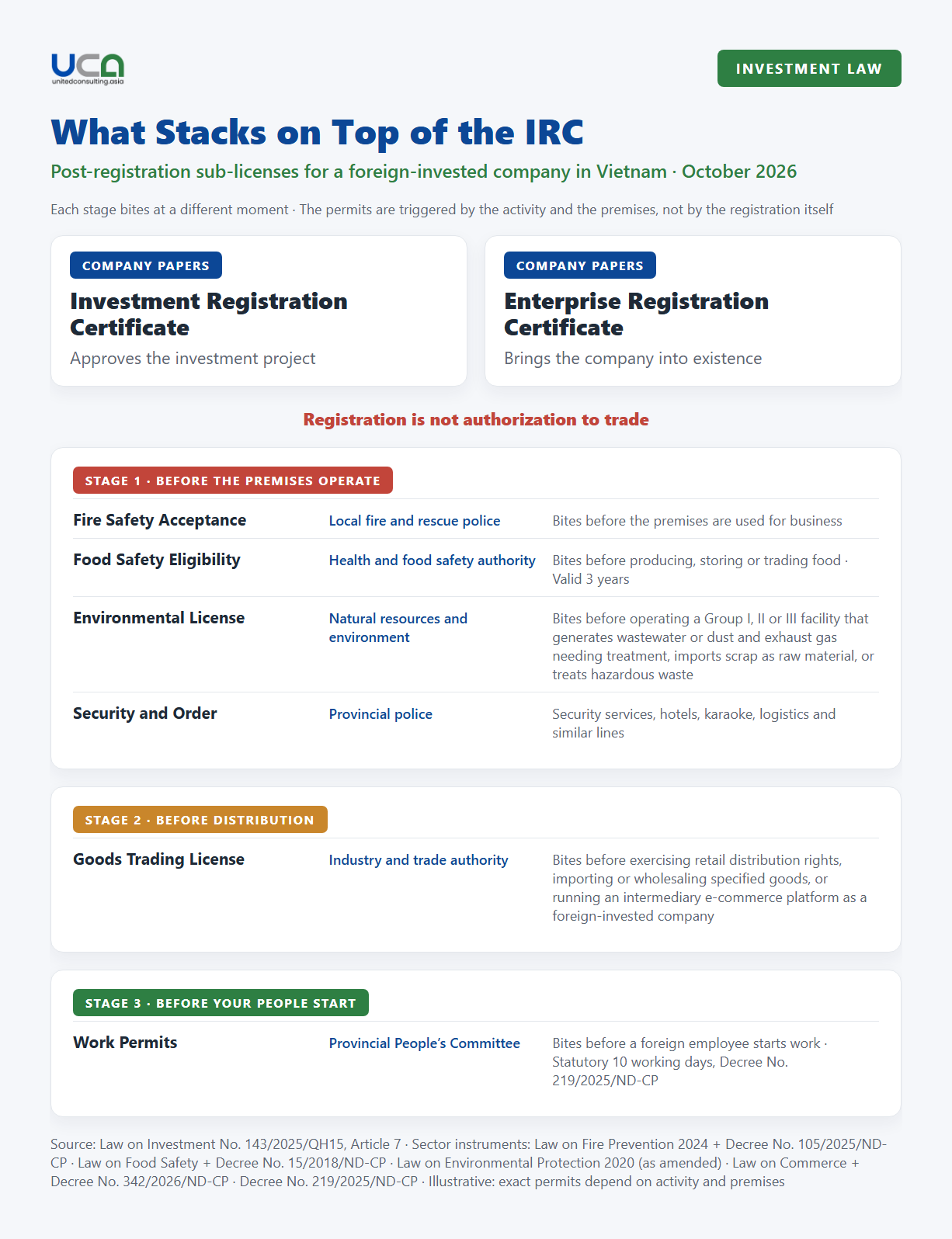
Six families cover most of what surprises founders. They are not one uniform second stage: Some are company licenses, and some attach to a specific premises or machine.
The work permit is an authorization for a foreign worker rather than for the company. The table gives the working picture as of October 2026.
Want a permit map for your project? Email info@unitedconsulting.asia.
The Six Permit Families
| Sub-License | Issued by | It bites when | Core instrument |
|---|---|---|---|
| Fire Safety Acceptance | Local fire and rescue police | Before the premises are used for business, where the law requires acceptance | Law on Fire Prevention, Fighting, Rescue and Salvage 2024, Decree No. 105/2025/ND-CP, as amended by Decree No. 347/2026/ND-CP |
| Food Safety Eligibility | Health and food safety authority | Before producing, storing or trading food where the certificate applies (statutory exemptions exist) · Certificate valid 3 years | Law on Food Safety, Decree No. 15/2018/ND-CP |
| Security and Order | Provincial police | Security services, hotels, karaoke, logistics and similar lines | Decree No. 96/2016/ND-CP |
| Environmental License | Provincial Department of Agriculture and Environment | Before operating a Group I, II or III facility that generates wastewater or dust and exhaust gas needing treatment, imports scrap as raw material, or treats hazardous waste | Law on Environmental Protection 2020 (as amended), Decree No. 08/2022/ND-CP |
| Goods Trading License | Department of Industry and Trade, or the Ministry of Industry and Trade | Before exercising retail distribution rights, importing or wholesaling specified goods, or running an intermediary e-commerce platform as a foreign-invested company | Law on Commerce, Decree No. 342/2026/ND-CP |
| Work Permits | Provincial People’s Committee, through the Department of Home Affairs | Before the foreign employee starts work | Labor Code, Article 157, and Decree No. 219/2025/ND-CP |
Plenty of lines add their own. Alcohol distribution, education, healthcare, transport and pharmaceuticals each carry sector permits with their own names. The six above are simply the ones that surprise founders most often.
What Decides Which Sub-Licenses Apply to You?
Two inputs. Only two.
- Your registered business lines. A conditional line usually has its own conditions layered on top. Our 142 conditional business lines article names them.
- Your premises and your activity. A restaurant pulls in fire safety and food safety regardless of anything else. A software office in a serviced building may need neither.
Foreign-invested companies meet one extra trap. Buying and selling goods is a licensed activity in its own right. A manufacturer that starts selling what it did not produce is trading. If goods trading is not in the registered scope, the sales are the problem.
This is also where our CPC versus VSIC explainer earns its keep. The codes you register decide the permits you need.
Can an Industrial Park Spare You the Paperwork?
Sometimes, yes. The special investment procedure has existed since early 2025, under Article 36a of the Investment Law (inserted by Law No. 57/2024/QH15) and Decree No. 19/2025/ND-CP. The 2025 Investment Law carries it forward in Article 28 and expands it for qualifying projects in industrial parks, export processing zones, high-tech zones and similar areas.
How the Special Investment Procedure Works
Under Article 28 of the Law and Articles 46 and 47 of Decree No. 96/2026/ND-CP, a project registered this way replaces whole stacks of procedure with a written commitment. No separate investment policy approval steps. No technology appraisal.
No full environmental impact assessment dossier. No detailed planning or construction permit steps. And no separate approvals in construction and fire prevention and fighting.
Read that carefully. The commitment replaces the paperwork, not the obligations. Fire safety standards still apply to the building. The decree also lists the project types that cannot use the route.
If the location is still an open question, our guide to Vietnam’s industrial parks covers the options, and our factory setup cost guide covers the numbers.
How Long Does Each Sub-License Take?
Short statutory periods, longer real ones. Fire safety acceptance runs roughly 5 to 10 working days with complete documentation.
A goods trading license runs 15 to 25 working days in practice. The statutory period for the business license is 10 working days from a complete dossier under Decree No. 342/2026/ND-CP, and work permits follow the statutory 10 working days under Decree No. 219/2025/ND-CP.
Sub-License Processing Times 2026
The timeline that matters runs backwards from your opening date. Several permits need physical things first: Completed fit-out for fire acceptance, trained and medically cleared staff for food safety, and equipment and layouts for environmental registration.
Founders who treat sub-licenses as paperwork discover they are really construction and hiring tasks.
Which Mistakes Cost Founders the Most Time?
- Applying after the fact. Fines arrive for operating without the permit, and in conditional lines the registration authority can order suspension of the activity itself.
- The wrong premises. Fire and environmental permissions attach to a specific site. Moving mid-application resets work that was done.
- Scope drift. If the registered lines do not cover the activity, the sector authority can refuse the permit outright. Fix the scope first.
- Expiry blindness. Some sub-licenses are time-limited. A food safety certificate runs three years.
- Assuming the ERC change is enough. Adding a line records a wish. The sub-license grants permission.
Several of these sit in our round-up of the common mistakes when setting up a business in Vietnam. None of them is exotic. All of them cost weeks.
What Should You Do Before Signing the Lease?
- Fix your registered lines and scope. Everything downstream keys off them.
- Map the premises and activity to the permit families above.
- Check whether the special investment procedure applies to your location.
- Apply against a timeline that ends at your opening date, not at your lease signature.
Conclusion
Treat sub-licenses as the second half of market entry, not as an afterthought. The permits decide the opening date, not the fit-out.
You cannot start the permitted activity while its application is pending, because the law looks at whether the permit was held when the activity began. And an informal green light from a local officer counts for nothing. Open after the permits, not alongside them, for any activity that needs one.
Thinking about entering or expanding in Vietnam? Contact United Consulting to discuss which sub-licenses your project needs. Email info@unitedconsulting.asia.