International business events are choosing Vietnam for a simple reason: The access, the venues and the cost base finally line up at once. The industry calls the sector MICE, short for meetings, incentives, conferences and exhibitions, and Vietnam’s is now valued at around US$6 billion. The visitor numbers behind it keep climbing. Nearly 21.2 million international visitors were recorded in 2025, up 20.4% on the year before, against the 2026 arrivals target of 25 million. For companies deciding where to hold a regional conference or an incentive trip, that combination is hard to ignore.
TL;DR – Vietnam’s meetings, incentives, conferences and exhibitions market is valued at around US$6 billion and growing, backed by visa reforms, a national tourism promotion plan and a dense calendar of international exhibitions. The pull is the mix of modern venues, improving air access and lower costs than regional rivals. This article covers what is driving the shift, which city and venue to shortlist, how Vietnam compares with its neighbours, and what planners should weigh before committing.
Two earlier pieces frame the business context behind the events boom. Singapore’s investment in Vietnam explains why the corporate audience keeps expanding, and delegates who extend a stay past the closing session usually start asking different questions, which our living and working in Vietnam guide answers.
Why Are International Business Events Choosing Vietnam?
Three shifts landed close together. Entry for visitors got easier, purpose-built venues opened their doors, and the government started treating business events as a growth line rather than a by-product of tourism. Each shift is recent, and together they change the maths for a planner comparing host cities across Southeast Asia.
What Changed in the Visa Regime?
Delegates used to plan around paperwork. Unilateral visa exemptions, extended stays and the expanded electronic visa scheme, now issued with longer validity, removed most of that friction, and the tourism authority credits the changes with lifting inbound volumes through 2024 and 2025. Fewer approval steps means fewer dropped registrations, which is the quiet fear behind every international conference. The practical effect is simple. Organisers spend less time chasing invitation letters and more time on the programme itself.
What Is the Government Doing About It?
Promotion is now deliberate rather than accidental. The 2026 tourism promotion plan published by the Vietnam National Authority of Tourism runs a dedicated MICE programme across key Asian markets, complete with familiarisation trips for organisers and buyers. In August 2026 the Minister of Culture, Sports and Tourism described business events as a strategic segment capable of leading the sector’s next phase. When a national plan schedules roadshows specifically for event organisers, the supplier ecosystem around it matures faster, and planners notice.
How Big Is the MICE Opportunity in Vietnam?
Industry delegates put the market at roughly US$6 billion in August 2026, a figure carried in coverage of the national MICE promotion push. A commercial study by Mordor Intelligence, measuring the wider MICE industry on a different methodology, values it at US$7.28 billion for 2025 and forecasts US$10.31 billion by 2031, a compound growth rate near 6%. The two figures measure different things, but both point the same way.
The composition matters more than the headline. On Mordor Intelligence’s base-year data:
- Meetings account for the largest share of activity.
- Exhibitions are the fastest-growing segment.
- Corporate clients make up about half of all participants.
- Manufacturing multinationals accounted for around 37% of inbound meetings in 2025, which spreads demand across the year instead of concentrating it in one season.
For a planner, that steady baseline matters more than any single blockbuster week.
Hanoi and Da Nang follow the same curve from different angles. The capital pairs its convention facilities with government-facing access, while central Vietnam’s coast sells the after-hours programme as much as the meeting room. Incentive buyers have discovered that a beach evening closes a sales conference differently than a hotel ballroom.
How Does Vietnam Compare With Its ASEAN Neighbours?
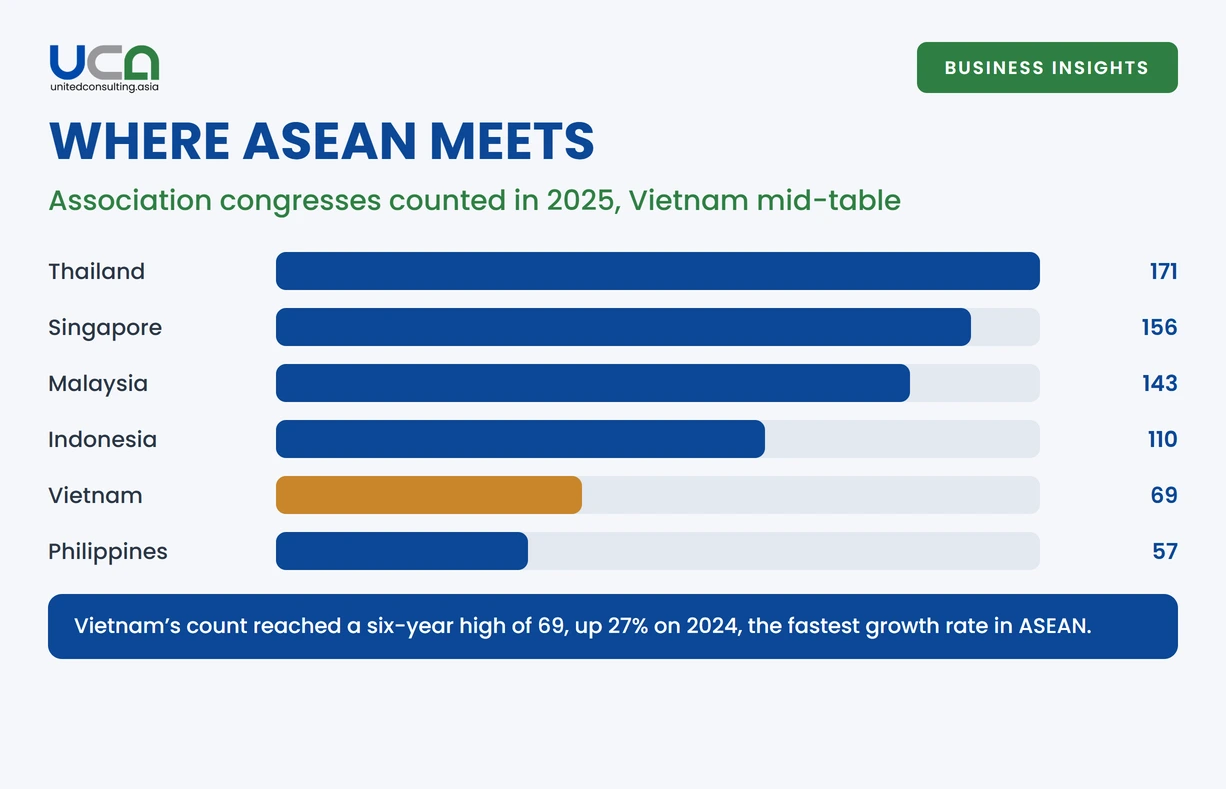
On association congresses, the International Congress and Convention Association (ICCA) counted 69 meetings in Vietnam for 2025. That places Vietnam behind Thailand, Singapore, Malaysia and Indonesia, but ahead of the Philippines. The count covers qualifying international association congresses only, not corporate conferences, exhibitions, domestic meetings or incentive trips. The regional stack of ICCA association meetings in 2025 looks like this:
- Thailand: 171
- Singapore: 156
- Malaysia: 143
- Indonesia: 110
- Vietnam: 69
- Philippines: 57
Mid-table with room to grow is a fair summary, and the exhibition pipeline supports that reading. The Saigon exhibition calendar for late 2026 alone runs from coffee and franchise shows to water, energy, food, laboratory and medical expos within a single month.
Why Is Thailand at the Top of the Table?
Thailand leads ASEAN for a reason that is easy to name and hard to copy. The country treats business events as an export industry, and it funds the machinery that wins them.
What Does the Thai Model Actually Do?
The Thailand Convention and Exhibition Bureau runs the whole funnel. It maintains sixteen designated MICE cities with regional promotion offices, markets them through roadshows in target markets such as India, China and Indonesia, and backs organisers with case-by-case financial support for upgraded exhibitions. The result shows up in the hard data. Thailand leads ASEAN in exhibition space, and Bangkok and Phuket rank among the region’s most cited host cities.
What Does Singapore Sell That Others Cannot?
Singapore sells certainty. It has topped the ICCA meeting-city rankings for Asia Pacific for twenty-three consecutive years, according to the Singapore Tourism Board, hosting 156 association congresses in 2025 alone, and Changi Airport connects 170 cities through around 100 airlines. The Singapore Tourism Board adds its own layer, from hotel incentive schemes that pull delegates into the city to sustainability certifications across every purpose-built venue. Organisers pay a premium for a city where nothing goes wrong.
What Is Holding Vietnam Back?
Honestly, not the product. Vietnam has the venues, the coastline and the price point, and recent visa reforms have made it more accessible to many international visitors, although organisers should still verify entry requirements for every delegate nationality. What it lacks is the go-to-market layer the leaders run. Vietnam promotes tourism nationally and runs a MICE agenda, but it fields no single bureau bidding for congresses the way the Thailand Convention and Exhibition Bureau does, bid support for local associations is thin, and international marketing still splits across tourism and trade bodies.
Congress bidding is the clearest case: Winning an international association congress takes years of relationship work and a funded bid. Thai and Singaporean destinations run that machinery at national level, so winnable congresses often go to better-supported rivals.
What Would Move the Needle for Vietnam?
Three moves would change the ranking.
- A dedicated bid fund that helps local associations compete for congresses.
- Partnerships that put Vietnamese chapters of international associations at the centre of the calendar.
- One coordinated marketing story rather than several.
The visa wins and the venues are already in place. The bidding machine is the gap.
What Events Are Actually Happening in Vietnam?
The clearest evidence of a destination is a full calendar, and Vietnam’s is busy.
- Ho Chi Minh City hosted the 20th edition of its international travel expo in August 2026, with a dedicated forum on MICE tourism and familiarisation delegations flown in from Japan, France, Australia, the United States and Singapore.
- The final quarter of 2026 sees the city’s main exhibition centre list back-to-back trade shows spanning coffee, franchising, water technology, energy, food, laboratory equipment and pharmaceuticals.
- Hanoi’s venues track a similar pattern with industry congresses and consumer expos.
For a planner, density is a feature rather than a warning. A mature supplier market develops where events happen often, and hotel and production capacity gets built in response to real bookings, not forecasts.
Which City Should You Host In?
Vietnam is really three event destinations in one country, and the right choice depends on the audience rather than the budget. The three cities compete less with each other than with Bangkok, Kuala Lumpur and Singapore, and each has a distinct pitch.
- Ho Chi Minh City for commercial gravity. The largest exhibition centre in southern Vietnam sits here, the hotel base is deep, and the calendar is the busiest in the country. Best fit for trade shows, dealer conventions and partner summits.
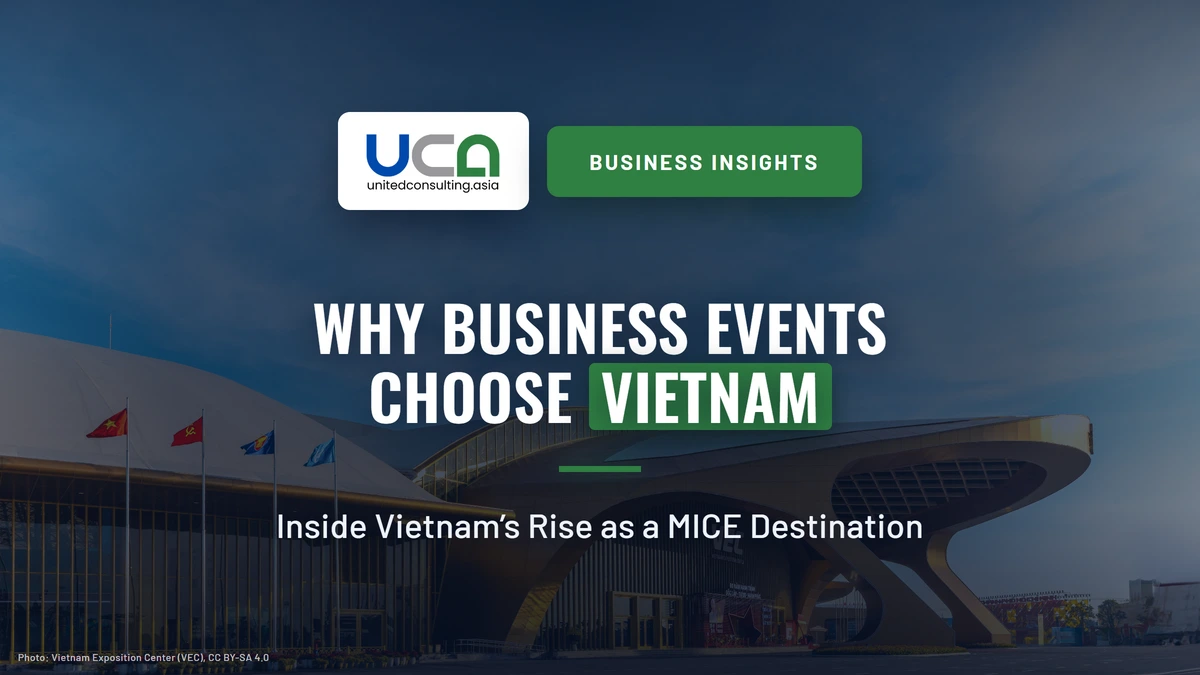
- Hanoi for institutional and association events. The capital’s convention facilities have hosted major regional summits, and the new Vietnam Exposition Center in Dong Anh has added Southeast Asia’s largest exhibition complex. Best fit for policy-linked congresses and academic gatherings.
- Da Nang for incentive trips and conferences that blend work with downtime. Central Vietnam’s resort coastline is the fastest-growing part of the market, and the tourism authority has led its MICE roadshows through this region. Best fit for retreats and reward travel.
What Should Planners Weigh Before Committing?
The destination pitch is easy. The execution questions are where events succeed or quietly fail, and each one has a Vietnam-specific answer.
Which Checks Matter Most Before You Sign?
- Delegate access. Check visa requirements per nationality early, even with exemptions and long-validity electronic visas in place. Build a fallback list of nationalities that need invitation letters.
- Season and weather. Northern winter is cool and clear, central coast storms peak late in the year, and summer heat affects outdoor incentive programmes. Match the format to the forecast window.
- Venue fit. Match head count to the actual hall capacity, not the venue’s marketing figure, and confirm power, rigging and interpretation facilities before signing.
- Lead time. Popular venues book out around the autumn exhibition peaks. Six to nine months of runway is comfortable, and more is better for large international congresses.
- Local suppliers. Production, staging and translation quality varies across providers. Ask for references from comparable international events before committing.
- Budget shape. Venue and production costs typically land below Singapore’s, but translation, rigging and imported audio-visual kit can narrow the gap. Price the full package, not the hall.
Planning a conference, incentive trip or trade delegation in Vietnam? Email info@unitedconsulting.asia to talk through your plans.
Conclusion
Vietnam’s case as an events destination rests on three legs: An open door for visitors, venues that handle serious international programmes, and a cost base that goes further than the regional alternatives. The market is large enough to have real depth and young enough to reward planners who arrive early. The country’s standing in the regional rankings has room to climb, and the pipeline suggests it will.
Events are often the first step of a longer story. If the visit turns into a market entry, our guide to the new licensing rulebook covers what comes next.
Thinking about entering or expanding in Vietnam? Contact United Consulting at info@unitedconsulting.asia to map how hosting business events in Vietnam could support your plans.