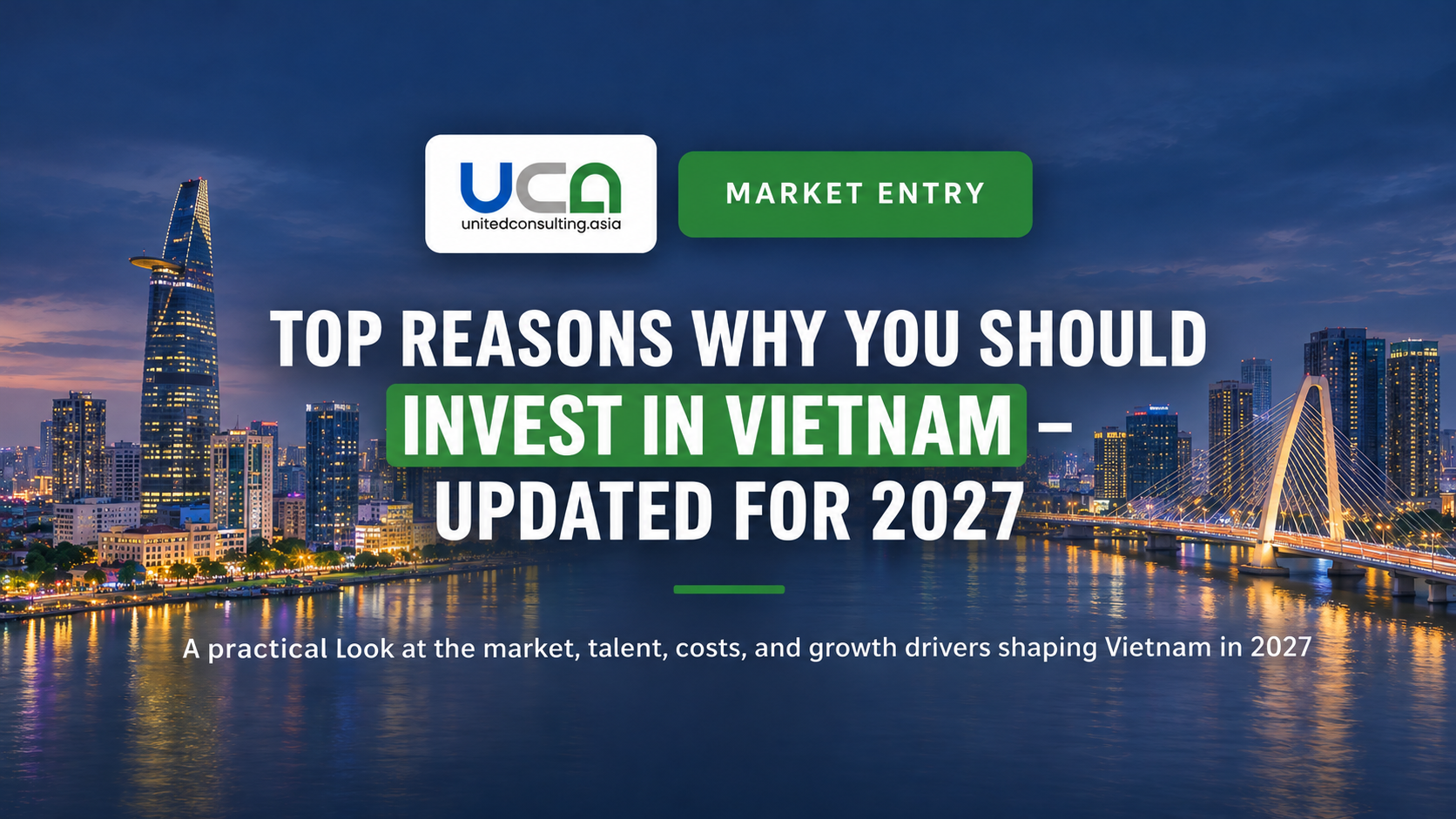
Top Reasons Why You Should Invest in Vietnam – Updated for 2027
Vietnam has spent the last few years moving from “interesting option” to “standard part of the plan” for international investors. Vietnam is definitely the smart choice for startups, entrepreneurs, and digital nomads in 2027. Strong economic growth, a swelling middle class, and a durable role in global supply chains explain the attention. If you are making your first serious look at the market – particularly with 2027 budgets and timelines in mind – here is the short version of why investing in Vietnam makes sense, from the business environment to the sectors where the money is actually going.
Vietnam’s Strong Economic Fundamentals – Why You Should Invest in Vietnam
The numbers set the tone. Vietnam grew 8.02% in 2025 (National Statistics Office) – its second-fastest year in the 2011-2025 period – and kept momentum with 7.83% growth in the first quarter of 2026. The National Assembly’s April 2026 resolution goes further, targeting average growth of at least 10% a year from 2026 to 2030 and GDP per capita of US$5,400-5,500. That is an ambitious target, but it is backed by policy, and in July 2026 the World Bank reclassified Vietnam as an upper-middle-income economy – a milestone that changes both the consumer profile and the project pipeline.
Foreign investors have been backing the thesis with money, not memos: US$38.4 billion of registered FDI in 2025, of which US$27.6 billion was actually disbursed. Disbursements have kept running ahead of 2025’s pace through 2026 – roughly 13% higher year on year in the first ten months. Capital that lands and gets spent is the honest signal in any market, and Vietnam’s has been compounding for years.
The consumer side is where this pays off. The middle class is projected to roughly double its share of the population, from about 13% in 2023 to around 26%, and that shift is already visible in spending on retail, healthcare, education, and technology. Through the global shocks of recent years, the government has kept investing in infrastructure, offering incentives to foreign businesses, and adjusting policy to keep investment flowing – which is the kind of stability investors actually price in.

Vietnam’s Strategic Advantages for Investment
- Strategic Location and Access to Major Shipping Lanes
- Vietnam’s coastline of over 3,200 kilometers sits astride the main East Sea shipping routes, with deep-water port complexes such as Cai Mep-Thi Vai serving container traffic directly. For companies running a “China + 1” strategy, that means diversified production without giving up Asian logistics networks.
- Proximity to Key Asian Markets
- China, India, South Korea, Japan, and Singapore are all a short hop away, making Vietnam both a consumer market of 100 million-plus people and a staging point into the wider Asia-Pacific region.
- Free Trade Agreements (FTAs) and Regional Trade Partnerships
- By late 2026 Vietnam had 18 free trade agreements in force or signed, covering the major economies its exporters sell to: the CPTPP (in force since 2019), the EU-Vietnam FTA (2020), the UK-Vietnam FTA (2021), RCEP (2022), the Vietnam-Israel FTA (signed 2023), and the EFTA agreement with Switzerland, Norway, Iceland, and Liechtenstein, signed on 18 October 2026 and pending entry into force. Few export platforms offer that depth of preferential access.
- Developed Industrial and Economic Zones
- Vietnam’s Economic Zones (EZs) and Industrial Parks (IPs) are the backbone of its manufacturing appeal. Established operators such as VSIP in Binh Duong and DEEP C near Hai Phong offer ready-built factories, reliable power, on-site customs support, and the tax incentives that come with the zone. Plants in these parks feed supply chains into China, Europe, and the Pacific.
- Competitive Labor Costs and Skilled Workforce
- Wages remain competitive well into the next planning cycle. From 1 January 2027, the regional minimum wage (Decree 399/2026/ND-CP) runs from VND 4.04 million to VND 5.70 million a month, roughly US$155-219 depending on location – still well below China’s coastal rates. Behind that sits a population of over 101 million with a median age of about 33 and a working-age population near 69 million, increasingly fluent in new technology and joined each year by returnees with international education and work experience.
- Logistics Hub Potential
- The national logistics strategy now targets a top-40 place in the World Bank’s Logistics Performance Index and a logistics value-added share of 5-7% of GDP by 2035. The hardware is following: the North-South expressway program, Ho Chi Minh City’s Metro Line 1 (operating since December 2024), and Long Thanh International Airport under construction near Ho Chi Minh City.
- Evolving Production Base and Manufacturing Value Chain
- This is no longer just an assembly story. Samsung is Vietnam’s largest foreign investor, with over US$23 billion committed and about half of its global smartphones made in the country – its Bac Ninh and Thai Nguyen plants built their 2 billionth handset in June 2025, and a US$1.5 billion semiconductor testing plant is in the works. LEGO opened its US$1 billion-plus Binh Duong factory in April 2025. Apple’s main assembly partners, Luxshare and GoerTek, run large plants in the north. The government’s incentive policy now explicitly favors projects bringing new technology and higher-value processes.
- Growing Tech Sector and E-Commerce Market
- Vietnam’s digital economy was worth about US$39 billion in gross merchandise value in 2025, up 17% year on year, with forecasts of US$85-190 billion by 2030 (e-Conomy SEA 2025, Google, Temasek, and Bain). Digital payments alone moved some US$178 billion in 2025. Cheap, fast internet and a consumer base that has shifted shopping online make the digital economy one of the cleanest growth stories in the country.
- Favorable Demographics and Growing Urban Population
- With more than 101 million people and one of Southeast Asia’s largest working-age populations, Vietnam has the labor depth to staff new factories and the consumer mass to support them. Urbanization continues around Hanoi, Da Nang, and Ho Chi Minh City, pulling demand for housing, services, and infrastructure with it.
- Vietnam and the China+1 Strategy
- Companies are still diversifying out of China, but the bar has risen. Under the October 2025 US-Vietnam trade framework, the United States maintains a 20% reciprocal tariff on Vietnamese goods while working toward zero rates on selected products, and applies a 40% rate to goods merely transshipped through the country. The practical lesson for 2027 planners: real production in Vietnam – real factories, real value addition – is what earns preferential treatment. Relabeling is not a strategy.
Vietnam’s Favorable Business Environment
- Stable Political System
- Vietnam’s political environment is predictable by regional standards, and long-horizon commitments – infrastructure, incentives, FDI policy – have survived multiple leadership transitions. For capital that takes years to deploy, predictability matters more than headlines.
- Open Economy
- Trade is the country’s growth engine: goods exports reached US$475 billion in 2025, up 17% year on year. With 18 trade agreements behind that performance, Vietnam offers one of the most open trading platforms in Southeast Asia for companies serving Asia, Europe, and North America from one production base.
- Competitive Corporate Tax Rate
- The standard corporate income tax rate is 20%, and qualifying projects typically pay less: preferential rates of 10-17% run for 10-15 years, often with four years of full exemption and a 50% reduction for up to nine years. One caveat for large groups: the 15% global minimum tax (Resolution 107/2023/QH15, applying from fiscal year 2024) limits the value of tax holidays for multinational groups with consolidated revenue above EUR 750 million, which is why Vietnam is competing increasingly on infrastructure and workforce rather than tax alone.
- Government Incentives for Foreign Investors
- Incentives cluster around Economic Zones, Industrial Parks, encouraged sectors, and disadvantaged regions: reduced land rents, tax holidays, and import duty relief on equipment. The Investment Law 2025, in force since 1 March 2026, also created a special incentive tier for large, high-technology projects that meet investment and disbursement thresholds.
- Focus on Infrastructure
- Infrastructure spending remains a national priority: the North-South expressway program, Long Thanh International Airport, deep-water port expansion, and urban metro lines in Hanoi and Ho Chi Minh City are all either operating or under construction. For investors, the improvement that matters most is reliability of power and road links to industrial parks, and both are where the money is going.
- Developing Digital Economy
- As covered above, the digital economy is compounding fast – about US$39 billion of GMV in 2025 and a projected US$85-190 billion by 2030 – with e-commerce, fintech, and digital services pulling in investment. Vietnam’s IT services industry is scaling with it: FPT Software alone booked US$1.33 billion in global IT services revenue in 2025, and Kearney’s 2023 Global Services Location Index ranked Vietnam 7th in the world for offshore services.
Vietnam Investment Opportunities in Key Sectors
- Manufacturing
- Still the main draw for foreign capital. Electronics (Samsung, Luxshare, GoerTek), toys and consumer goods (LEGO), textiles, footwear, and automotive components all have deep supplier bases here – and the anchor tenants are genuine exporters: Samsung’s Vietnam plants alone accounted for about 12% of the country’s goods exports in the first seven months of 2026. The government’s preference for higher-value, technology-bearing projects is steadily shifting the mix up the value chain.
- Technology and IT
- Software outsourcing and digital services are the second wave. Vietnam trains engineers aggressively, the cost base is competitive, and the proof is in the export numbers – FPT Software’s US$1.33 billion of global IT services revenue in 2025 is one company’s share of a much larger industry. Investors in online retail, digital services, and fintech find both the talent and the fast-growing domestic customer base here.
- Consumer Goods and Services
- The middle-class expansion is the demand story. Rising disposable income is lifting spending on quality consumer goods, healthcare, education, and leisure, from premium imports to everyday essentials – and the fastest-moving slice is online: the digital economy grew 17% in 2025, with regional platforms and local retailers competing hard for the Vietnamese shopper. A market that rewards brands which localize early.
Market Entry: What to Get Right Before You Invest
Thorough market research comes first: local consumer behavior, regional demand, and the industry rules that apply specifically to your product. Cultural fluency is not soft stuff – it decides how fast negotiations and approvals move. On top of that groundwork, four practical levers determine how smoothly your first year goes.
- Local Partnerships
- A credible local partner – a distributor, a landlord, a co-investor, or a professional advisory firm – shortens the learning curve on regulation, consumer behavior, and hiring. Done right, they introduce you to the customers, suppliers, and employees that would otherwise take years to find.
- Compliance
- Vietnam’s legal framework keeps evolving – the Investment Law changed again in March 2026, the amended Enterprise Law took effect in July 2025, and a new VAT Law has applied since July 2025 – and the cost of staying compliant is far lower than the cost of fixing it later. Outsourcing functions like company setup and accounting and tax compliance to people who track the changes keeps you out of the expensive mistakes.
- Outsourcing Essential Business Functions
- Company setup, accounting, recruitment, and HR administration are all functions you can rent before you need them at full scale. Founders who outsource the admin spend their first year on customers and product instead of filings and queues.
- Work Permits and Visas
- Bringing in foreign staff means work permits, temporary residence cards, and a file that matches what the authorities expect to see. A complete work permit application is normally processed within five working days and the permit runs for up to two years, renewable once under the rules in force since December 2025. Getting the file right early makes later transfers routine; getting it wrong delays your own people.
The Bottom Line for 2027
Vietnam in 2027 offers what most markets cannot: 8%-plus growth off a US$500 billion-plus economy, 18 trade agreements, wages that remain competitive despite repeated minimum-wage increases, and an industrial base that now includes Samsung, LEGO, and Apple’s main assembly partners. The trade environment is tougher than it was – the US tariff framework rewards genuine production and penalizes transshipment – so the planning question is no longer whether Vietnam belongs on the list, but what exactly you will build and run here.
That planning works better with local help. Company setup, accounting, recruitment, and compliance are all functions where experienced local partners save months of trial and error, leaving you to scale the business rather than administer it.
At United Consulting, we work with entrepreneurs and businesses on market entry, compliance, and operations in Vietnam. Whether you need to read the regulatory environment, hire your first team, or get a company running without detours, we have done it before – usually this month.
Talk to United Consulting about your Vietnam plans and turn the market thesis into an operating company.