
Executive hiring in Vietnam is hard for a specific reason. The country produces plenty of graduates and mid-level professionals, but very few executives who can satisfy a regional headquarters and the local market at the same time. Recruiters put numbers on it.
Vietnam Salary Survey 2026 found around 80% of Vietnamese employers struggling to find qualified candidates. For companies expanding into Vietnam, the leadership search deserves as much attention as the business plan it has to execute.
TL;DR – Vietnam’s executive talent market is tight at the top, with senior salaries approaching regional levels and C-suite moves commanding double-digit jumps. The profile everyone wants is a bridge candidate who combines local fluency with international standards, and that combination is scarce. This article covers what senior talent costs in 2026, the trade-offs between expatriate, local and returning Vietnamese candidates, why standard recruiting channels miss executives, and how to keep the leader you hire.
Two posts frame the compensation question before you start. The CPF and social insurance comparison explains how Vietnamese employment costs differ from Singapore’s, and our employee benefits guide separates the statutory floor from what senior candidates actually expect.
Why Is Executive Hiring So Hard in Vietnam?
Scarcity at the top is structural rather than cyclical. Foreign direct investment has grown faster than the supply of leaders who have actually run cross-border teams, and formal credentials are now table stakes rather than differentiators.
What is scarce is the executive who can drive a transformation programme, report to a regional board in its own language, and still navigate local relationships with credibility. Vietnam’s fastest-growing employers, from new northern factories to technology centres, are all competing for that same profile.
Where Does the Leadership Pipeline Come From?
Vietnam’s senior talent pool concentrates in three places. Multinational country desks carry regional governance experience, returning overseas Vietnamese bring international operating habits, and large domestic groups have grown their own commercial leaders.
Where Does the Pipeline Actually Break?
The pipeline is widening, but slowly. More Vietnamese professionals are returning after careers in Singapore, Australia, the United States and Europe, and regional companies keep hiring Vietnamese managers into regional roles. The catch is timing. A professional who left as a senior manager comes back as a director a decade later, and the market’s demand curve is steeper than that supply curve.
What Does a Senior Hire Actually Cost in 2026?
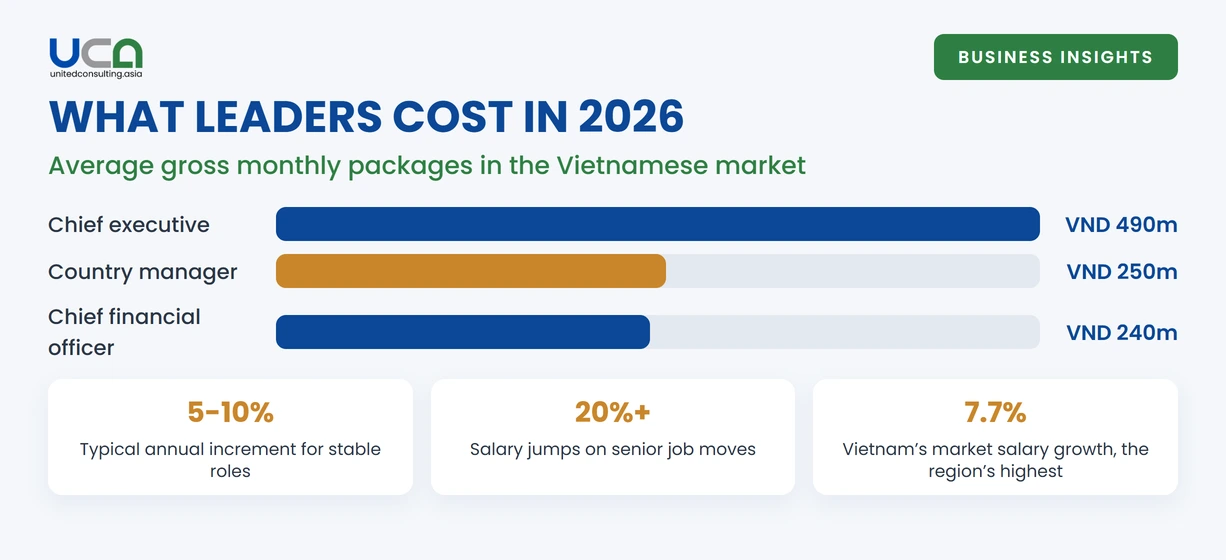
Vietnam salary guides for 2026 give a workable range. A country manager commands a gross monthly package averaging around VND 250 million, with the band stretching from roughly VND 190 million to VND 600 million depending on sector, company scale and role scope.
Chief financial officers sit in a similar range, and chief executive packages run higher still. Annual increments typically land between 5% and 10% for stable roles, while managerial moves command more and senior role changes can require materially higher packages depending on the role, company and candidate.
What Should a Senior Package Include?
Base salary is only the headline. Competitive senior offers typically combine five elements:
- Performance bonus. Tied to personal and company targets.
- Long-term incentives. Vesting hooks that keep leaders through the first transformation cycle.
- Car or transport allowance. Standard at this level in Ho Chi Minh City and Hanoi traffic.
- Housing and schooling support. Expected for expatriate and returning hires.
- Insurance top-ups and flexible working. Once differentiators, now table stakes above the statutory floor.
The offers that lose candidates tend to look generous on base and thin everywhere else.
Why Are Salaries Rising Faster Than Budgets?
Vietnam recorded the region’s highest salary growth in 2025 at 7.7% on a regional compensation study.
Market expectations measure something else: Vietnam Salary Survey 2026 expects increments of 15% to 25% for in-demand specialists through 2026, a scarce-skill premium rather than an across-the-board number, and finds 35% of employees planning to move asking for over a quarter more pay. Budgets set at last year’s bands lose candidates in the first conversation, which is why compensation design belongs at the start of a search, not the end.
Should the First Leader Be an Expat or a Local Hire?
There are four realistic pools, each with a clear trade-off.
- Expatriate leaders arrive with headquarters trust, product knowledge and control at market entry. They cost more, often work on fixed-term arrangements, and may take years to build the local networks the role eventually needs.
- Local senior hires bring relationships, cultural fluency and faster execution at a lower package. The gap is usually in headquarters-facing governance and reporting habits.
- Regional hires from other markets, such as a Singaporean finance director or a Japanese plant manager, add regional breadth and often bridge both worlds, at a cost between the other two pools.
- Returning Vietnamese professionals combine cultural fluency with international standards. They need realistic package framing, and where a candidate holds foreign nationality, work permit handling should be assessed against that person’s actual legal status.
What Pattern Works in Practice?
The common pattern among experienced market entrants is a blended structure. A globally fluent leader sets the direction and hands over to a team that mixes returnees with seasoned local managers once the operating rhythm is established.
Why Do Standard Recruiting Channels Miss Executives?
Job boards and internal referrals are built for volume hiring. Senior mandates are different, because the people who can do the job are rarely looking, and their moves happen through quiet conversations rather than applications.
Where Do Senior Moves Actually Happen?
Job boards and inbound applications fill operational roles well and senior roles badly. Candidate surveys show the market runs on agencies, professional networks and referrals, and senior moves in particular happen through trusted introductions rather than postings. The practical consequence is visibility. The best candidate for your role is usually employed, comfortable, and not looking at advertisements, which means the search has to go to them rather than wait.
Most senior moves are triggered rather than advertised. Senior candidates are often recruited through discreet, relationship-driven searches rather than open applications, which is why the introductions arrive through trusted intermediaries long before a job description does.
How Long Should an Executive Search Take?
Plan for a structured search measured in a few months, not a few weeks. Mapping the market, approaching employed candidates discreetly, and running multi-round assessments across two or three time zones all take calendar time.
The lunar new year slows every hiring timeline in the region, and quarter-end periods drain decision-makers’ availability. Formal assessments and referencing add weeks that cannot honestly be compressed, and skipping them is a false economy. Compressing the process usually shows up later as a mis-hire, which costs far more than the months saved.
How Do You Keep the Leader You Hired?
Retention starts before the start date. The first hundred days decide whether a senior hire builds a team that compounds or simply fills a seat, and the pattern recurs across most searches.
What Makes a Mandate Stick?
Retention data points to a gap between annual reviews and real retention. Recruiters see voluntary turnover running higher where salary reviews lag the market, and exit interviews cluster around three drivers: Pay, career path and management quality. Among senior candidates specifically, the ranking recruiters report most often puts compensation and benefits first, culture second and flexible working third.
A non-compete may discourage a move, but it does not create a reason to stay. The levers that hold senior leaders are consistent:
- A mandate with real authority.
- Direct access to the regional decision-makers.
- A development path beyond the current role.
- A working culture that does not erode the package they joined for.
Why Does Vietnam’s Hiring Calendar Change the Rules?
Vietnam’s hiring market runs on a cultural calendar and bonus culture that catch new entrants off guard. Three patterns explain most of the surprises, and each one is manageable once it is in the plan.
- The Tet reset. The 13th-month salary and Tet bonus land in the run-up to the lunar new year, and a large share of resignations land in the weeks after it. Employees collect the year-end money and re-enter the market together, so the first quarter is the deepest hiring window of the year. Our Tet hiring trends guide maps the cycle.
- Job hopping is normal. Surveys of workforce loyalty in Vietnam show ambitious professionals weighing moves every 2 to 3 years, and counter-offers are routine rather than exceptional.
- Pay is a package, not a number. The 13th-month salary and Tet bonus are customary rather than statutory, and candidates compare total packages across the year, not monthly figures. The year-end bonus is also the single biggest driver of post-Tet resignations.
None of these patterns is a problem on its own. They become expensive when a search, a budget or a contract is built on a different country’s assumptions.
What Should You Do Before Starting a Search?
- Write the real brief, including which headquarters expectations are non-negotiable and which are habits rather than requirements.
- Set the package before the shortlist, benchmarked to current market data rather than last year’s bands.
- Decide the profile pool in advance, so expatriate, local, regional and returning candidates are compared like for like.
- Plan the onboarding, including immigration and work-permit checks for foreign-national candidates and any returning Vietnamese professionals whose actual nationality or legal status makes those requirements relevant, plus a first-quarter mandate the new leader can actually deliver.
- Design the team around the hire, because a leader without deputies and authority becomes a frustrated departure within 18 months.
Retention work starts before the offer. The candidates who stay are the ones whose first-year mandate matched what they were sold, so the brief is a retention document as much as a hiring one.
Building out a leadership team in Vietnam and want to compare notes? Email info@unitedconsulting.asia to talk it through with us.
Conclusion
Executive hiring in Vietnam rewards preparation and punishes improvisation. The market is tight, the prized profile is genuinely scarce, and the compensation ground keeps moving. Companies that define the role honestly, benchmark early, search through the channels where senior people actually move, and design the job for retention give themselves a real advantage in a market where the leadership question decides how fast everything else follows.
Hiring the leader is usually followed by building the team. Our guide to hiring without a local team covers the next stage.
Thinking about entering or expanding in Vietnam? Contact United Consulting at info@unitedconsulting.asia to map how finding the right leaders in Vietnam fits your expansion plans.