
Companies hiring in Vietnam often need local staff long before they need a local company. The good news is that Vietnamese law provides routes to employ people without setting up a subsidiary first.
The caution is that the rules define those routes precisely, and two new decrees are changing the paperwork this year, from revised work permit rules to a higher base salary that lifts the contribution ceilings. Getting the structure right at the start matters, because the substance of the working relationship, not the label on the contract, decides who carries the obligations.
TL;DR – You can hire in Vietnam without your own entity through a licensed Vietnamese employer or a labour sub-leasing arrangement, but each route has limits on roles and duration. Budget about 21.5% of the contribution base for employer-side statutory contributions plus a 2% trade-union fee, and watch misclassification and permanent establishment risk. This article covers the lawful routes, the true employment cost, the main risks, and when setting up an entity becomes the better option.
Two posts frame the cost side before you commit. The CPF and social insurance comparison shows how Vietnamese payroll obligations differ from Singapore’s, and our employee benefits guide separates statutory requirements from market practice.
How Can You Hire Employees in Vietnam Without a Company?
Through a provider or another permitted arrangement, not as a direct employer. Vietnamese labour law applies to work performed in the country regardless of where the hiring entity sits, and a contract governed by foreign law does not displace it.
The legal test is simple to state. Anyone working set hours under your direction is an employee, whatever the agreement is called. In practice, the signals are concrete: Your hours, your equipment, your managers, and no other client. No contract label overrides those signals. Inspectors apply that test from the first day of the relationship rather than the day someone complains.
What Changes for Foreign Employers in 2026?
The administrative side is also tightening. From 15 November 2026, Decree 371/2026/ND-CP governs how foreign bodies in Vietnam that are not Vietnamese legal entities, such as representative offices, consular missions and international organisations, recruit Vietnamese staff, while ordinary foreign-invested companies hire under the Labor Code itself.
The decree requires a written notice of hiring needs, vacancy posting on the national employment exchange or another lawful channel, and reports of contract signings and terminations within 10 working days. These are filing duties rather than barriers, but they land on the employer of record or on you directly, depending on the structure.
What Are the Lawful Routes to Hire Without an Entity?
Two structures work in practice, and they serve different needs.
How Does an Employer of Record Handle Hiring in Vietnam?
Under an employer of record model, a Vietnamese company with the proper legal status signs the employment contract as the legal employer, runs payroll, withholds personal income tax and pays the insurance contributions.
Three different arrangements travel under one label:
- Provider service delivery. A provider genuinely employs its own staff to deliver the provider’s own services.
- Direct local employment. A direct employment arrangement with a local employer, exactly as named.
- Supplied workers. Workers who take day-to-day direction from your company.
The third is the one to watch.
Supplying workers under another party’s direction can amount to labour sub-leasing, where the provider’s licence, permitted occupations and assignment limits decide what is lawful. Note that employer of record is a commercial term rather than a Vietnamese legal one. What the law recognises is the single legal employer on the contract, and all statutory duties sit with that party. Verify which entity holds that role and which arrangement you are buying before anyone starts work.
The foreign-national case is separate. From 5 December 2026, Decree 393/2026/ND-CP prohibits subleasing foreign workers, confines them to the employer’s own direct needs and adds twice-yearly reporting. An EOR arrangement that works for local staff should never be assumed to fit a foreign-national hire. Work permits attach to a sponsoring employer, so the sponsor question has to be answered first.
What Is Labour Sub-Leasing and When Does It Fit?
Labour sub-leasing is the licensed supply of staff to another employer, and it is tightly bounded.
- Licensed suppliers only. Only companies holding a sub-leasing licence may supply staff, and the licence requires a substantial bank deposit and experienced management.
- 20 listed occupations. From administrative support and translation to programming and machinery maintenance.
- 12-month assignments. Each assignment is capped at 12 months with the same client, after which the arrangement must end or restructure.
- Short-term fit. The model suits cover for leave, demand spikes and short projects. Standing teams do not fit it.
What Does an Employee Really Cost Beyond Salary?
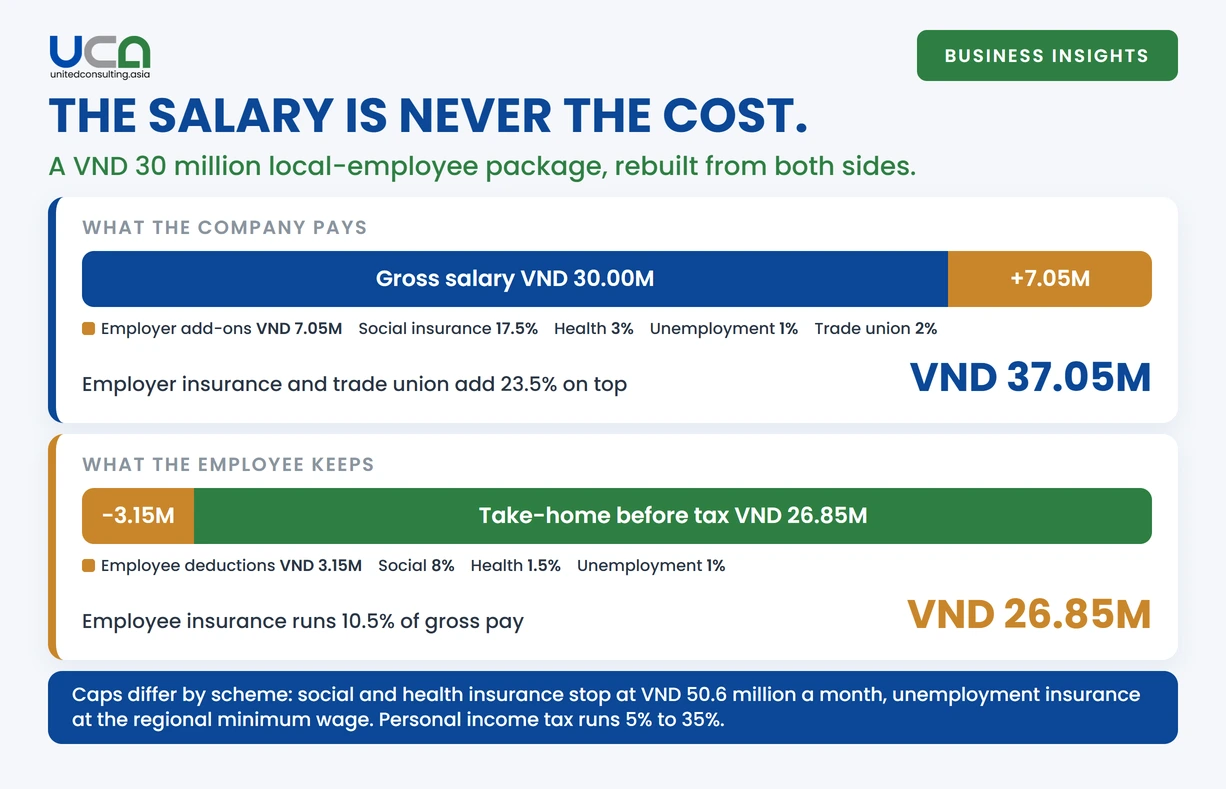
As of late 2026, employers carry about 21.5% of the applicable contribution base, covering social insurance at 17.5%, health insurance at 3% and unemployment insurance at 1%, plus a trade union fee worth 2% of the salary fund that is payable whether or not a union exists internally.
Employees contribute about 10.5%, and that share is deducted from gross pay rather than added to it. Combined, employer and employee contributions reach roughly a third of gross salary, but every rate applies on a capped base rather than the full package. From July 2026 the social insurance ceiling rose with the base salary to VND 50.6 million a month.
For example, on a VND 30 million monthly package in Ho Chi Minh City, the employer-side statutory cost is about VND 6.5 million a month, plus a VND 600,000 trade-union fee. The employee’s own deduction is about VND 3.15 million, leaving roughly VND 26.85 million in take-home pay before personal income tax.
What Does the Local Salary Market Look Like?
For budgeting context, planning estimates rather than published benchmarks put average monthly income across the economy at around VND 9 million and experienced office professionals in Ho Chi Minh City and Hanoi between VND 12 million and VND 25 million depending on seniority. The regional minimum wage for the two largest cities rose to VND 5.31 million a month from January 2026, which also lifts the reference points for entry-level roles.
What Else Should a Hiring Budget Carry?
A hiring budget in Vietnam carries four lines beyond gross salary:
- Personal income tax. Withheld monthly on a five-band scale from 5% to 35% for residents, with a personal deduction of VND 15.5 million a month since January 2026.
- Non-resident tax. A flat 20% on Vietnamese employment income.
- Probation pay. At least 85% of the normal salary for the role.
- Foreign staff insurance. Contracts of a year or more generally join the compulsory social insurance system, though unemployment insurance does not cover them.
What Are the Risks of Getting the Structure Wrong?
Two risks dominate. The first is misclassification. If a service contract amounts to employment in substance, inspectors can reclassify the relationship from its start, triggering back-dated social insurance with interest, back personal income tax and tiered fines.
The second is taxable presence. If your Vietnam-based staff sign contracts for the foreign company, act as its dependent agent or run its core revenue activity, the tax authorities may assert a corporate taxable presence regardless of the employment structure.
The classic triggers are concrete:
- A long-term office or fixed place of business.
- Contracts signed in Vietnam in the company’s name.
- One person habitually closing deals here as your agent.
Remote management from abroad is not one.
A Vietnam tax opinion is a sensible gate before a sales or country-manager role is designed, because no employment arrangement absorbs that exposure. The outcome depends on the facts, on Vietnamese tax rules and on any applicable treaty, and a local employment structure does not by itself remove it.
Who Carries the Liability When Things Go Wrong?
A third risk deserves a line. If the provider you engage lacks the proper licence, or the arrangement is a contractor relationship dressed up as employment, the liabilities can travel back to your company. The diligence is quick:
- Ask for the licence.
- Read which entity appears on the contract.
- Confirm who actually runs payroll.
When Does Setting Up an Entity Beat Hiring Through a Provider?
The comparison is speed against control. A hire through a licensed provider can start within days, since the legal employer already exists. Setting up your own company typically takes 1 to 3 months end to end, from investment registration through enterprise registration and a working bank account, with capital contribution deadlines behind it.
The rule of thumb most companies land on is straightforward. A few testers and market research staff fit the provider route. A revenue team, a manufacturing line or a fixed office usually justifies the entity.
What Should You Do Before Your First Hire?
- Check the provider’s licence and confirm which model it is actually using, employer of record or labour sub-leasing, before anyone starts.
- Classify the role honestly, because full-time work under your direction will be treated as employment regardless of the paperwork.
- Get tax advice on sales roles early, since contract authority is what creates taxable presence risk.
- Track the new rules. A decree effective in November 2026 adds notification duties for foreign bodies without a Vietnamese legal entity that hire Vietnamese staff, and revised work permit rules follow in December 2026.
- Handle personal data properly, since employee data processing has been governed by a dedicated law since January 2026.
What Does the Switch to Your Own Entity Look Like?
Moving employees to a newly established entity requires a compliant transition of their employment arrangements. Depending on the existing contracts and the legal structure, this may require new employment contracts, employee consent and updated payroll, tax, insurance or work-permit documentation. Plan the transition with the provider before incorporation is completed. The companies that plan this from the start tend to pick providers who can execute it later.
One budget line surprises most first-time employers. A 13th-month salary is customary rather than statutory in Vietnam, and candidates benchmark offers on the total package rather than the monthly figure. Build it in from the start.
Working out whether to hire first or incorporate first? Email info@unitedconsulting.asia to talk through your entry sequence with us.
Conclusion
Hiring before incorporating is a recognised and practical path into Vietnam, and thousands of professionals work in exactly these structures today. The companies that avoid trouble are the ones that treat the arrangement as real employment from day one: Lawful provider, honest role classification, correct contributions, and tax advice before authority is delegated. Do that, and the team you build becomes the strongest possible argument for the entity you set up later.
The first hire is often the hardest one to get right. Our guide to executive hiring in Vietnam covers the leadership search itself.
Thinking about entering or expanding in Vietnam? Contact United Consulting at info@unitedconsulting.asia to map how hiring in Vietnam fits your entry plans.