
Vietnam Business Overview: Rising Standards, Digital Pressure, and Policy Shifts
Vietnam continues to evolve into a more structured and competitive market for companies doing business in Vietnam. Recent developments across Vietnam compliance, Vietnam investment policy, and Vietnam digital economy initiatives show a clear shift toward higher standards and more disciplined growth. The country is moving beyond expansion driven by cost advantages toward a model built on quality, efficiency, and technology. This includes tightening Vietnam regulations, improving transparency, and accelerating digital transformation across SMEs and large enterprises with the aim to attract higher attention and investment from abroad.
For investors and SMEs, this means stronger opportunities but also higher expectations. Success in doing business in Vietnam now depends on not only knowing when and how to setup, but also understanding compliance in Vietnam, adapting to regulatory changes, and aligning with long-term economic priorities within this ever-growing market.
Looking to do business in Vietnam? Read about our step-by-step guide here: Setting Up a Business in Vietnam: A Complete Step-by-Step Guide for Foreign Investors
Key Vietnam Business Developments This Week
- Ho Chi Minh City aims to become a regional science and technology hub
- Government prepares base salary reform and wage policy changes
- New tax management rules introduced for household businesses
- Fuel prices drop sharply after recent volatility
- Global AI race faces public pressure and regulatory scrutiny
Vietnam Investment Policy Targets HCMC Science and Technology
Overview
Ho Chi Minh City is accelerating its ambition to become a leading science and technology hub in Southeast Asia. This strategy is a core part of Vietnam’s long-term Vietnam investment policy, aimed at transforming the economy into a high-value, innovation-driven ecosystem.
The city is focusing on developing integrated innovation clusters that connect universities, research institutes, startups, and multinational corporations. The logical next step to what has been an outstanding period for Vietnam in terms of its technology exports.
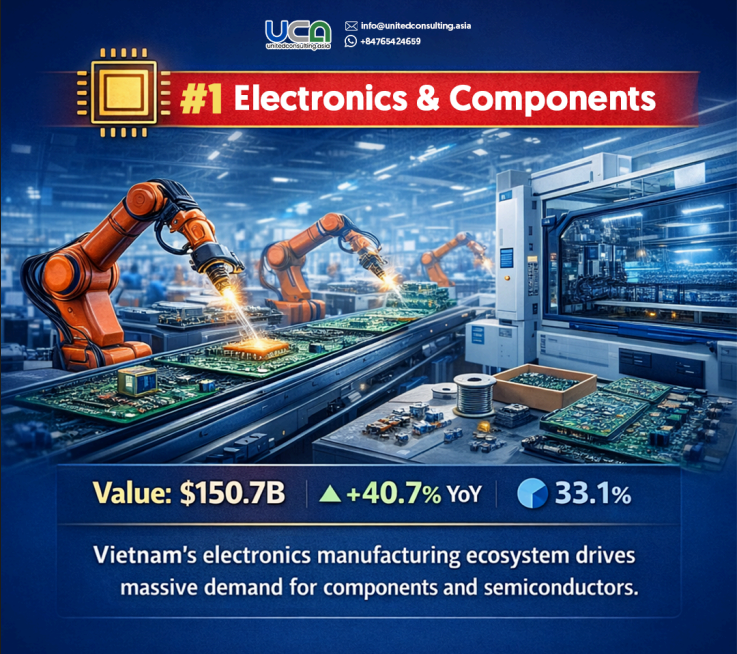
Check out the full list on our LinkedIn - there's a really nice set of graphics there!
This is expected to significantly strengthen the Vietnam business environment, especially in high-tech sectors. This transition also supports Vietnam’s positioning within global supply chains, particularly in semiconductors, AI, and advanced manufacturing.
Highlights
- Target to become a top-tier science and technology hub in Southeast Asia
- Strong focus on R&D, AI, semiconductors, and digital infrastructure
- Expansion of innovation ecosystems linking academia and industry
- Increased investment attraction in high-tech sectors
- Alignment with national digital transformation strategy
What this means for businesses
For companies doing business in Vietnam, this creates several concrete opportunities:
- Access to higher-quality talent pools, especially in engineering and tech
- Increased availability of R&D partnerships and innovation funding
- Stronger integration into regional and global supply chains
For SMEs:
- Opportunity to move up the value chain from low-cost production to higher-margin activities
- Increased demand for suppliers that meet international standards
However, this also raises expectations:
- Businesses must meet stricter Vietnam compliance standards in technology and data
- Greater competition from both local and foreign high-tech firms
- Increased need for investment in digital capability and innovation
Vietnam Base Salary Policy Changes
Regulatory update
The Vietnamese government is accelerating the development of a new decree to adjust the base salary, while simultaneously conducting a comprehensive review of broader wage reform policies. This initiative forms part of a long-term effort to modernize Vietnam’s labor framework and ensure that compensation structures better reflect economic realities, productivity levels, and fiscal capacity. The base salary, currently set at VND 1.8 million per month, is used as the foundation for calculating public sector wages, social insurance contributions, and various allowances.
For companies doing business in Vietnam, this is particularly relevant in the context of hiring and workforce planning, as labor costs remain one of the largest operational expenses. Any adjustment to the base salary will directly influence hiring strategies, employee retention, and overall cost structures across both SMEs and large enterprises. The proposed adjustment is expected to increase the base salary to approximately VND 2.34 million per month, representing an increase of around 30%. This change is part of Vietnam’s long-term wage reform roadmap, which aims to align compensation more closely with productivity, inflation, and overall economic growth.
- Maintaining fiscal sustainability
- Supporting income growth and domestic consumption
- Ensuring competitiveness in the labor market for companies doing business in Vietnam
This cautious, scenario-based approach reflects the government’s intent to avoid sudden shocks while still progressing toward a more structured and transparent wage system.
Key changes
- Current base salary: VND 1.8 million/month
- Proposed increase to: ~VND 2.34 million/month
- Estimated adjustment: ~30% increase Base salary used to calculate:
- Social insurance contributions
- Health insurance and unemployment insurance
- Employee allowances and benefits
Reform is part of a broader wage restructuring framework, not a one-off adjustment
Implications for SMEs
For SMEs doing business in Vietnam, wage reform has direct financial implications:
- Potential increase in labor costs across all sectors
- Higher social insurance and compliance-related contributions
- Need to revise payroll structures and cost planning
In practical terms:
- Labor costs may rise by 5% to 10% depending on adjustment levels
- Businesses with large workforces will face the highest impact
- SMEs must improve productivity to offset rising costs
New Tax Circular for Vietnam Household Business
Regulatory update
Circular 18/2026/TT-BTC introduces updated tax management procedures for Vietnam household business and individual business, marking another step in Vietnam’s ongoing effort to formalize the economy and strengthen Vietnam compliance across all business segments.
This reform specifically targets one of the largest but least regulated parts of the Vietnam business landscape. Vietnam Household business with manual taxation practices account for a significant share of economic activity, yet many have historically operated with simplified or inconsistent tax reporting practices. The new circular aims to close these gaps by introducing more standardized procedures and clearer documentation requirements.
At its core, the regulation reflects a broader shift toward transparency, data integration, and more centralized oversight. Tax authorities are moving away from fragmented and manual processes toward a more structured system that aligns with Vietnam’s wider push for administrative modernization and Vietnam’s digital governance. Previously, many household businesses operated under simplified or loosely enforced systems, often relying on estimated or flat tax methods with limited documentation. The new framework introduces clearer procedures and tighter oversight.
Key changes
- New framework under Circular 18/2026/TT-BTC
- Tax registration procedures - Household businesses must register tax identification details more formally, including business location, activity type, and revenue basis
- Tax declaration and reporting - Businesses are required to submit periodic tax declarations with more structured formats, rather than relying solely on fixed tax assessments
- Revenue-based tax calculation - Tax obligations are increasingly tied to declared or verified revenue instead of broad estimations
- Record-keeping requirements - Businesses must maintain basic accounting records, invoices, and transaction evidence
- Interaction with tax authorities - Standardized processes for submitting documents, responding to audits, and updating business information
- Digital integration - Gradual transition toward electronic filing and integration with digital tax management systems
What this means for businesses
For entrepreneurs and SMEs doing business in Vietnam:
- Informal operations will face increasing pressure to formalize
- Tax reporting requirements will become more standardized
- Compliance costs may increase in the short term
However, long-term benefits include:
- More predictable regulatory environment
- Improved transparency and fairness in the Vietnam business ecosystem
- Easier access to financing for compliant businesses
Vietnam Fuel Prices Drop Nearly VND 4,000/Litre
Key update
Vietnam fuel prices get more affordable as the government has implemented a significant fuel price reduction following a period of sharp increases, highlighting the government’s active role in stabilizing the Vietnam business environment. Prices for RON95 gasoline dropped by nearly VND 3,900 per litre, while diesel and kerosene saw even larger adjustments.
This move reflects a combination of declining global oil prices, active use of the Petroleum Price Stabilization Fund, and ongoing adjustments in Vietnam investment policy to reduce inflationary pressure. Authorities also intervened outside the standard pricing cycle, signaling a more proactive approach to market stabilization. Fuel pricing remains one of the most sensitive cost drivers for companies doing business in Vietnam, especially in logistics, producing and manufacturing, and distribution-heavy sectors like retail and supermarkets.
Wanting to expand into Vietnamese Manufacturing but still curious about what it takes? Read our full Vietnam Industrial Parks Cost Guide here: Vietnam Factory Setup Costs for Industrial Parks Near HCMC
Notable points
- RON95 gasoline reduced by approximately VND 3,900/litre
- Diesel prices cut by over VND 4,200/litre
- Kerosene dropped by nearly VND 8,000/litre
- Adjustments made outside the regular 10-day pricing cycle
- Fuel stabilization fund used actively to absorb global price shocks
- Previous import tax reductions (10% → 0%) still supporting price control
-
Environmental tax maintained at reduced levels:
- Petrol: VND 2,000/litre
- Diesel: VND 1,000/litre
Business impact
For companies doing business in Vietnam, this creates immediate cost relief, particularly for:
- Logistics firms where fuel can account for 30% to 40% of operating costs
- Manufacturing businesses with high transport and distribution needs
- SMEs with limited ability to hedge input cost volatility
In practical terms:
- Lower fuel costs can improve margins by 2% to 5% depending on sector
- Businesses can stabilize pricing strategies in the short term
- Working capital pressure is reduced due to lower operating expenses
However, the broader implication is volatility. Companies must build flexibility into cost structures and recognize that Vietnam compliance and policy tools will continue to play a central role in managing economic stability.
Vietnam Law on AI - First in SEA
Key update
The global AI industry is facing growing scrutiny, with hundreds of protesters calling on major companies such as OpenAI, Anthropic, and xAI to slow down development. Concerns focus on safety, governance, and the pace of AI deployment.
Vietnam has entered a new stage in AI governance with the new Vietnam Law on AI (Artificial Intelligence - Law No. 134/2025/QH15) officially taking effect on March 1, 2026. This marks one of the first comprehensive AI regulatory frameworks in Southeast Asia, positioning Vietnam ahead of many emerging markets in formalizing AI oversight
This development coincides with rising global scrutiny of AI, where governments and the public are pushing for stronger controls on how AI systems are developed and deployed. Together, these trends signal that AI is no longer just a growth driver. It is now a regulated domain within the broader Vietnam compliance and Vietnam digital economy framework.
The law governs the entire AI lifecycle, including research, development, deployment, and usage, and applies to both domestic and foreign organizations doing business in Vietnam.
Notable points
- AI Law effective from March 1, 2026
- Covers the full lifecycle: development, deployment, and use of AI systems
- Applies to both Vietnamese and foreign companies doing business in Vietnam
- Risk-based classification system:
- Low-risk AI: minimal regulatory burden
- Medium-risk AI: notification and transparency requirements
- High-risk AI: strict compliance, safety, and approval requirements
- Obligations for high-risk AI systems:
- Pre-deployment conformity assessments
- Ongoing risk management and monitoring
- Human oversight requirements
- Technical documentation and audit trails
- Transparency requirements:
- Users must be informed when interacting with AI
- AI-generated content must be clearly disclosed
- Prohibited uses:
- AI systems that threaten national security or public safety
- Use of AI for illegal or harmful activities
- Government strategy:
- Development of national AI infrastructure and data systems
- Investment in AI talent, R&D, and computing capacity
Business impact
For companies doing business in Vietnam, AI is now a compliance issue, not just a technology decision.
- Businesses must classify AI systems by risk level and meet corresponding requirements
- High-risk AI use cases require audits, documentation, and ongoing monitoring
- Data governance and transparency will become mandatory, especially for customer-facing tools
For SMEs:
- Low-risk tools remain flexible
- More advanced AI applications will face higher compliance costs
Businesses that align early with Vietnam compliance in AI will gain a competitive edge, while those that delay may face higher regulatory risks as enforcement strengthens.
Conclusion: Vietnam Business Growth Now Depends on Compliance and Capability
The trajectory of Vietnam Business Growth is: UP!
- Stronger Vietnam compliance frameworks across tax, labor, and digital systems
- More selective and higher-quality investment environment
- Rapid expansion of the Vietnam digital economy
- Increasingly structured and competitive Vietnam business environment
For companies doing business in Vietnam, success now depends on adaptability.
Businesses must:
- Stay ahead of regulatory changes
- Invest in digital capabilities
- Align with evolving Vietnam investment policy
The next phase of growth will reward businesses that combine compliance discipline with operational execution.
How United Consulting Can Support You
United Consulting helps businesses navigate every aspect of doing business in Vietnam, from market entry and structuring to ongoing Vietnam compliance.
Contact us and let's chat about how you can reduce risk, improve efficiency, and capture long-term growth opportunities in Vietnam’s evolving market.
Schedule a free consultation!
Disclaimer:
The information provided in this article is for general informational purposes only and does not constitute legal, tax, or investment advice. While every effort has been made to ensure accuracy at the time of publication, laws and regulations may change. Readers are encouraged to consult with qualified legal or financial advisors before making decisions related to foreign investment or share transfers in Vietnam. United Consulting is not liable for any actions taken based on this content.
Vietnam Business News: Vietnam Market Updates (27 Mar 2026)