Vietnam Hiring Trends After Tet 2026 - A Practical Guide for Foreign SMEs Expanding in Vietnam
Tet has just concluded, and for foreign SMEs operating in Vietnam, this is not a quiet transition period - it is the most important hiring window of the year. For foreign manufacturing companies, trading businesses, logistics operators, and technology firms with lean teams, this period directly affects production continuity, sales expansion, and regulatory exposure. It is about understanding how employment contracts are regulated under the Labor Code 2019 of Vietnam, how expanded statutory obligations under the Law on Social Insurance 2024 effective 1 July 2025 may affect payroll planning, and how administrative enforcement under Decree 12 2022 ND CP governs penalties for labor and insurance violations.
Foreign SMEs hiring in Vietnam often assume that because Vietnam’s labor market is large, hiring will be simple. In practice, the regulatory framework requires structured documentation, proper probation planning, and compliant social insurance registration from day one. At the same time, workforce classification risks are rising. Misunderstanding the difference between contractors and employees can create exposure under Vietnamese labor and insurance law. Our detailed breakdown in Independent Contractors vs Employees in Vietnam explains why substance over form matters when structuring hiring.
Beyond compliance, foreign SMEs looking to hire must also balance statutory obligations with competitive compensation planning. Post-Tet employee mobility is frequently influenced by benefit structures and perceived career stability. A deeper explanation of mandatory and market-based benefits is outlined in Employee Benefits in Vietnam: What’s Legally Required vs. Market Competitive.
TLDR - Vietnam Hiring Trends After Tet 2026 for Foreign SMEs
Post-Tet marks Vietnam’s annual labour market reset. Employee mobility rises, wage expectations adjust, and hiring activity accelerates across industrial zones and major cities. For foreign SMEs, this period combines recruitment opportunity with increased compliance sensitivity under the Labor Code 2019, the Law on Social Insurance 2024 effective 1 July 2025, and Decree 12 2022 ND CP. Acting quickly is important, but structured execution is critical.
- Post-Tet is the highest employee mobility period in Vietnam
- Manufacturing SMEs face short-term labor shortages in industrial zones
- Skilled bilingual professionals remain highly competitive
- Probation limits under Labor Code 2019 are strictly regulated
- Social insurance obligations expand from 1 July 2025
- Misclassification of workers can trigger statutory exposure
- Administrative penalties apply under Decree 12 2022 ND CP
- Foreign companies cannot hire directly without a compliant legal structure
For foreign SMEs looking to hire in Vietnam, in manufacturing, trading, logistics, professional services, and technology, Vietnam hiring trends after Tet represent a predictable but legally sensitive hiring cycle. Acting quickly is necessary - but acting without proper documentation, payroll alignment, and regulatory awareness creates avoidable risk.
If hiring is structured properly in Q1, businesses can stabilize teams before mid-year expansion cycles. If rushed without documentation, the same hiring surge can expose companies to administrative penalties and payroll corrections.
Finally, retention is as important as recruitment. Vietnam hiring trends after Tet reward employers who combine legal discipline with cultural awareness. We explore this further in A Better Way to Hire in Vietnam: Cultural Insights for Fit and Retention, which examines why structured onboarding and cultural alignment reduce post-Tet turnover.
Who This Article Is For
This article is written specifically for:
- Foreign manufacturing SMEs in Vietnam operating in industrial zones
- Trading and import-export companies establishing local teams
- Technology and software companies hiring Vietnamese engineers
- Logistics and distribution firms building warehouse teams
- Professional service firms building lean Vietnam offices
- Overseas entrepreneurs entering Vietnam for the first time
These businesses typically share several characteristics:
- Lean management structures
- Limited in-house legal or HR capacity
- Cross-border reporting obligations
- Pressure to hire quickly but remain compliant
Vietnam Hiring Trends After Tet 2026 - What Is Happening in the Market
Post-Tet labor mobility is a structural feature of Vietnam’s employment landscape. Employees often reassess employment decisions after receiving Tet bonuses. Some return to their hometowns permanently. Others switch employers for incremental salary improvements.
Government reporting and national media regularly highlight post-Tet labor gaps in industrial zones and increased recruitment activity during Q1. Broader regulatory and economic movements shaping employer obligations are also covered in a previous issue of The Week in Review: Compliance, Tax, and Economic Updates for Doing Business in Vietnam.
For SMEs hiring in Vietnam, this translates into:
- Increased resignation notices in February and March
- Faster hiring cycles for production and operations roles
- Strong competition for skilled bilingual professionals
- Gradual upward pressure on wage expectations
The overall market remains broadly stable. However, stability does not eliminate risk. It simply means that execution quality determines success.
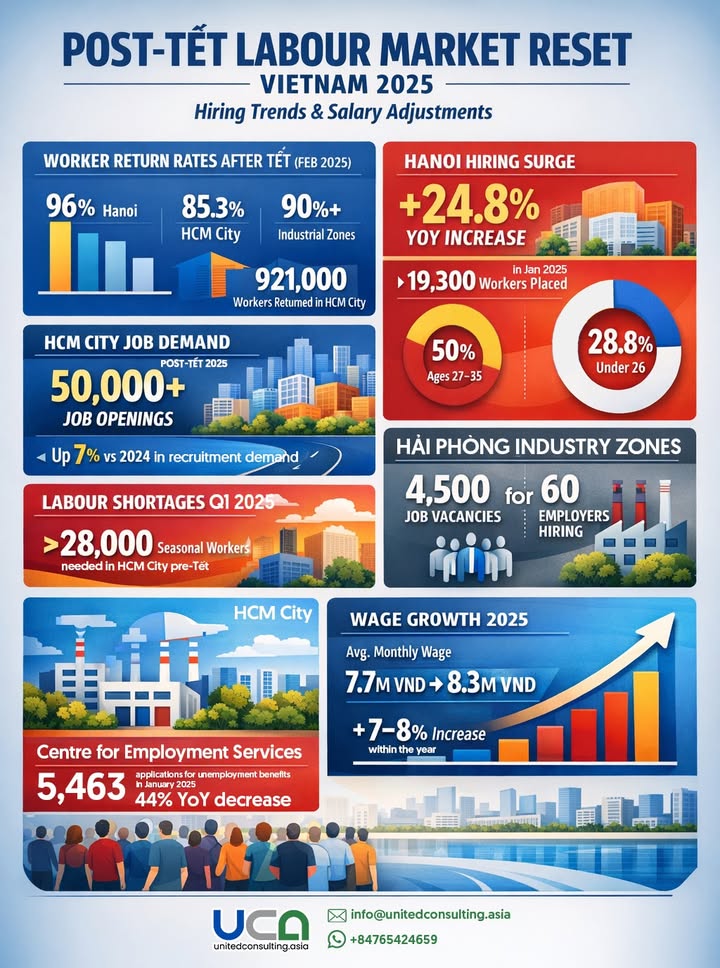
Post-Tet Labour Reset 2026: Key Labour Market Indicators
The following indicators shape Vietnam hiring trends after Tet 2026:
- Worker return rates stabilizing above 85–95% in major cities
- Hanoi Q1 hiring acceleration
- HCMC job demand exceeding 50,000 openings post-Tet
- Industrial zone vacancy clusters in Hai Phong and Northern provinces
- Wage growth adjustments averaging 7–8%
- Decline in unemployment benefit applications after seasonal peaks
These patterns confirm that post-Tet is not contraction, it is structured labour recalibration.
Vietnam Post Tet Hiring Infographic
For foreign SMEs expanding in Q1, this means:
- Recruitment speed matters
- Wage benchmarking must be realistic
- Vietnam Social insurance registration timing is critical
- Documentation discipline becomes operational protection
Vietnam Hiring Trends After Tet in Manufacturing SMEs
If your SME operates in electronics assembly, garment production, furniture manufacturing, or mechanical processing, Vietnam Hiring Trends After Tet 2026 directly impact production continuity and cost stability.
While worker return rates in major cities stabilize between 85–95%, industrial zones in Northern provinces, particularly vacancy clusters in Hai Phong and surrounding areas, continue to experience short-term labor gaps after Tet. Even a 5–10% workforce shortfall can disrupt production lines for lean Foreign SMEs.
At the same time, wage expectations are adjusting upward, with average wage growth of 7–8% in Q1, increasing payroll pressure for manufacturers operating on tight margins.
A typical SME scenario:
A foreign-owned manufacturer needs 30 production workers and 2 technical supervisors in March. In the context of Vietnam Hiring Trends After Tet 2026, where hiring acceleration in Hanoi and major hubs increases competition, delayed recruitment can mean losing candidates to competitors offering slightly higher base pay or faster onboarding.
If recruitment begins without structured preparation, the company may face:
- Delays in candidate sourcing due to regional labor gaps
- Incomplete employment contracts under the Labor Code 2019
- Late social insurance registration
- Payroll miscalculations amid wage adjustments
- Production schedule disruption during peak Q1 output
Vietnam Probation Rules Under the Labor Code 2019:
- Probation is not permitted for contracts under 1 month
- Only one probationary period is allowed per job
- Maximum probation duration depends on job classification
These limits are mandatory. Extending probation or repeating probation periods, even during labor shortages, is not compliant.
For SMEs operating on tight production margins, structured HR documentation, compliant probation structure, and payroll alignment during Vietnam Hiring Trends After Tet 2026 are operational safeguards not administrative formalities.
Vietnam Hiring Trends After Tet in Service and Trading SMEs
SMEs in trading, retail distribution, consulting, logistics, and technology face a different, but equally competitive, hiring environment during Vietnam Hiring Trends After Tet 2026.
In Ho Chi Minh City alone, post-Tet recruitment demand has exceeded 50,000 job openings, intensifying competition for skilled professionals. Q1 hiring acceleration in Hanoi further compresses recruitment timelines.
Common post-Tet hiring needs include:
- Sales representatives
- Account managers
- Logistics coordinators
- Customer service staff
- Junior accountants
- Software developers
Skilled professionals, especially bilingual staff, often receive multiple offers within days. With wage growth adjustments averaging 7–8%, salary benchmarking becomes critical. Even small compensation gaps can trigger candidate drop-offs.
Hiring challenges for SMEs now include:
- Longer recruitment timelines for mid-level roles due to offer comparison
- Increased offer negotiation pressure
- Candidate drop-offs caused by delayed internal approvals
- Unclear probation structure under the Labor Code 2019
- Salary inflation risks during Q1 hiring surges
Vietnam Hiring Trends After Tet 2026 reward employers who can:
- Issue compliant employment offers quickly
- Align salary expectations with market-adjusted benchmarks
- Demonstrate structured onboarding
- Confirm probation terms upfront under the Labor Code 2019
In a market where mobility is elevated and competition is measurable, speed without compliance creates exposure, but slow, bureaucratic hiring loses talent.
Vietnam Social Insurance and Payroll Compliance After Tet 2026
Rapid onboarding is where most foreign SMEs encounter compliance exposure.
Under the Law on Social Insurance 2024, effective 1 July 2025, the scope of compulsory social insurance coverage expands. Eligibility depends on contract structure and statutory definitions.
Risk areas for SMEs include:
- Delayed registration of social insurance
- Incorrect employer contribution calculations
- Misclassification of employees as service providers
- Incomplete personnel records
Administrative penalties for labor and social insurance violations are governed by Decree 12 2022 ND CP. Ongoing policy adjustments and enforcement trends are discussed further in Vietnam Business News: Week in Review (25 Oct 2025).
Foreign companies without a legally established entity in Vietnam cannot directly hire local employees without a compliant structure such as:
- A locally incorporated company
- A properly licensed entity
- A compliant employer of record arrangement
This issue frequently arises for overseas entrepreneurs testing the Vietnam market.
30-Day Hiring Strategy for Foreign SMEs
Vietnam hiring trends after Tet require structured execution.
| Phase | Key Actions | Risk if Ignored |
| Week 1 – Legal and Operational Preparation |
| Incomplete contracts, unlawful probation terms, delayed insurance registration, payroll miscalculations, and exposure to administrative penalties under Decree 12 2022 ND CP |
| Weeks 2–3 – Recruitment Execution |
| Candidate drop-offs, onboarding delays, salary misalignment, operational disruption, and documentation gaps during inspections |
| Week 4 – Onboarding and Compliance Stabilization |
| Retroactive insurance liabilities, weak termination position during probation, payroll corrections, and increased audit exposure |
Why Vietnam Hiring Trends After Tet Matter for Long-Term SME Growth
For foreign SMEs, hiring in Vietnam is not just a staffing decision. It affects:
- Regulatory exposure
- Cash flow predictability
- Audit readiness
- Investor reporting
- Production continuity
Vietnam hiring trends after Tet are predictable. Compliance mistakes are avoidable. Recent developments affecting labor regulation and business conditions are summarized in Vietnam Business News: Week in Review (17 Oct 2025).
Businesses that combine:
- Clear recruitment planning
- Legally compliant documentation
- Proper payroll setup
- Structured HR processes
gain a measurable competitive advantage.
Frequently Asked Questions from Foreign SMEs
Can we delay Vietnam social insurance registration during probation?
Statutory obligations depend on contract classification and legal definitions. From 1 July 2025, expanded coverage increases compliance sensitivity. Employers should verify obligations before onboarding.
Can Vietnam probation rules be extended?
No. Only one probationary period per job is permitted under Labor Code 2019. Duration limits depend on role classification.
Is high turnover after Tet normal?
Yes. Vietnam hiring trends after Tet consistently show elevated Q1 mobility. Planning for turnover is more effective than reacting to it.
Can a foreign company hire in Vietnam without incorporation?
Generally no. Direct hiring requires a compliant legal structure in Vietnam, however, there are mid-term solutions available that don't require incorporation. Contact Us for more information about remote work arrangements and EOR Services.
Can we hire immediately after Tet without finalizing payroll setup?
No. Payroll structure and statutory contribution planning should be aligned before onboarding begins.
Are Vietnam manufacturing SMEs more exposed to compliance risk after Tet?
Yes. Rapid headcount replacement in industrial zones increases documentation and insurance registration pressure.
Can we use service contracts temporarily during hiring gaps in Vietnam?
Only if the relationship genuinely reflects independent contractor status under Vietnamese law.
Should Vietnam employment contracts be signed before the first working day?
Yes. Employees should not commence work without properly executed documentation.
Does post-Tet salary competition justify informal offer letters?
No. All offers should align with compliant contract terms and statutory requirements.
Can we adjust probation terms after the employee starts?
No. Probation terms must comply with Labor Code 2019 from the outset.
Is it acceptable to delay Vietnam internal HR documentation during urgent hiring?
No. Incomplete records increase exposure during inspections.
Does high Q1 mobility reduce employer compliance obligations?
No. Market conditions do not modify statutory responsibilities.
Should SMEs review contractor arrangements during post-Tet expansion?
Yes. Workforce classification risk increases when hiring accelerates.
Can we onboard employees while waiting for insurance account activation?
Insurance procedures should be prepared in advance to avoid compliance gaps.
Are bilingual professionals more likely to trigger wage inflation after Tet?
Yes. Competitive demand often creates upward salary pressure in Q1.
Can short-term labor shortages in Vietnam justify extended probation periods?
No. Probation limits under Labor Code 2019 remain mandatory.
Final Takeaway for Foreign SMEs
Vietnam Hiring Trends After Tet 2026 create measurable growth opportunities for Foreign SMEs, particularly in manufacturing, logistics, trading, and technology.
But growth must align with the Labor Code 2019.
- Acting quickly is important.
- Acting compliantly is essential.
Foreign SMEs that structure contracts correctly, align payroll before onboarding, and maintain documentation discipline will stabilize their teams before mid-year expansion cycles.
Build your workforce correctly from day one.
How United Supports Foreign SMEs During Post-Tet Hiring
Vietnam hiring trends after Tet create growth opportunities but also compliance exposure.
United supports foreign SMEs with:
- Employment contract drafting aligned with Vietnamese labor law
- Probation structure compliance review
- Payroll setup and statutory insurance registration
- Labor regulation advisory
- Employer of record solutions
- Market entry structuring
- HR compliance audits
If you are planning to hire in Vietnam in 2026, particularly in manufacturing, trading, logistics, or technology services, early structuring reduces long-term risk.
Request a Post-Tet Hiring Compliance Checklist or schedule a consultation to assess your hiring readiness.
The hiring window after Tet is active. The regulatory framework is evolving. Structure your workforce correctly from day one.
Schedule a free consultation!
Disclaimer:
The information provided in this article is for general informational purposes only and does not constitute legal, tax, or investment advice. While every effort has been made to ensure accuracy at the time of publication, laws and regulations may change. Readers are encouraged to consult with qualified legal or financial advisors before making decisions related to foreign investment or share transfers in Vietnam. United Consulting is not liable for any actions taken based on this content.
Vietnam Hiring Trends After Tet 2026 - A Practical Guide for Foreign SMEs Expanding in Vietnam