From 5 December 2026, the paperwork behind every foreign hire in Vietnam runs on a new rulebook. Decree 393/2026/ND-CP replaces Decree 219/2025/ND-CP entirely, keeps the work permit at the centre of the system, and widens the list of people who no longer need one. For companies staffing a Vietnam operation, the question is simple. Who needs a permit, who qualifies for an exemption, and what has to be filed before the rules change all come down to the decree’s terms. The decree drew coverage in the national press the week it landed (see the foreign worker regulations summary on Nhân Dân).
TL;DR – Decree 393/2026/ND-CP takes effect on 5 December 2026 and replaces the 2025 foreign worker decree. Work permits last up to two years with one extension, new permits move on a 10-working-day decision clock while extensions follow a five-working-day one, and eighteen groups of foreign workers are now exempt from the permit entirely. Employers should audit who is onshore and on what basis before the changeover.
Staffing decisions usually start before the paperwork does. The choice between hiring locally and bringing in a senior hire from outside (the subject of our executive hiring piece) sets up the permit question. The decree then answers it in a fixed order. It sets out what counts as working in Vietnam, who counts as an expert, how long a permit runs.
What Exactly Does Decree 393/2026 Cover?
On 20 October 2026, Deputy Prime Minister Phạm Thị Thanh Trà signed the decree on the recommendation of the Minister of Home Affairs. The instrument runs to five chapters and 37 articles with four appendices, and replaces Decree 219/2025/ND-CP whole on 5 December 2026. Its scope is narrow and deep. It covers the conditions, dossiers and procedures behind work permits and work permit exemption certificates, plus the temporary transfer of staff into Vietnam under Article 157 of the Labor Code.
Who Counts as a Foreign Worker?
The decree recognises four job positions for foreign workers. They are managers, executive directors, experts and technical workers. It also lists the ways a person can be in the country and working, from an employment contract or an intra-corporate transfer to a service contract, a volunteer placement, or the task of establishing a commercial presence. Whichever route applies, the position has to match one of the four roles.
Who Counts as an Expert Under the New Rules?
Article 4 is the definition hiring teams will live with, and it now offers more than one way in. A graduate holding an excellent-class degree or higher in a science or technology field from one of the world’s top 500 universities (ranked by Quacquarelli Symonds, Times Higher Education, Shanghai Ranking Consultancy or U.S. News within the last three years, or listed by the Ministry of Education and Training) qualifies with as little as one year of relevant experience. A specialist with at least five years of relevant experience for the intended position qualifies as an expert with no degree requirement attached. Culture, arts and sports specialists follow the separate list in Appendix III.
How Does the Work Permit Process Work in 2026?
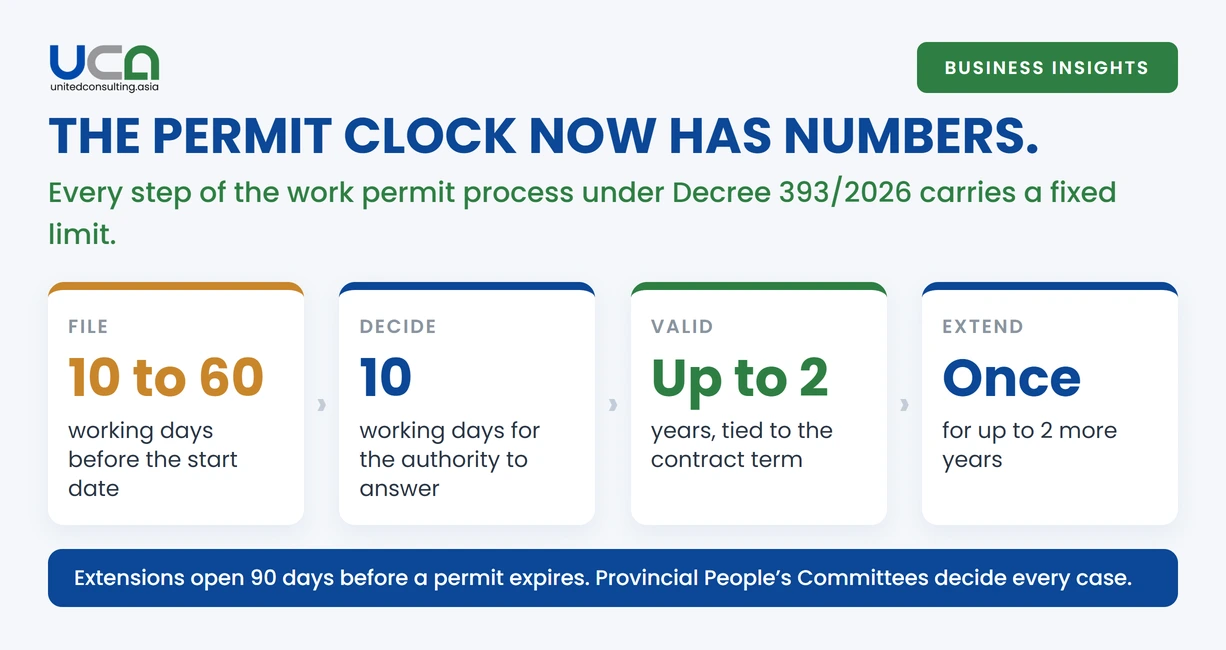
Three limits define the process under the new decree. The filing window, the decision time and the validity period each carry a fixed number, and each lands on the employer’s calendar.
How Long Does a Work Permit Last?
A permit runs for the term of whatever justifies it, whether the labour contract, the secondment document, or the agreement between the Vietnamese and foreign parties. The ceiling is two years. Article 30 allows one extension of up to two more years, and that is the end of the road. After the extension, the next step is a fresh application.
What Is the Processing Timeline?
The clock is now explicit. The employer files at least 10 working days and no more than 60 days before the worker is expected to start. Once the dossier is complete, the authority has 10 working days to approve the labour demand and grant the permit, and a refusal must come back in writing with reasons. For extensions, Article 29 opens the window earlier. Employers file at least 10 working days and no more than 90 days before the current permit expires, and the authority decides the extension within five working days.
Who Approves the Application?
Provincial People’s Committees hold the pen. They grant, re-grant, extend and revoke both work permits and exemption certificates for workers in their locality, and may delegate the task to a designated agency. In practice the filing goes to the provincial public administration centre or the National Public Service Portal, and the local office’s habits matter as much as the national rules.
Who Is Exempt From a Work Permit in 2026?
The exemption list is the decree’s headline feature, though not all of it is new. The 10-working-day decision clock, the 90-day short-term threshold and the VND 3 billion capital threshold carried over from the previous regime, while the talent and technology exemptions announced with the decree are new. Eighteen groups of foreign workers now sit outside the permit requirement, and the 18 exemption groups cluster into six buckets:
- Investors and board members: Owners or capital-contributing members of a limited liability company, and chairpersons or board members of a joint-stock company, where the contributed capital is at least VND 3 billion.
- Official and treaty roles: Heads of representative offices or projects, licensed foreign lawyers, journalists confirmed by the Ministry of Foreign Affairs, diplomatic families, and official-passport holders working for State bodies.
- Development and service work: Professional or technical consultancy on official development assistance and non-refundable aid programmes, and volunteers.
- Education and training: Students and trainees with internship agreements or job invitation letters, and staff at education institutions established under treaties.
- Presence and transfers: Founders of a commercial presence, implementers of international agreements, and intra-corporate transferees within the 11 service sectors in Vietnam’s World Trade Organization (WTO) commitments listed in Appendix II.
- New talent routes: Strategic technology experts named under the Prime Minister’s strategic technology lists (with family members), recruits of the National Programme for the Development of Artificial Intelligence Human Resources, and the teaching and research routes below.
What Is New for Talent and Education Roles?
The talent exemptions are where the decree genuinely breaks new ground. Master’s graduates or higher in science, technology, digital transformation, finance, economics or business administration who teach or conduct research are exempt, as are doctoral holders and professors at vocational and higher education institutions. Persons certified by ministries or provincial People’s Committees and holders of special visa exemption cards are covered too. For companies chasing scarce specialists, these routes replace a permit application with a well-documented profile.
What Is the VND 3 Billion Capital Threshold?
The threshold is the exemption most foreign-owned companies can act on immediately. Cross the VND 3 billion contributed-capital line and the foreign owner, capital contributor, chairperson or board member no longer needs a work permit. For a small trading or consulting vehicle, that single line can take the permit off the founder’s to-do list entirely.
Do Short-Term Assignments Need a Permit?
This is where the decree tightens as well as loosens. Managers, executive directors, experts and technical workers can come in for short-term work without a permit, but only while the cumulative total across all employers stays within 90 days in a calendar year. The trap sits in the same clause. Once an employment or hire relationship arises and the person is paid, a work permit is required under the employment-contract form before the work starts. Short assignments that quietly turn into paid engagements are the classic way companies end up on the wrong side of this rule.
Do Exempt Workers Still Need Paperwork?
Exempt from the permit does not mean exempt from documentation. Chapter II of the decree (Articles 8 to 18) lays down the procedure for the work permit exemption certificate, which employers file to put the exemption on record. The applicable procedure depends on the particular exemption route, and not every category needs the same paperwork. Some groups run on the certificate, others on notification to the labour authority, so match the filing to the route your worker qualifies under before December.
The certificate is the employer’s filing, not the worker’s: The employer assembles the evidence for the claimed route and sends it to the labour authority, which records the exemption. Keep that record with the employment papers, because a labour inspection will look for it.
Working out who on your team needs a permit and who does not? Write to United Consulting at info@unitedconsulting.asia.
What New Duties Do Employers Have?
From 5 December 2026, foreign workers must serve the employer’s own direct needs and may not be subleased. Employers must also report foreign-worker information before 5 June and 5 December each year, unless the state database holds it.
What Should Employers Do Before 5 December 2026?
Permits and exemption certificates issued under the previous decree stay valid until they expire under Article 35, and applications filed before 5 December are finished under the old rules. Changing a position, field or working arrangement later needs a fresh permit. Most of the work is administrative. Four moves cover it.
- Audit who is onshore and on what basis. Permits, exemption certificates and no documentation at all each call for a different check.
- Map every permit to its expiry date and decide whether the new 90-day extension window is the right move.
- Get documents in order. Papers issued abroad must be consular-legalised and translated into Vietnamese.
- Line up the evidence for the route each person relies on, since the dossier requirements follow the route.
Which Papers Should Be Ready Now?
The evidence differs by route. Expert routes need degrees and written experience confirmations, and the top-500 route needs proof of the university’s ranking. The capital threshold needs the company’s contribution records. Identity and health documentation must follow the decree’s forms. For the contract and payroll side, our employee benefits guide sets out what is legally required and what is market practice.
Conclusion
Decree 393/2026 keeps the work permit at the centre of Vietnam’s foreign worker system and makes the edges more flexible. From 5 December 2026, more talent qualifies as an expert, eighteen groups work without a permit, and the filing clocks are written down in working days. The payoff goes to whoever audits early, since the permit map, the exemption certificates and the legalised paperwork are all cheaper to fix now than in January.
The permit is usually the last mile of a staffing decision. Our guide to hiring without a local team covers the structure around it.
Thinking about entering or expanding in Vietnam? Contact United Consulting at info@unitedconsulting.asia to map how the new work permit rules reshape your staffing plans.