Southeast Asia is living through two crises at once this month, and businesses across the region are connecting them to energy security faster than the headlines do. As of late October 2026, the region’s worst haze season in over a decade is choking Singapore and Malaysia, while Indonesia has begun cutting gas exports to Singapore in the middle of the smog. One story is about air. The other is about power. Together they are about how much of Southeast Asia’s economy depends on decisions made across a border.
TL;DR – Indonesia’s 2026 haze is the worst in over a decade, with Singapore’s air quality index hitting the highest readings of the season and a one-hour fine-particle reading crossing the National Environment Agency’s highest band for the first time this season. Malaysia is counting losses in the tens of millions of ringgit a day. In the same weeks, Indonesia trimmed piped gas exports to Singapore, its largest energy customer. On current assessments, Vietnam sits largely outside the smoke zone, but the ripple effects reach it through energy prices, supply chains, investor sentiment and tourism flows. This article separates the immediate damage from the longer-term risks for companies operating in Vietnam and the wider ASEAN market.
Two earlier pieces frame the ground under these developments. Singapore’s investment in Vietnam explains why the city-state’s exposure matters to Vietnam directly, and our post on the business events boom shows one channel through which attention is already shifting.
What Exactly Happened in October 2026?
This did not arrive overnight. The season built from August, and by October the smoke had turned a weather story into a regional emergency. Indonesian fires, concentrated in Sumatra and Kalimantan, produced smoke that drifted across the Strait of Malacca and settled over the region’s two wealthiest cities.
On 14 October, Singapore’s one-hour fine-particle (PM2.5) reading peaked at 284 micrograms per cubic metre in the west of the island, crossing the National Environment Agency’s Very High band for the first time this season.
On 16 October its air quality index reached 229, the highest reading of the 2026 haze season at that point. Malaysia declared an emergency in one Sarawak district as its index passed 500 in early September.
Why Did the Politics Move So Fast?
The politics moved as fast as the smoke. Indonesia’s president chaired an emergency response meeting on 12 October as firefighting aircraft sat grounded in Central Kalimantan, and Singapore’s National Environment Agency has served preventive notices under its transboundary haze law on ten Indonesian companies and is seeking information from ten Singapore-registered firms.
By late October the two disputes were being argued across the same table, with ministers trading statements across the Strait, though Indonesia has framed the gas cut around its own domestic energy needs rather than the haze.
How Bad Is the 2026 Haze Season?
The numbers are ugly. Indonesia’s SiPongi fire-monitoring system recorded more than 7,500 hotspots in October alone, the most for any month since 2015. Across the fire season, estimates vary by methodology and reporting period. Environment group Auriga recorded about 637,000 hectares burned from January to August, while a Nusantara Atlas assessment published on 21 October estimated around 1.9 million hectares affected by fire nationwide from January to September.
The figures are not directly interchangeable, since land affected by fire is not the same as vegetation destroyed. Indonesia’s health ministry counted over 283,000 respiratory illness cases between 18 August and 13 October, rising to about 350,000 by 25 October.
Indonesia moved around 12,900 schools serving some 1.43 million students to remote learning as of 1 September, Indonesia’s education ministry reported, and Indonesia’s transport ministry counted 2,604 domestic flights disrupted since August, 1,420 of them cancelled or postponed and the rest delayed. Malaysian economists put daily haze losses at RM 20 million to RM 50 million in mid-October reporting, with tourism arrivals down and agricultural output in Johor hit hard.
What Has the Haze Cost So Far?
These are not rounding errors. The comparable 2015 season cost Indonesia an estimated US$16 billion, around 2% of its economy at the time, and Singapore more than S$1.8 billion. Seasons this bad leave marks on national accounts as well as on lungs.
Why Is Indonesia Cutting Gas Exports to Singapore?
On 24 October, Indonesia began trimming piped gas shipments to Singapore, framing the move as putting domestic energy needs first. Jakarta’s position is that existing contracts have not been breached, since the reduction stays within the tolerance the agreements allow.
Singapore’s energy regulator notes the cut amounts to less than 2% of daily gas demand, with importers asked to sort the commercial dispute through the contracts themselves. The volumes are small. The signal is not.
How Long Could This Energy Security Disruption Last?
The contracts underpinning piped supply run to the end of 2028, so the near-term volumes will settle somewhere in a negotiation rather than a shutdown. What has changed is the assumption. A supplier willing to adjust flows during a diplomatic row is a supplier whose flows are political, and that assumption now sits in every regional energy contract review.
What Does Singapore’s Exposure Mean for Regional Businesses?
Here is the number that matters. Gas generates roughly 95% of Singapore’s electricity, and the city-state has spent a decade building buffers: Diversified pipelines, strategic reserves, a central gas buyer, and spot purchases running to well over a hundred cargoes a year. The lights will stay on. The lesson for companies is narrower and sharper.
If your regional headquarters, treasury or data infrastructure sits in Singapore, your continuity planning should price political trajectory, not just supply volumes.
Is Vietnam Directly Affected by the Haze?
Largely, no. Ho Chi Minh City’s murky skies this season are mostly local haze, the usual mix of traffic, industry and humidity. Meteorologists have said a transboundary contribution is possible but unproven, and no Vietnamese city has recorded anything close to the readings in Kuala Lumpur or Singapore. Vietnam sits south and east of the worst smoke plumes, and its industrial centres are not in the fire zone. The practical rule for operators is straightforward.
Treat Vietnamese air quality as a local management question this season, not a regional emergency one, while keeping an eye on the regional picture for everything downstream of the smoke.
What Could This Mean for Businesses in Vietnam?
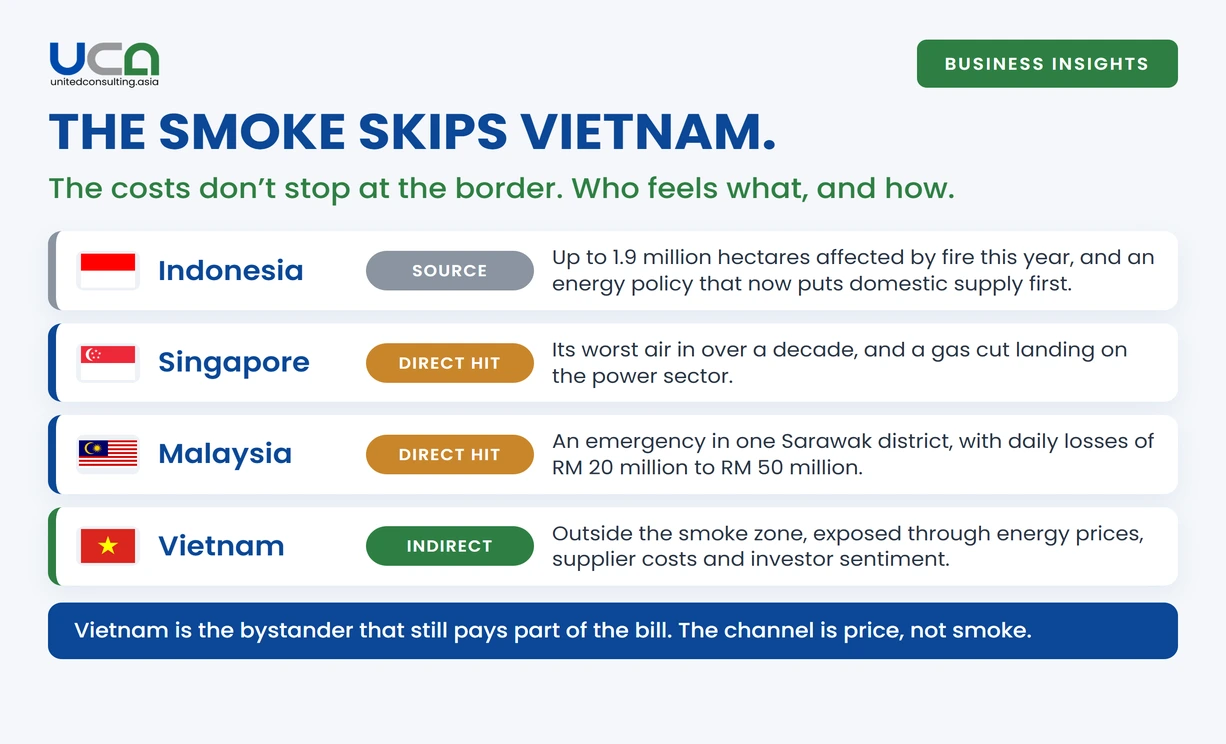
Vietnam sits outside the smoke and inside the consequences. The effects run in both directions. Some favour Vietnam, and some cut against it, and a serious read has to hold both.
Where Are the Advantages for Vietnam?
- Continuity. Factories and investors comparing sites see cleaner air and stable operations next door to a smoke zone, and that comparison is likely to surface in site reviews.
- Energy structure. Gas is only about 9% of Vietnam’s power mix, well below Singapore’s dependence, so regional gas price swings would be expected to pass through more gently.
- Demand reallocation. If haze seasons keep biting, travellers and event planners may look elsewhere in the region, and Vietnam’s tourism and events sectors would be natural landing points.
Where Are the Risks for Vietnam?
The exposure is indirect but real. Vietnam trades, invests and manufactures alongside every economy in the smoke zone, and the pressure arrives through prices rather than air quality.
Which Costs Reach Vietnam First?
- Energy pricing. Regional gas tension feeds into import costs and the fuel bill, and Vietnam has already leaned on its price stabilisation tools twice this year.
- Supply chains. Many Vietnamese manufacturers buy from Malaysian and Indonesian suppliers whose costs and output the haze is squeezing, and cash-strapped suppliers slip delivery dates before they cut prices.
- Sentiment. Institutional investors increasingly read Southeast Asia through an environmental and governance lens, and seasons like this colour asset reviews across the region, not just in the affected countries.
- Logistics. Haze-related flight delays and port slowdowns ripple into freight schedules and insurance terms even when Vietnam’s own skies are clear.
What Should Businesses in Vietnam Do Now?
Two horizons matter here. What to do before the next quarter closes, and which dependency to reassess while capital is still deployable.
What Should the Next Quarter Look Like?
The haze may ease with the rains. The dependency question will not. A short checklist for the next quarter:
- Review supply contracts for exposure to Indonesian and Malaysian suppliers, and price in the possibility of politically driven interruptions.
- Stress-test energy assumptions in 2027 budgets, including fuel escalation clauses and backup power arrangements.
- Refresh continuity plans for any Singapore-based regional functions, from treasury systems to data infrastructure.
- Watch the sentiment shift in investor and lender questionnaires that increasingly ask about environmental exposure across an entire region.
- Keep an air-quality plan for Vietnamese sites anyway. Local pollution peaks deserve the same employee-health playbook the haze forced on neighbouring cities.
Working through a regional risk review for your Vietnam operations? Email info@unitedconsulting.asia to talk it through with us.
Conclusion
Call the 2026 season what it is: A stress test of Southeast Asian interdependence. The gas decision turned it into an energy security story within days. Vietnam sits in a comparatively comfortable position, largely outside the smoke and less gas-dependent than its neighbours, but no economy in the region prices risk in isolation.
Companies that treat this season as a regional planning input, rather than a Singapore problem, will be better positioned for whatever the next cross-border surprise turns out to be. The companies already asking these questions are the ones that will answer them fastest.
Regional risk reviews usually end in a compliance question. Our annual compliance checklist covers the routine side of keeping a Vietnamese operation in order.
Thinking about entering or expanding in Vietnam? Contact United Consulting at info@unitedconsulting.asia to map how regional energy and environmental shifts could affect your 2027 plans.