Vietnam Business Overview: Regional Growth, Compliance Reform, and Long-Term Capacity Building
Vietnam is entering a new stage of economic development, with greater emphasis on regional coordination, logistics infrastructure, regulatory discipline, and long-term talent formation. For companies looking forward to doing business in Vietnam, this matters because the next phase of growth is no longer just about low-cost entry. This week’s updates point in a consistent direction.
The government is pressing for stronger coordination across all 6 socio-economic regions, with renewed emphasis on planning, cross-provincial execution, and shared regional data systems.
At the same time, large logistics and industrial projects are moving forward, while new Vietnam compliance rules affecting foreign nationals took effect on April 1, 2026. On a different but equally important front, Vietnam is also deepening international education partnerships, especially in science, technology, engineering, AI, and green technology, which will shape future workforce quality for investors and employers.
Market opportunity remains strong, but success will depend more on regional positioning, logistics efficiency, labor access, and compliance in Vietnam than before.
Looking to do business in Vietnam? Read about our step-by-step guide here: Setting Up a Business in Vietnam: A Complete Step-by-Step Guide for Foreign Investors
This Week’s Vietnam Business Update Highlights
- UK transnational education enrollment in Vietnam is growing by 20% annually
- Cái Mép - Thị Vải is being positioned as a regional logistics and maritime hub
- New deportation rules for offending foreigners took effect on April 1
- Construction started on a US$182 million industrial park in the Mekong Delta
- Vietnam pushes deeper coordination across 6 economic regions
Vietnam UK Education Partnerships Deepen Future Talent Pipeline
Overview
UK transnational education enrollment in Vietnam has been growing at about 20 percent annually since 2018, according to the British Council in Vietnam. There are now around 70 joint programs operating in the country, with more than 12,600 students enrolled in UK transnational education programs delivered locally.
The trend reflects growing demand for internationally accredited education in Vietnam without requiring students to study abroad, while also showing deeper academic cooperation between UK and Vietnamese institutions.
What is especially notable for the Vietnam business landscape is the shift in subject mix. Growth is increasing in engineering, science, technology, STEM, AI, and green technology, moving beyond older partnership models focused more heavily on traditional academic disciplines.
Vietnamese universities are also moving beyond basic program transfer toward joint curriculum design, collaborative research, and deeper institutional partnership, as emphatically proven by its comparison to the closest neighbor - Thailand, and winning by most categories:
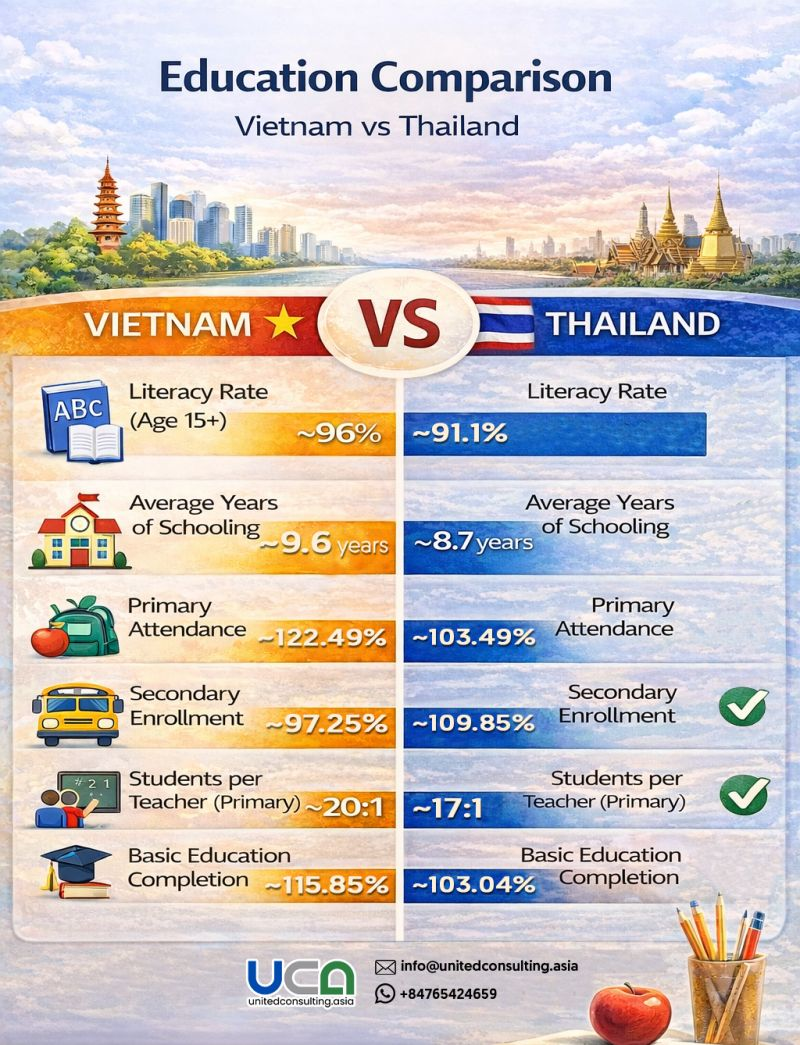
Interested in how Vietnam education compares to other countries? Read from our LinkedIn infographic here
Key takeaways
- UK transnational education enrollment has grown about 20% annually since 2018
- Around 70 UK joint programs are operating in Vietnam
- More than 12,600 students are currently enrolled
-
Growth is strongest in:
- engineering
- science
- technology
- STEM
- AI
- green technology
What this means for businesses
This may look like an education story, but it is also a labor and capability story for companies doing business in Vietnam. Over time, a stronger pipeline of locally trained graduates with international-quality education can improve hiring depth in technical roles, management, research collaboration, and innovation-led sectors.
For employers, likely effects include:
- Better availability of talent for engineering, tech, AI, and internationally managed business functions
- Stronger university-industry collaboration potential
- More credible local hiring options for foreign firms that want to reduce dependence on overseas talent
For SMEs, the benefit is longer term but still important. As talent quality rises, local businesses may gain better access to skilled employees in areas that were once hard to recruit domestically. In the broader Vietnam investment story, stronger talent formation also improves the country’s attractiveness for higher-value sectors.
Development of Cái Mép - Thị Vải Regional Vietnam Logistics Hub
Overview
Ho Chi Minh City is advancing plans to develop the Cái Mép - Thị Vải port cluster into a regional maritime and logistics center. Under current planning, the area is intended to become a large-scale international transshipment port with regional and international standing, including the Cái Mép terminal area and the Cần Giờ port area at the Cái Mép river mouth.
Authorities are also preparing a broader development proposal to modernize the international gateway port and position it as the country’s largest international transshipment port with regional scale in Asia and beyond.
A major related element is the proposed 3,800-hectare Cái Mép Hạ free trade area, which would sit alongside logistics and port functions. Officials also stress that the cluster’s long-term strength will depend on synchronized infrastructure and multimodal connectivity, especially in combination with Long Thành International Airport and regional trade corridors across Asia-Pacific and the Indo-Pacific.
The broader goal is not just cargo volume, but lower logistics cost, faster movement, and stronger export competitiveness for the wider Vietnam business ecosystem. Overall, Vietnam, leveraging its deep roots in sea transports and reliance can be a fascinating player in the new and exciting global maritime conversation.
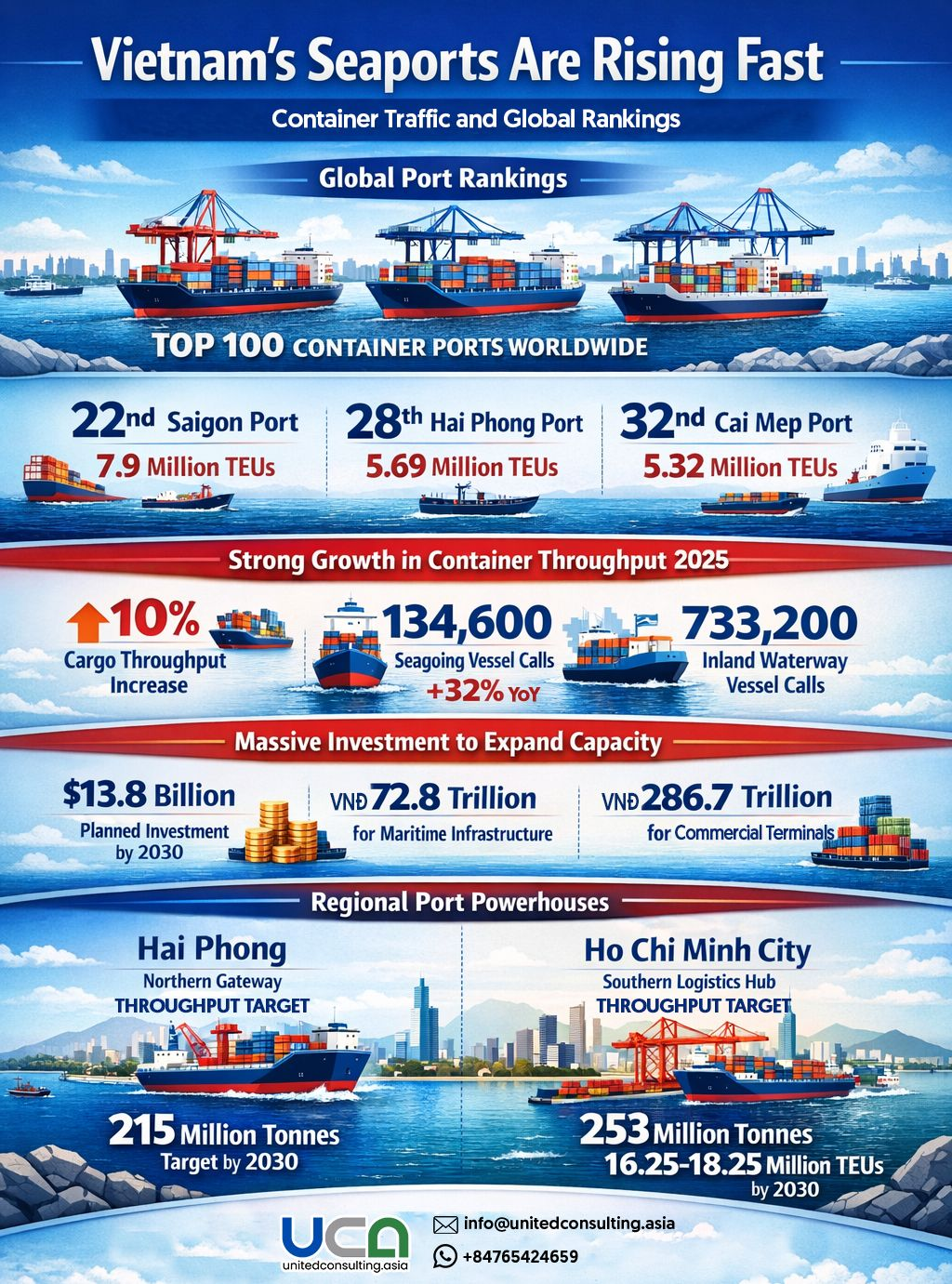
Read more about Vietnam's rising Ranking in the Global Sea Trade Business here: https://www.linkedin.com/posts/united-consulting-asia_unitedconsulting-vietnam-infographic-activity-7442791647039369216-Ggzc?
Key takeaways
- Cái Mép - Thị Vải is being planned as a major international transshipment cluster with regional scale
- Proposed Cái Mép Hạ free trade area would cover about 3,800 hectares
- Development is linked to Long Thành International Airport and wider multimodal trade corridors
-
Policy focus includes:
- infrastructure investment
- modernization
- greener port development
- logistics integration
What this means for businesses
For exporters, manufacturers, and logistics firms doing business in Vietnam, this is one of the most important infrastructure signals in the current market. If implemented well, the project could cut transport time, attract more outside investments, reduce logistics cost, and improve access to international shipping lanes.
Specific business effects may include:
- Better routing options for import-export businesses in the South
- Lower inland transport friction when airport, port, and road networks work together
- Stronger case for locating warehousing, fulfillment, and light industrial operations near the logistics corridor
- More attractive conditions for foreign investors using Vietnam as a regional export platform
For SMEs, the gain is indirect but meaningful: lower logistics cost can improve margins, delivery reliability, and competitiveness. For larger investors, this strengthens the case for doing business in Vietnam in manufacturing, trade, and supply chain operations.
New Vietnam Deportation Rules Tighten Compliance for Foreign Nationals
Overview
Vietnam’s new deportation rules for offending foreign nationals took effect on April 1, 2026 under Decree 59/2026/NĐ-CP, replacing earlier provisions under Decree 142/2021. The new framework contains 6 chapters and 44 articles, and applies to foreign nationals who commit administrative violations within Vietnam’s territory, contiguous zones, exclusive economic zone, and continental shelf.
The government says the new rules are designed both to streamline procedures and strengthen human rights protections.
One of the biggest changes is full digitalization of the deportation process, covering case handling, temporary detention, escort, and management. The decree also expands rights for affected individuals, including legal assistance, interpreter access, consular contact, and at least 48 hours’ notice before enforcement.
At the same time, enforcement becomes more direct in some cases, including immediate deportation where an individual cannot pay administrative fines, with fine enforcement suspended in those cases. The decree also gives authorities clearer powers and allows fewer layers of approval for interim management decisions.
For an across-the-board perspective about Vietnam Visa Regulations in 2026, please refer to: Practical Guide to Vietnam Visa Regulations 2026
Key takeaways
- New rules took effect on April 1, 2026 under Decree 59/2026/NĐ-CP
- Decree replaces Decree 142/2021 and includes 6 chapters and 44 articles
- Full digitalization now applies to deportation procedures
-
Foreign nationals gain:
- legal representation
- interpreter access
- consular contact
- minimum 48-hour notice before enforcement
-
Daily detention standards were raised, including:
- meat allowance from 0.1kg to 0.2kg
- drinking water from 1 litre to 2 litres
What this means for businesses
This is a clear Vietnam compliance issue for foreign-invested companies, employers of expatriates, and businesses that rely on foreign staff, consultants, or cross-border operators. The regulation is not aimed at ordinary lawful workers, but it raises the importance of maintaining strong internal controls around immigration status, work documentation, administrative conduct, and legal response protocols.
For businesses doing business in Vietnam, practical implications include:
- HR and legal teams should ensure foreign staff records are current and auditable
- Employers should tighten procedures for visa, work permit, and compliance-related incidents
- Companies may need clearer escalation processes when foreign staff face administrative violations
- Firms in hospitality, manufacturing, services, and project-based sectors with foreign labor exposure should pay particular attention
The wider takeaway is that compliance in Vietnam is becoming more digitized, more traceable, and more procedurally defined. Businesses that depend on foreign talent should treat immigration and administrative compliance as a core operational issue, not a back-office task.
US$182 Million Mekong Delta Industrial Park
Overview
Construction has officially started on the Vàm Cống industrial park project in An Giang Province in the Mekong Delta. The project covers 199 hectares and carries a total investment of VND 4.8 trillion, or about US$182 million.
It is being developed by T&T Group in cooperation with the provincial government and is located in Mỹ Thới Ward, with direct access to the Long Xuyên bypass, about 3.5 kilometers from the western North-South Expressway, and connected to the Châu Đốc - Cần Thơ - Sóc Trăng Expressway.
The project is designed to attract a broad mix of sectors, including high-tech manufacturing, food processing, agriculture and aquaculture, logistics, textiles and footwear, construction materials, IT, and electronics. Once operational, it is expected to create around 7,800 jobs.
Local authorities say more than 30 hectares will be reserved for logistics services, while green space and water surfaces will account for over 22 percent of the site.
Looking into Industrial Parks in Ho Chi Minh City instead? Look at our comprehensive price list here: Vietnam Factory Setup Costs for Industrial Parks Near HCMC
Key takeaways
- Total investment: VND 4.8 trillion or about US$182 million
- Site area: 199 hectares
- Expected employment: about 7,800 workers
- More than 30 hectares allocated to logistics services
- Over 22% of the site allocated to green space and water surface
- Located about 3.5km from the western North-South Expressway
What this means for businesses
For investors doing business in Vietnam, this project shows that the Mekong Delta is being positioned for more than agriculture. It is being prepared for higher-value industrial, logistics, and processing activity, with better transport connectivity than before.
Specific implications include:
- Manufacturers looking for alternatives to more crowded southern industrial zones may find stronger medium-term options in the Delta
- Agribusiness, food processing, aquaculture, and logistics firms may benefit most because the park aligns with regional strengths
- Companies considering Vietnam market entry should look more closely at second-tier industrial locations where land availability and regional specialization may offer better economics
For SMEs, this kind of project can create supplier opportunities in construction, logistics, support services, packaging & retail, workforce services, and downstream industrial activity.
Vietnam Pushes Stronger Coordination Across 6 Economic Regions
Overview
Vietnam is placing renewed focus on regional coordination as a core growth driver, with policymakers stressing that inter-regional linkage cannot remain a formal exercise without real execution. At a conference in Hanoi on April 2, 2026, central authorities reviewed progress on the 6 Politburo resolutions issued in 2022 for socio-economic development and security across Vietnam’s 6 socio-economic regions, with targets through 2030 and vision to 2045. The review comes after 3 years of implementation and highlights both progress and persistent bottlenecks in coordination, planning, and resource allocation.
The main policy message is that regional development must move from fragmented local planning toward coordinated execution. Officials called for stronger inter-provincial linkage in planning, sector development, production chains, and shared regional databases. They also emphasized the urgent need to complete approval and publication of regional plans for the 2021-2030 period so they can function as real management tools, rather than remain strategic documents on paper.
Key takeaways
- Review covers 6 socio-economic regions under 6 Politburo resolutions issued in 2022
- Planning horizon runs to 2030, with vision to 2045
- Authorities reviewed implementation after 3 years and highlighted remaining bottlenecks
-
Priority areas include:
- regional planning
- cross-regional sector linkage
- production integration
- shared regional data systems
What this means for businesses
For companies doing business in Vietnam, stronger regional coordination could gradually reduce one of the market’s biggest structural frictions: fragmented execution across provinces. In practice, that could mean better infrastructure alignment, faster movement of goods, more coherent industrial zoning, and clearer investment logic by region rather than by province alone.
For SMEs and investors, this matters in several concrete ways:
- Site selection should increasingly be based on regional logistics and supply chain fit, not only on local incentives
- Businesses in manufacturing, logistics, agriculture, and export sectors may benefit from stronger cross-provincial integration
- Companies that depend on permits, land access, or infrastructure timing should watch how quickly regional plans move from approval to implementation
This is also relevant for Vietnam investment strategy. If regional councils and planning mechanisms become more effective, the Vietnam business environment may become more predictable for larger, multi-location investments.
Conclusion: Vietnam Business Growth Is Becoming More Regional, More Structured, and More Compliance-Driven
This week’s developments point to a clear shift in the Vietnam business landscape. Growth is no longer driven primarily by cost advantages, but by how well businesses align with infrastructure, policy direction, and Vietnam compliance requirements.
For companies doing business in Vietnam, these changes translate into more concrete operating realities:
-
Location strategy matters more
Choosing the right region, not just the right province, will increasingly affect cost, logistics efficiency, and growth potential -
Logistics and infrastructure are becoming competitive advantages
Businesses positioned near major corridors, ports, or industrial clusters will benefit from lower costs and faster market access -
Compliance is now operational, not administrative
From immigration rules to tax systems and digital processes, compliance in Vietnam is becoming more structured, traceable, and enforced -
Labor and talent are long-term differentiators
Improvements in education and training will gradually raise workforce quality, but businesses must plan hiring and capability-building early -
Regional expansion beyond traditional hubs is accelerating
Areas like the Mekong Delta are becoming more viable for manufacturing and logistics, offering new opportunities for investors
The key takeaway is that success in doing business in Vietnam now depends on integration. Businesses must align location, compliance, workforce, and supply chain strategy, rather than optimizing each in isolation.
Companies that adapt early to this more structured and interconnected environment will be better positioned to scale, reduce risk, and capture long-term growth in Vietnam’s evolving market.
How United Consulting can support you
United Consulting helps SMEs and investors navigate doing business in Vietnam, from market entry and location strategy to ongoing Vietnam compliance, licensing, and operational structuring. In a market that is becoming more regional, more selective, and more execution-driven, the right guidance from United's expert panel can help businesses move faster and reduce risk.
Schedule a free consultation!
Disclaimer:
The information provided in this article is for general informational purposes only and does not constitute legal, tax, or investment advice. While every effort has been made to ensure accuracy at the time of publication, laws and regulations may change. Readers are encouraged to consult with qualified legal or financial advisors before making decisions related to foreign investment or share transfers in Vietnam. United Consulting is not liable for any actions taken based on this content.
Vietnam Business News: Week in Review (03 Apr 2026)