Want to know how to register a company in Vietnam? Make informed decisions! Learn about the key types of business structures in Vietnam for foreign investors, including ROs, branches, and FIEs.
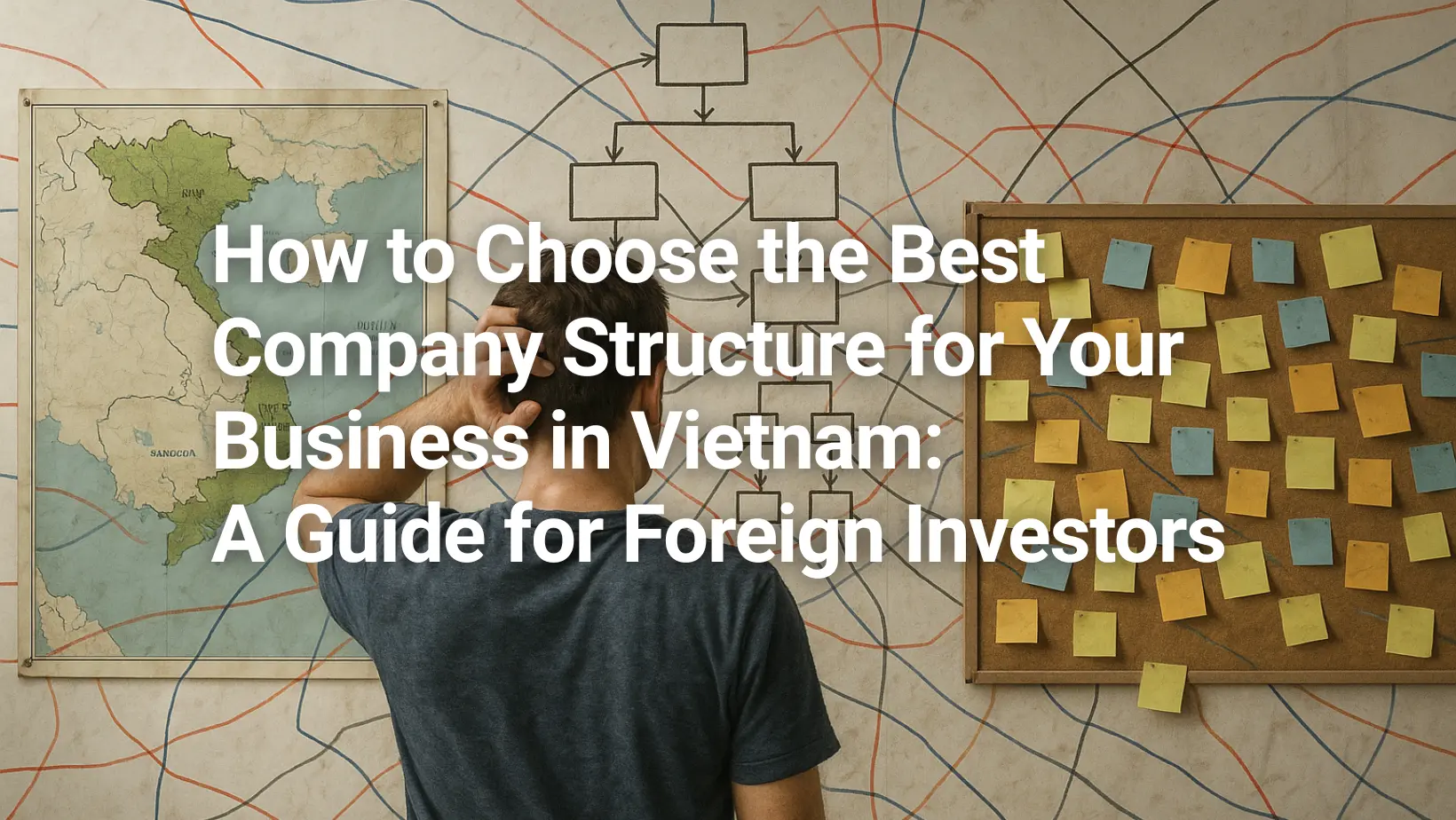
How to Choose the Best Company Structure in Vietnam: A Guide for Foreign Investors
Vietnam is a rapidly expanding economy, drawing in foreign investors thanks to its strategic location, favorable trade agreements, and an expanding consumer base. In 2025, registered foreign investment reached USD 38.42 billion and disbursed capital hit a record USD 27.62 billion, the highest in five years (National Statistics Office). For those planning to register a foreign business in Vietnam in 2027, there are several registration options, each suited to different operational goals and legal requirements. Below, we cover the main entity types foreign investors can establish - representative offices, branches, and foreign-invested enterprises (FIEs) - and the benefits and limits of each.
Representative Office in Vietnam (RO)
A Representative Office (RO) is the simplest form of business setup available to foreign companies that wish to explore the Vietnamese market without engaging in direct commercial activity. ROs are ideal for foreign businesses aiming to establish a local presence to conduct market research, network with potential partners, and manage relationships with local suppliers or clients. However, they are restricted from generating revenue directly in Vietnam; they cannot sign contracts, issue invoices, or engage in any profit-making activities.
Even with those limits, an RO is a low-cost way to gauge market potential and gather business intelligence before committing to an operational investment.
Key Points
- No direct profit-making activities allowed.
- Focused on research and relationship management.
- Can employ staff and have a local office presence for coordination purposes.
Industry Examples
- Consumer Goods: Companies in consumer goods may set up an RO to study consumer trends and establish brand awareness, or perhaps be the start of a Sourcing Office.
- Professional Services: Consultancies or firms in legal, engineering, or financial services use ROs to build relationships with potential clients.
- Technology: Tech companies can set up ROs to assess Vietnam’s rapidly growing digital economy, network with local tech talent, and research partnerships.
Suitable Business Goals
- Evaluating the Market: Large Multinational Corporations would benefit from first establishing an RO in Vietnam to evaluate market demand and network with local partners before making significant investments.
- Having “Some” Type of Presence: Mid-sized firms interested in Vietnam but cautious about risks may use an RO to explore expansion potential with minimal overhead. This is a great way to dip your toe in the lake, before jumping in.
Branch Office in Vietnam
For companies that need more extensive operational capabilities but aren’t yet ready to form a fully independent legal entity, a Branch Office may be appropriate. Unlike Representative Offices, branches are permitted to perform a wider range of activities, including revenue-generating operations under the same brand and legal entity as the parent company. However, branches are still limited in scope compared to local companies and are subject to specific industry restrictions.
Key Points
- Can generate revenue but still operates under the foreign parent company’s legal identity.
- Industry restrictions apply, so availability may be limited to certain sectors.
- Often subject to local compliance requirements similar to those of fully registered Vietnamese companies.
Industry Examples
- Banking and Finance: Many banks use branches to handle transactions, offer financial services, and serve clients locally.
- Logistics and Shipping: International logistics firms may establish branches to manage Vietnamese operations, handle customs, and transport services.
- Insurance: Insurance companies establish branches to provide coverage options and customer service directly to Vietnamese clients.
Suitable Business Goals
- Regional Expansion: Large corporations that have established operations in neighboring countries might consider setting up branches to serve existing regional clients, and test the waters for a more significant expansion.
- Specialized Sectors: Companies operating in sectors such as finance, insurance, and logistics often choose branches due to industry regulations and the need to offer localized services.
For more information on representative offices, and branch offices, here is the official Circular (97/2020/TT-BTC) from the Vietnamese government.
Foreign-Invested Enterprise in Vietnam (FIE)
Foreign-Invested Enterprises (also known as FDI companies - foreign direct investment) are by and large the most common option for foreign companies and individuals looking to establish a comprehensive business presence in Vietnam.
FIEs can be established offering full or majority ownership to foreign investors. This structure allows companies full control over business operations and decision-making, making it an attractive option for companies planning significant investment in Vietnam’s economy.
Scale is where FIEs earn their keep. LEGO Group runs LEGO Manufacturing Vietnam as a wholly foreign-owned operation in Binh Duong province - a US$1 billion plant that opened in April 2025 as the group’s sixth factory worldwide - while Samsung’s manufacturing companies in Bac Ninh and Thai Nguyen account for most of the roughly US$24 billion the group had invested in Vietnam by the end of 2025.
Scale is where FIEs earn their keep. LEGO Group runs LEGO Manufacturing Vietnam as a wholly foreign-owned operation in Binh Duong province - a US$1 billion plant that opened in April 2025 as the group’s sixth factory worldwide - while Samsung’s manufacturing companies in Bac Ninh and Thai Nguyen account for most of the roughly US$24 billion the group had invested in Vietnam by the end of 2025.
Limited Liability Company (LLC)
The LLC is a popular choice for foreign investors, especially those planning smaller or family-owned operations, as it provides a simpler management structure with fewer formalities. LLCs can be 100% foreign-owned or structured as joint ventures with Vietnamese partners. With limited liability protection, shareholders’ risk is contained to their investment in the company.
Joint Stock Company (JSC)
JSCs are suitable for larger investments and companies anticipating growth. They require a minimum of three shareholders and have a more complex governance structure, including a board of directors and general shareholder meetings. JSCs can issue shares to raise capital, making them ideal for businesses planning to attract investment or eventually list on a stock exchange.
Key Points
- FIEs provide foreign investors full control and flexibility.
- LLCs offer a streamlined structure, while JSCs accommodate growth with share issuance capabilities.
- FIEs can access industry-specific tax incentives, though compliance is required in specific sectors, including labor and environmental standards.
Investment Process: Licenses and Certificates
Before operations can commence, all foreign-owned entities must secure specific licenses:
- Investment Registration Certificate (IRC): This certificate approves the foreign investor’s project in Vietnam, outlining the scope, capital, and location of the business.
- Enterprise Registration Certificate (ERC): After obtaining the IRC, the business must apply for an ERC to formally register the company as a legal entity in Vietnam.
Timing and sequencing are friendlier than they used to be. The Enterprise Registration Certificate normally issues within three working days of a valid file, and since March 2026 the Law on Investment (No. 143/2025/QH15) and Decree 96/2026/ND-CP have let foreign investors register the enterprise first and obtain the IRC within 12 months afterwards. These licenses establish a foundation for legal operation and ensure compliance with Vietnam’s business regulations. Depending on the sector, additional approvals or licenses may be required, particularly in regulated industries such as finance, education, and healthcare.
Final Thoughts for Investors Planning 2027
Choosing the right business entity in Vietnam depends on your long-term goals, desired level of operational involvement, and industry-specific restrictions.
There are other company types which might be suitable for specialized investment, but for the overwhelming majority of business goals, Representative Offices and Branches serve as suitable points of market entry, ideal for research and relationship-building.
On the other hand, FIEs are preferable for individuals and businesses who are ready to jump in and establish a solid foothold with full operational control for their operations in Vietnam.
Match the structure to what you actually plan to do in Vietnam, not just to what is cheapest to register: the negative list, sector rules, and treaty commitments bite differently for each entity type. Given those layers, consulting a local advisor like United Consulting can save time and rework, and keeps the entity compliant long after setup.