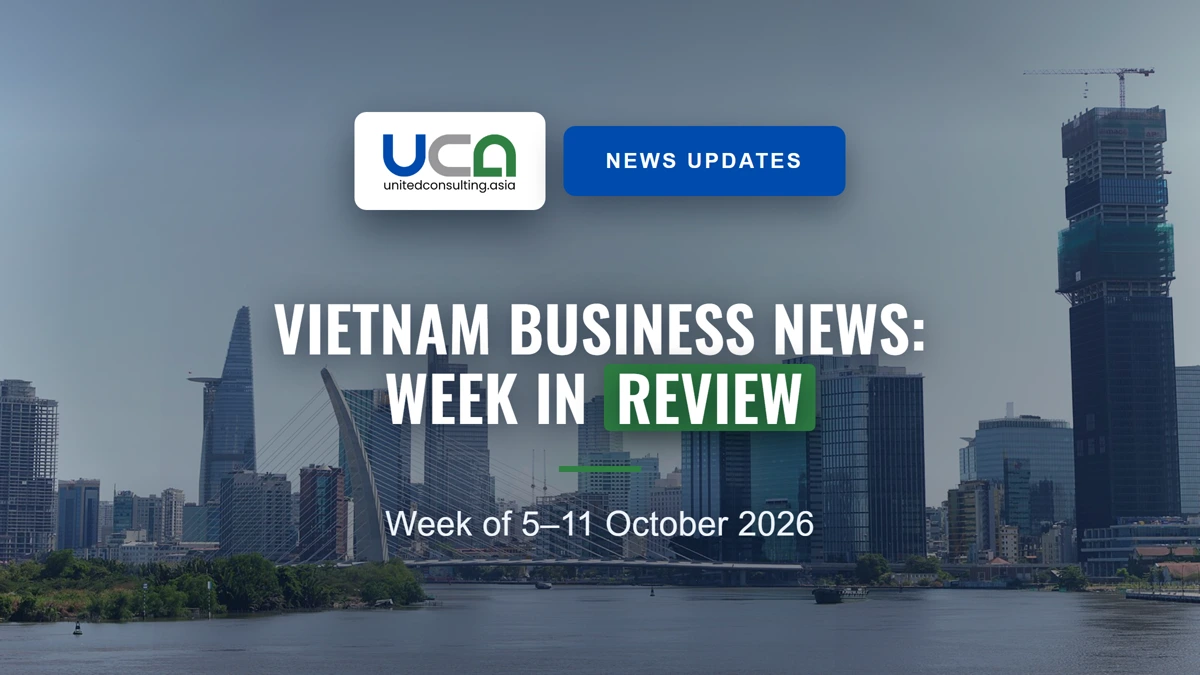
Stay updated on the biggest Vietnam business news and compliance developments from the week of 5 to 11 October 2026, including the 2026 Investment Law overhaul, new conditions attached to foreign direct investment (FDI) incentives, and record-breaking growth in Ho Chi Minh City (HCMC). Here is what the week’s news means for anyone doing business in Vietnam.
TL;DR – Law No. 24/2026/QH16 cuts Vietnam’s conditional business list to 137 sectors from 1 March 2027, FDI incentives are being tied to technology and local-supplier commitments, and HCMC posted its strongest quarter in about a decade while consulting on a US$122 billion infrastructure funding plan. Foreign investors should re-check their business lines before March 2027, document every incentive commitment, and watch the city’s project pipeline.
Vietnam has quickly become one of Asia’s most dynamic economies, and this week showed why foreign investors keep watching. Doing business in Vietnam is no longer just about market entry, it is about reading policy shifts early and turning them into compliance and investment decisions.
This week’s Vietnam business news highlights key developments:
- Investment Law 2026: 62 Conditional Sectors Cut From March 2027
- FDI Incentives Tied to Commitments Under Resolution 10
- Ho Chi Minh City Posts Its Strongest Quarter in a Decade
- Funding Saigon’s Growth: Municipal Bonds Enter the Conversation
Whether you are already doing business in Vietnam or exploring Business & Investment opportunities, staying ahead of these changes helps you navigate compliance and spot growth early.
Investment Law 2026: 62 Conditional Sectors Cut From March 2027
On 24 August 2026, Vietnam issued Law No. 24/2026/QH16, amending and supplementing provisions of the Law on Investment. From 1 March 2027, the law replaces the list of conditional business sectors with a shorter one of 137 sectors, cutting 62 and revising 14.
The reform reaches well beyond the list itself. Government estimates reported by VnEconomy put its scale in context:
- Around 786 business conditions and 232 administrative procedures are expected to disappear.
- The savings are expected to reach roughly VND 175 billion and 7,500 compliance hours per year.
- One new condition appears: visa support services provided by authorised business establishments, listed as sector 137.
- The regulatory approach keeps shifting from pre-inspection toward post-inspection accountability.
For foreign investors, the key point is that a shorter conditional list does not automatically mean a more open market. Foreign market access conditions, including ownership caps, permitted investment forms and Vietnamese-partner requirements, are assessed separately.
If you are planning a 2027 entry or reviewing an existing Investment Registration Certificate (IRC) or Enterprise Registration Certificate (ERC), compare your business lines against the new list now and decide whether to file before or after 1 March 2027.
Our guide to the Law on Investment explains how the pieces fit together.
FDI Incentives Tied to Commitments Under Resolution 10
Vietnam is changing how it selects foreign investment. Politburo Resolution No. 10-NQ/TW, dated 8 June 2026, and Government Resolution No. 280/NQ-CP, dated 22 September 2026, move the focus from capital volume to quality, technology and linkages with domestic firms.
At a Hanoi forum on 8 October, the Ministry of Finance (MoF) and the Foreign Investment Agency (FIA) outlined what that means in practice, as Vietnam Investment Review reported:
- A draft law amending the Law on Investment will tie incentives to technological performance and commitments to work with domestic companies.
- Investors benefiting from incentives will report on their commitments quarterly and annually, with post-audit checks.
- Incentives can be withdrawn when registered commitments go unmet, and a decree replacing Decree No. 182/2024/ND-CP on the Investment Support Fund is being finalised.
- Priority sectors include semiconductors, artificial intelligence (AI), research and development (R&D), digital transformation and green transition projects.
The numbers behind the shift are strong. Registered FDI reached US$50.36 billion between January and September 2026, up 76.4% year-on-year, while disbursed capital hit US$21.07 billion, up 12.1% and the highest nine-month level in five years.
On 11 October, the MoF’s Taxation Department added that stable, predictable tax policy is now a deciding factor in keeping investors, according to VietnamPlus.
For founders, the practical answer is simple: document your technology-transfer, training and supplier commitments as you make them. The question of why Singapore invests so much in Vietnam is increasingly answered by exactly these ecosystem effects.
Ho Chi Minh City Posts Its Strongest Quarter in a Decade
HCMC’s economy grew 9.86% year-on-year in the third quarter of 2026, its strongest quarterly performance in about a decade, lifting nine-month growth to 9.06%.
Services expanded 9.95% and contributed 51.9% of overall growth, while industry and construction grew 10.17%. Foreign investment surged alongside it, as The Star reported on 6 October:
- Registered FDI reached US$17.2 billion in nine months, about 4.2 times the same period last year.
- New projects accounted for US$9.35 billion, expansions for US$4.9 billion, and capital contributions or share purchases for US$2.9 billion.
- The city is targeting roughly US$19 billion for the full year, with more than 13% growth needed in the fourth quarter to hit its double-digit annual goal.
- Export processing and industrial zones host more than 5,400 projects with about US$82 billion invested, and took in around US$5.6 billion of FDI in 2026 alone.
At a city-business dialogue on 9 October, authorities with the Investment and Trade Promotion Centre (ITPC) and the zones’ management boards focused on clearing project bottlenecks, environmental procedures and power supply, according to Vietnam Investment Review.
For companies weighing expansion, this is a practical window. Approvals are being pushed forward, and the city is actively solving operational problems in industrial and export processing zones.
Funding Saigon’s Growth: Municipal Bonds Enter the Conversation
The city’s growth plans need financing on a scale its budget cannot cover alone. The municipal Department of Construction estimates infrastructure needs of more than VND 3.17 quadrillion (US$122.01 billion) for 2026 to 2030, while the city budget covers about VND 975 trillion, roughly 31% of the total.
To bridge the gap, HCMC is consulting on a People’s Council resolution to issue municipal and project bonds through the Vietnam International Financial Centre in Ho Chi Minh City (VIFC-HCMC).
The International Finance Corporation (IFC) is advising. The consultation runs from 6 to 16 October 2026, as VietnamPlus reported.
- Bonds would be issued under a medium-term programme, with documentation prepared once and tranches sized to project disbursement needs.
- Proceeds would go to approved projects that have completed investment and environmental procedures, in Vietnamese dong or convertible currencies.
- Flagship projects already in the pipeline include the Can Gio international transshipment port (over US$4.9 billion) and an AI factory data centre (about US$2.1 billion).
For foreign businesses, a credible municipal bond channel matters beyond the bonds themselves. It signals a pipeline of bankable infrastructure projects, and a growing market for project finance, credit rating and advisory services.
Suppliers and contractors positioned early in seaports, logistics, digital infrastructure and green energy will feel the effects first.
Vietnam Business News: Key Takeaways for Foreign Investors
- Investment Law 2026 removes licensing friction from 1 March 2027, but foreign market access rules are a separate test.
- Incentives are becoming contractual. Keep evidence of technology, training and supplier commitments, and expect closer tax dialogue.
- HCMC is accelerating. Record growth, surging FDI and active problem-solving in industrial zones make this a strong expansion window.
- Infrastructure financing is opening up. The municipal bond consultation points to a deep project pipeline in ports, logistics and digital infrastructure.
- Compliance discipline stays essential. More autonomy under post-inspection regimes comes with tougher accountability afterwards.
Conclusion
Vietnam’s 2026 reforms are rewriting the rules of market entry and investment incentives. Ho Chi Minh City is converting that momentum into record growth and major infrastructure plans.
Businesses that re-check their investment structure now, document their commitments and stay close to the city’s project pipeline will be best placed to benefit.
Thinking about entering or expanding in Vietnam? Contact United Consulting to discuss your market entry, tax and compliance strategy.